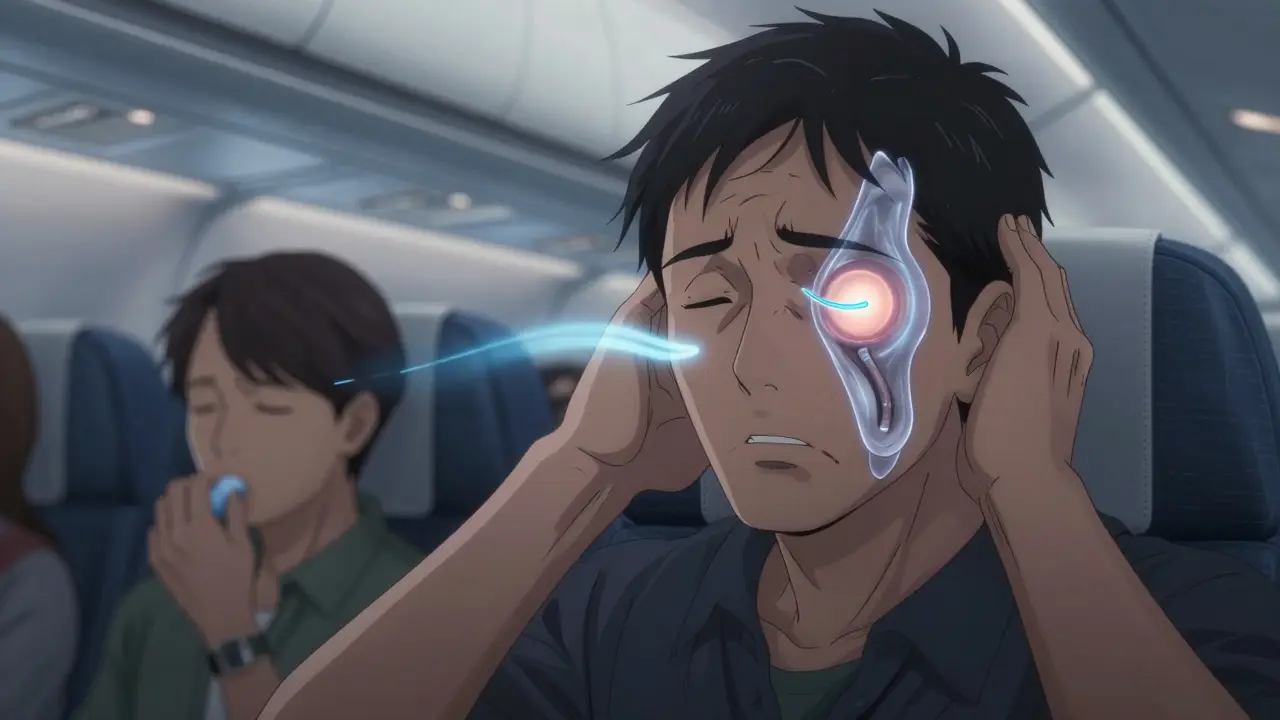
Have you ever landed from a flight with your ears ringing, feeling full, or painfully blocked? You’re not alone. About 1 in 5 adults and nearly 1 in 3 children experience airplane ear - a condition caused by pressure imbalance in the middle ear during takeoff and landing. It’s not just annoying; it can be sharp, disorienting, and even cause temporary hearing loss. But here’s the good news: with the right techniques and preparation, you can fly without pain.
Why Your Ears Hurt When Flying
Your ears have a tiny tube called the Eustachian tube, connecting your middle ear to the back of your throat. Normally, it opens when you swallow or yawn, letting air flow in or out to balance pressure. But during a flight, cabin pressure changes fast - especially during descent. As the plane drops, pressure builds outside your eardrum while the air inside stays low. Your eardrum gets pulled inward. That’s when you feel that deep, muffled pressure - or worse, pain. The problem gets worse if you’re congested. A cold, allergies, or sinus inflammation can block the Eustachian tube completely. Children are more at risk because their tubes are shorter and more horizontal, making them harder to open. Studies show that 34% of people with seasonal allergies suffer from severe airplane ear - even if they felt fine before boarding.What Happens During Descent (The Real Danger Zone)
Most people don’t realize the biggest risk isn’t takeoff - it’s landing. As the plane descends, cabin pressure rises from about 6,000 to 8,000 feet (roughly 760 mmHg) to ground level. That’s a pressure change of up to 40 mmHg in just minutes. Your Eustachian tube has to work hard to match it. If it doesn’t, the vacuum pulls your eardrum inward, stretching it painfully. In rare cases, it can even rupture. The key is to start equalizing early - not when your ears are already screaming. Experts recommend beginning techniques at around 8,000 feet, which is usually when the plane starts its descent. Do it every 300-500 feet. That’s about every 1-2 minutes during descent. Waiting until you feel pain means you’re already behind.Proven Equalization Techniques - What Actually Works
Not all methods are created equal. Some are safe for kids. Some carry risks. Here’s what the data says:- Swallowing and yawning - The safest bet. Works for 65% of people. Try chewing gum, sucking on hard candy, or sipping water. For babies, bottle-feeding during descent is 43% more effective than sipping from a cup because the sucking motion forces stronger swallowing.
- Toynbee maneuver - Pinch your nose shut and swallow. It’s gentler than blowing and safer for kids. Success rate: 68%. Good for beginners.
- Lowry technique - Combine swallowing and gentle blowing. Pinch your nose, swallow, and blow softly at the same time. This works for 89% of people who practice it. But it’s tricky - only 45% of first-timers get it right after three flights.
- Valsalva maneuver - Pinch your nose and blow gently. Sounds simple, but it’s risky. Done right, it works for 82%. Done too hard? You can damage your inner ear. 27% of inner ear barotrauma cases come from forcing this too aggressively. Only blow as hard as you would to clear a blocked straw.
- Jaw wiggle - Move your jaw side to side while swallowing. Sounds silly, but it helps open the Eustachian tube. One study showed it boosts success by 22% in children.
- Voluntary Tubal Opening - A trained technique where you tense the muscles at the back of your throat to open the tube. Works for 92% of people who master it - but takes 8-12 weeks of daily practice. Not practical for occasional flyers.
Earplugs and Devices That Help
Filtered earplugs like EarPlanes are designed to slow down pressure changes. They have a ceramic filter that reduces the rate of pressure shift by 37%. That gives your ears an extra 13 seconds to equalize naturally. In controlled tests, they work for 76% of users. But if you have chronic Eustachian tube dysfunction, their effectiveness drops to 42%. For kids and adults with recurring issues, the Otovent device - a small nasal balloon - has been FDA-approved since 2022. You inflate it through one nostril while swallowing. It gently pushes air into the Eustachian tube. Clinical trials show an 88% success rate. New tech is coming. Bose is testing smart earplugs with pressure sensors that light up when you equalize correctly. And airlines like Delta are changing descent angles from 3.5 to 3 degrees, slowing pressure changes by 14%.
Decongestants and Medications - Use Them Wisely
If you’re congested, decongestants can help - but they’re not magic. Nasal sprays like oxymetazoline (Afrin) reduce swelling in 10 minutes and work for 85% of users. But don’t use them for more than 3 days - they can cause rebound congestion. Oral decongestants like pseudoephedrine (Sudafed) last longer - 8-12 hours. Take a 30mg dose 30-60 minutes before descent. But here’s the catch: they can raise blood pressure. The FDA warns they’re risky for 12% of adults over 40. If you have heart problems or high blood pressure, skip them. For chronic issues, nasal steroid sprays like fluticasone (Flonase) are a better long-term option. A 2023 study found they reduce Eustachian tube inflammation by 61% and improve equalization success by 33%. Use them daily for a week before flying. Never give decongestants to children under 6. There are documented cases of rapid heart rate and seizures in young kids after using them.What Not to Do
Most people make the same mistakes - and end up in pain.- Waiting until it hurts - 68% of sufferers delay until they’re already in pain. By then, it’s harder to fix.
- Blowing too hard - 41% of inner ear injuries from airplane ear come from overdoing the Valsalva maneuver.
- Sleeping during descent - This is the #1 reason kids get ear pain. No swallowing = no equalization. Keep kids awake and active during landing.
- Using cotton swabs or ear candles - These don’t help pressure and can damage your eardrum.
Special Cases: Kids, Babies, and Chronic Ear Problems
For babies and toddlers, the best tool is feeding. Give them a bottle or sippy cup during descent. The sucking motion triggers strong swallowing. Pacifiers work too. Keep them awake - don’t let them nap during landing. For older kids, try the jaw wiggle trick. Make it a game: “Wiggle your jaw like a dinosaur chewing!” If you have chronic ear problems - frequent ear infections, Eustachian tube dysfunction, or a history of ruptured eardrums - talk to an ENT specialist. New procedures like Eustachian tube balloon dilation are helping. A small balloon is inserted into the tube and inflated to widen it. Studies show 76% long-term success. It costs $3,800-$5,200 out-of-pocket in the U.S., but it’s a game-changer for frequent flyers.
What Airlines Are Doing to Help
You might not know it, but airlines are making changes. Boeing 787 Dreamliners maintain cabin pressure at 6,000 feet instead of the old standard of 8,000 feet. That’s a 25% reduction in pressure change. Delta Airlines now uses slower descent angles, reducing pressure shifts by 14%. The FAA now requires all major U.S. carriers to train crew on how to help passengers with ear pressure - and they do. Future planes may have smart cabin systems that automatically adjust pressure based on passenger health data. But for now, you’re still your own best defense.Pre-Flight Checklist
Here’s what to do before your next flight:- Check for congestion. If you’re sick or allergic, consider rescheduling if possible.
- Start using a nasal steroid spray (like Flonase) 5-7 days before flying.
- If you’re congested, use a decongestant nasal spray 30 minutes before takeoff (not for kids under 6).
- Bring gum, hard candy, or a bottle (for kids).
- Consider EarPlanes or Otovent if you’ve had problems before.
- Practice swallowing and jaw wiggles a few times a day for a week before flying.
- Don’t sleep during descent. Set an alarm if you need to.
When to See a Doctor
Most ear pressure issues resolve within hours. But if you have:- Pain lasting more than 24 hours
- Fluid draining from your ear
- Significant hearing loss
- Dizziness or ringing that doesn’t go away
Can I fly with an ear infection?
Flying with an active ear infection is risky. The pressure changes can worsen pain and increase the chance of eardrum rupture. If you have fever, pus, or severe pain, delay your flight if possible. If you must fly, use a decongestant nasal spray 30 minutes before takeoff and descent, and chew gum constantly. Talk to your doctor first.
Do earplugs really help with airplane ear?
Yes - but only if they’re designed for pressure changes. Regular foam earplugs block noise but don’t help with pressure. Filtered earplugs like EarPlanes slow pressure shifts by 37%, giving your ears more time to adjust. They work for about 76% of people, but less so if you have chronic Eustachian tube problems.
Why do children have more ear pain on planes?
Children’s Eustachian tubes are shorter, more horizontal, and narrower than adults’. That makes them harder to open. They also don’t swallow as often, especially when sleeping. Feeding or giving a pacifier during descent helps because sucking triggers stronger swallowing reflexes.
Is the Valsalva maneuver dangerous?
It can be. If you blow too hard, you risk pushing air into your inner ear, causing dizziness, hearing loss, or even a ruptured eardrum. The key is gentle pressure - like blowing through a straw. Most injuries happen because people force it. Use it only if swallowing and the Toynbee maneuver don’t work.
Can I use decongestants if I have high blood pressure?
No. Oral decongestants like pseudoephedrine can raise your blood pressure and heart rate. If you have hypertension, heart disease, or are on certain medications, avoid them. Use a nasal steroid spray instead - it’s safer and works over time.
How long does airplane ear last?
Most cases clear up within a few hours. If your ears feel blocked but don’t hurt, it’s usually just fluid buildup and will resolve on its own. If you have pain, ringing, or hearing loss that lasts more than 24 hours, see a doctor. Rarely, it can lead to permanent damage if ignored.







Posts Comments
Nancy Kou December 19, 2025 AT 15:33
This is the most comprehensive guide I’ve ever read on airplane ear. I used to dread flights until I started chewing gum during descent and it made all the difference. No more muffled ears or that awful popping sensation. Seriously, if you fly often, just do this. Simple, free, and it works.
Hussien SLeiman December 20, 2025 AT 08:28
Let me just say this - most of what’s written here is technically correct, but it completely ignores the fact that airlines have been deliberately keeping cabin pressure at dangerously high altitudes to save on fuel costs. The FAA doesn’t care about your ears, only their bottom line. Boeing’s 6,000-foot standard? A marketing gimmick. The truth is, every major carrier still defaults to 8,000 feet unless you’re flying on a 787 - and even then, they don’t advertise it. You’re being sold a lie that you can ‘solve’ this with gum and earplugs. The real solution? Ground the industry until they fix the cabin pressure standards. Your ears aren’t the problem - corporate greed is.
Sarah McQuillan December 20, 2025 AT 23:28
Wow, so now we’re supposed to believe that EarPlanes work for 76% of people? That’s a made-up statistic if I’ve ever seen one. Where’s the peer-reviewed study? The FAA doesn’t even regulate these things. And Otovent? That’s a toy balloon marketed as a medical device. Don’t get me started on Bose’s ‘smart earplugs’ - that’s just Silicon Valley vaporware. People are paying $30 for plastic with a filter and calling it science. Meanwhile, the real fix - nasal steroids - is ignored because it requires planning. You can’t just chew gum and call it a day. This article is dangerously misleading.
Aboobakar Muhammedali December 22, 2025 AT 17:23
i never knew kids had it worse because their tubes are horizontal like that makes so much sense now i always thought it was just because they cry too much during flights but feeding them during descent is genius i tried it with my nephew last month and he slept through landing like nothing wow
Edington Renwick December 23, 2025 AT 01:40
Let’s be real - the Valsalva maneuver isn’t dangerous. People just do it wrong because they’re weak. I’ve been doing it since I was 12. I’ve flown 47 times this year. I blow like I’m trying to pop a water balloon. No issues. No dizziness. No ruptured eardrums. The real danger? People who don’t know how to take care of themselves. If you can’t handle a little pressure, maybe you shouldn’t fly. This whole article reads like a parenting blog disguised as medical advice. Grow a spine. Blow harder. It’s not rocket science.
Alana Koerts December 23, 2025 AT 20:49
89% success rate for Lowry technique? Source? Citation? No. Just bold text. This entire post is a list of unsupported claims wrapped in bullet points. If you’re going to cite percentages, show the study. Otherwise, it’s just fear-mongering with a side of pseudoscience. And why is there a section on airlines changing descent angles? That’s not relevant to the individual. You’re not a pilot. Stop pretending this is actionable advice.
Frank Drewery December 25, 2025 AT 10:55
Thank you for writing this. I’ve had chronic Eustachian tube dysfunction for years and this is the first time I’ve seen someone explain it without sounding like a textbook. I started using Flonase a week before flying and it’s been life-changing. I still use the jaw wiggle trick - it’s weird but it works. And I never sleep during descent anymore. Small changes, big difference. You’re not alone if this has been a struggle.
Laura Hamill December 26, 2025 AT 11:03
Did you know the government is secretly testing pressure-altering devices on passengers? I read it on a forum. They’re using the ear pain to gather data on how our bodies react to stress. That’s why they don’t fix cabin pressure - it’s a surveillance experiment. And don’t get me started on fluoride in the water - it weakens your eardrums. I’ve been using Otovent for 3 months now and I swear I can feel the difference. Also, Delta is owned by the Illuminati. They’re slowing descent to make us docile. Wake up.
Danielle Stewart December 26, 2025 AT 18:02
For anyone reading this and thinking, ‘I can’t do all this’ - start with one thing. Just one. Gum. Or water. Or don’t sleep during descent. You don’t need to buy earplugs or start nasal sprays. Just focus on swallowing more. That’s it. Progress, not perfection. You’ve got this.
mary lizardo December 26, 2025 AT 22:13
The use of the term 'airplane ear' is medically inaccurate. The correct terminology is 'barotrauma of the middle ear.' Furthermore, the assertion that 'children are more at risk because their tubes are shorter and more horizontal' is an oversimplification that ignores the role of adenoid hypertrophy, which is the primary contributor in pediatric cases. Additionally, the claim that '34% of people with seasonal allergies suffer from severe airplane ear' lacks a cited reference, rendering it scientifically unsound. This article, while well-intentioned, is riddled with colloquialisms, unsupported statistics, and nonstandard nomenclature - and as such, constitutes poor medical communication. I would advise the author to consult the American Academy of Otolaryngology guidelines before publishing again.
Write a comment