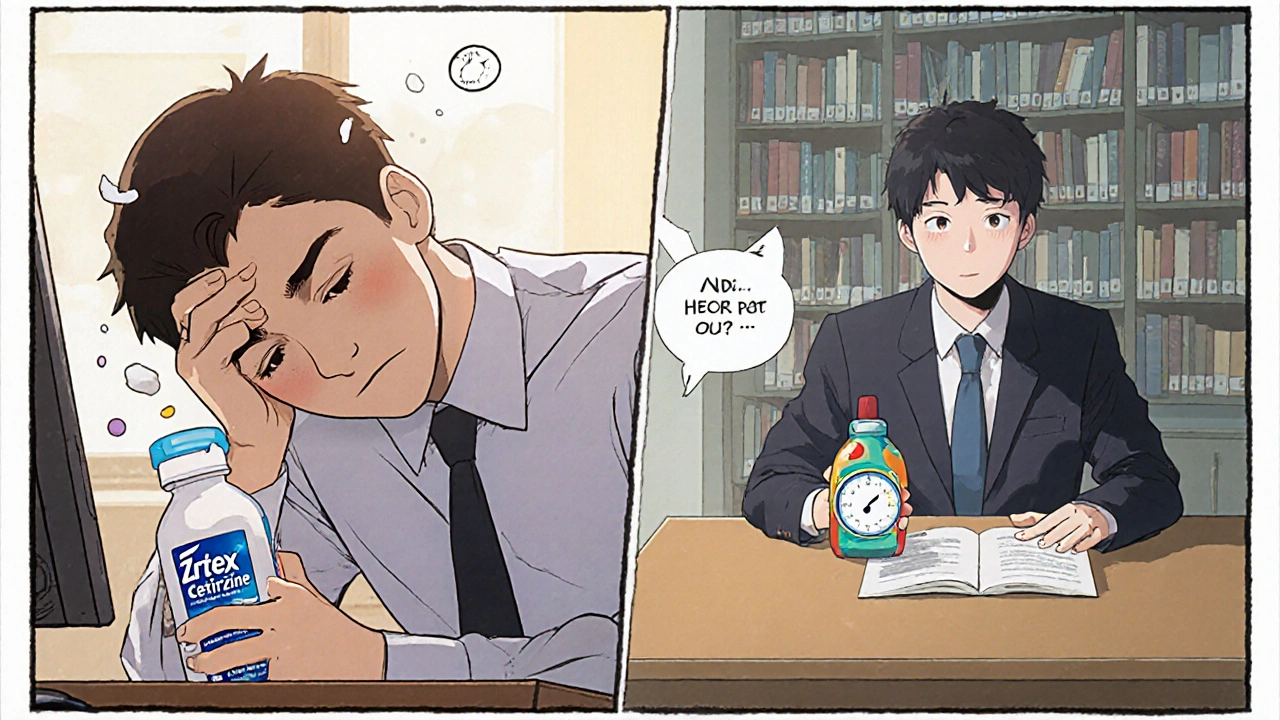
Choosing the right allergy pill shouldn’t feel like a gamble. You want relief from sneezing, itchy eyes, and a runny nose - but not at the cost of falling asleep at your desk or nearly missing your bus. Two of the most common over-the-counter antihistamines, cetirizine and fexofenadine, promise the same thing: allergy relief without the drowsiness. But they don’t deliver it the same way.
How They Work - And Why It Matters
Both cetirizine (Zyrtec) and fexofenadine (Allegra) belong to the second-generation antihistamine family. That means they were designed to block histamine - the chemical your body releases during an allergic reaction - without crossing into your brain as easily as older drugs like Benadryl. But here’s the catch: they’re not equally good at avoiding the brain. Cetirizine still lets about 5-10% of its molecules sneak into your central nervous system. Fexofenadine? Less than 1-2%. That tiny difference is why one makes you sleepy and the other usually doesn’t. This isn’t just theory. A 2005 study with 362 people showed cetirizine reduced allergy symptoms 26% more than fexofenadine at the 12-hour mark. Sounds great - until you realize that same study found 0.8% of people on cetirizine felt drowsy, while zero on fexofenadine did. And real-world data tells a clearer story: up to 15% of people taking cetirizine report feeling tired. For fexofenadine? Around 4-6%.Speed vs. Stability: When Each One Hits Hard
If you’re stuck in a pollen-filled office and your eyes are watering right now, timing matters. Cetirizine starts working in 20-30 minutes. Peak levels hit your bloodstream within an hour. That’s why so many people reach for it when symptoms strike fast - like when you walk outside and immediately start sneezing. Fexofenadine? It takes 2-3 hours to kick in. If you’re dealing with sudden symptoms, you might feel like it’s not working at all. But once it does, it lasts. Its 180 mg tablet is built for steady, all-day coverage. No spikes. No crashes. That’s why some users switch back and forth: cetirizine for acute flare-ups, fexofenadine for daily control.The Side Effect Showdown
Let’s get real about what actually happens when you take these pills. Cetirizine:- Drowsiness: 10-15% of users - enough that 41% quit within a month because of it
- Dry mouth: 18% of negative reviews mention this
- Headache: mild, but common
- Stomach upset: less frequent than with fexofenadine
- Drowsiness: under 6% - the lowest among all second-gen antihistamines
- Upset stomach: 22% of negative reviews cite nausea or bloating
- Headache: similar to cetirizine
- Back or muscle pain: occasionally reported

Food, Drinks, and Other Traps
One of the most overlooked differences? How you take them. Fexofenadine doesn’t like food. High-fat meals can cut its absorption by up to a third. Grapefruit juice? That slashes it by nearly half. Even orange juice can reduce its effectiveness. The FDA says: take it on an empty stomach. Two hours before or after eating. Cetirizine? No such rules. You can take it with breakfast, lunch, or a midnight snack. It doesn’t care. And then there’s the antacid problem. If you take fexofenadine within two hours of Tums or Maalox, your body absorbs 41% less of it. That’s like taking half a pill. Cetirizine doesn’t have this issue.Who Should Pick Which?
This isn’t about which drug is “better.” It’s about which one fits your life. Choose cetirizine if:- You need fast relief - like before a picnic or a walk with your dog
- Your symptoms are severe and you can afford to feel a little sleepy
- You take it at night and don’t mind being groggy the next morning
- You’re giving it to a child - it has more than 200 published studies on pediatric use
- You drive, operate machinery, or work in a safety-sensitive job
- You’re a student pulling an all-nighter and need to stay sharp
- You’ve tried cetirizine and felt too tired to function
- You take other meds that interact with food - fexofenadine’s restrictions are a pain, but you can plan around them
Pregnancy, Kidneys, and Special Cases
If you’re pregnant, both are considered safe. But cetirizine has far more data behind it - over 200 studies on outcomes. Fexofenadine? Only 43. Most doctors lean toward cetirizine for expectant mothers. For people with kidney problems, dosing changes matter. Fexofenadine needs a lower dose if your kidney function drops below 30 mL/min. Cetirizine does too - but only in severe cases. That makes fexofenadine trickier for older adults or those with chronic kidney disease.
What the Experts Say
The Cleveland Clinic says fexofenadine is the top pick for commercial drivers and medical staff. The European Academy of Allergy and Clinical Immunology gives cetirizine higher marks for effectiveness - but fexofenadine higher marks for safety. Dr. Harold Nelson, a leading allergist, put it bluntly: “The 14-26% efficacy difference means little for most people. Choose based on how you feel - not the numbers.” That’s the real takeaway. If you’re one of the 15% who gets drowsy on cetirizine, no amount of clinical data will convince you it’s the best. And if you’re one of the 35% who thinks fexofenadine doesn’t work well enough, you’re not wrong - you just need something else.Price, Availability, and Real-World Choices
Both are cheap. Generic cetirizine costs about $7.50 for 30 pills. Generic fexofenadine? $6.85. That’s less than 25 cents a day. In the U.S., Zyrtec (cetirizine) still sells more than Allegra (fexofenadine). But the trend is shifting. More people are switching to fexofenadine - not because it’s stronger, but because they can’t tolerate the sleepiness. A 2023 survey of 1,200 allergy sufferers found 43% preferred cetirizine for symptom control. But 38% picked fexofenadine - because they could actually work while taking it.Final Verdict: It’s About Your Body, Not the Label
There’s no universal winner. Cetirizine works faster and stronger for many. But it knocks people out. Fexofenadine is slower, sometimes weaker - but it lets you stay alert. If you’ve never tried either, start with fexofenadine. Take it on an empty stomach. Give it a full week. If your symptoms aren’t under control, switch to cetirizine - but take it at night. If you’ve tried one and it didn’t work, don’t assume the other won’t. Your body reacts differently to each. The side effect profile isn’t a flaw - it’s a signal. Listen to it. The best allergy pill isn’t the one with the most reviews or the highest rating. It’s the one that lets you breathe - without making you nod off.Is cetirizine more likely to make you sleepy than fexofenadine?
Yes. About 10-15% of people taking cetirizine report drowsiness, compared to 4-6% for fexofenadine. This is because cetirizine crosses into the brain slightly more than fexofenadine, even though both are labeled as "non-drowsy." If you need to stay alert for work or driving, fexofenadine is the safer choice.
Can I take fexofenadine with food?
It’s best to take fexofenadine on an empty stomach. High-fat meals, grapefruit juice, and orange juice can reduce how much of the drug your body absorbs by up to 43%. For best results, take it at least 2 hours before or after eating.
Which one works faster - cetirizine or fexofenadine?
Cetirizine starts working in 20-30 minutes, with peak effects around 1 hour. Fexofenadine takes 2-3 hours to reach its full effect. If you need quick relief from sudden allergy symptoms, cetirizine is the faster option.
Are there any dangerous interactions with these drugs?
Fexofenadine interacts with antacids (like Tums) and fruit juices - avoid taking them within 2 hours. Cetirizine doesn’t have major food interactions, but combining it with alcohol or other sedatives can triple drowsiness. Both can rarely affect heart rhythm - but this happens in fewer than 1 in 100,000 users.
Which is better for kids?
Cetirizine has far more safety data in children - over 200 studies. It’s approved for kids as young as 2 years old and is often the first choice for pediatric allergies. Fexofenadine is approved for children 6 and older, but there’s less long-term data. Most pediatric allergists recommend cetirizine for younger kids.
Can I switch between cetirizine and fexofenadine?
Yes. Many people alternate based on their needs - using cetirizine for bad allergy days and fexofenadine for workdays. There’s no known harm in switching. Just avoid taking both at the same time unless directed by a doctor.
Do these drugs cause weight gain?
Neither cetirizine nor fexofenadine is known to cause weight gain. Unlike some older antihistamines, they don’t significantly affect appetite or metabolism. Weight changes reported by users are usually linked to lifestyle factors, not the medication itself.
Is one cheaper than the other?
Generic fexofenadine is slightly cheaper - about $6.85 for 30 tablets versus $7.49 for generic cetirizine. But the difference is minimal. Price shouldn’t be the deciding factor. Effectiveness and side effects matter more.







Posts Comments
Scott Collard November 29, 2025 AT 22:32
Let’s be real-cetirizine is just a chemical nap. If you’re taking it during work hours, you’re not managing allergies, you’re surrendering to them. Fexofenadine is the only rational choice for adults who still want to function. The 15% drowsiness rate isn’t a side effect-it’s a warning label.
Brandy Johnson December 1, 2025 AT 07:27
While the data presented is statistically sound, it fails to account for the pharmacokinetic variability inherent in individual metabolic pathways. The 2005 study referenced, though peer-reviewed, utilized a non-diverse cohort with limited genetic representation, thus compromising external validity. Fexofenadine’s lower CNS penetration is not merely a pharmacological nuance-it is a clinically significant determinant of functional preservation.
Peter Axelberg December 2, 2025 AT 04:53
I’ve been on both for years. Cetirizine? I take it when I’m going to be on the couch anyway-like weekends or after a long day. But if I’ve got a presentation, a meeting, or even just need to drive to the grocery store without zoning out? Fexofenadine. It takes forever to kick in, sure. I’ll take it at 7 a.m., and by noon I’m finally breathing normally. But I’m not falling asleep in Zoom calls. And honestly? I’d rather wait two hours than spend two hours napping after lunch.
Also, the grapefruit juice thing? Total game-changer. I used to drink it with breakfast. Then I realized I was basically throwing money away. Now I take it with water, on an empty stomach, and suddenly it works like it’s supposed to. Small habits, big difference.
And don’t even get me started on the kids. My daughter’s on cetirizine because her pediatrician said it’s the most studied. But I keep fexofenadine in the cabinet for when she’s got a field trip or a school play. She doesn’t need to be sleepy during her solo violin recital.
Monica Lindsey December 2, 2025 AT 14:23
Anyone who takes cetirizine during the day is either reckless or delusional. The fact that people still choose it over fexofenadine proves how little they understand their own bodies. It’s not about preference-it’s about responsibility. If you can’t prioritize alertness over momentary relief, you don’t deserve to drive, work, or parent.
Jennifer Wang December 4, 2025 AT 07:33
It is critical to note that while fexofenadine exhibits superior CNS penetration profiles, its bioavailability is significantly reduced by concomitant administration with fruit juices and antacids. Clinical guidelines recommend a 2-hour window prior to or following food intake to ensure optimal absorption. Patients with renal impairment should be monitored closely, as both agents require dosage adjustment in moderate to severe renal dysfunction. The decision between agents must be individualized based on comorbidities, lifestyle, and pharmacokinetic tolerability.
stephen idiado December 5, 2025 AT 21:27
Studies are biased. Pharma-funded. Cetirizine’s efficacy is overblown. Fexofenadine’s absorption issues? That’s the system keeping you dependent on brand names. You think this is about allergies? Nah. It’s about profit margins. Take neither. Go herbal. Butterbur. Quercetin. Real medicine.
Steven Howell December 6, 2025 AT 07:56
One of the cleanest breakdowns I’ve seen on this topic. The food interaction point alone is something every pharmacist should scream from the rooftops. I’ve seen patients take fexofenadine with orange juice for years and wonder why it ‘doesn’t work.’ It’s not the drug-it’s the juice.
Also, the pediatric data point is huge. Cetirizine’s safety profile in kids isn’t just better-it’s foundational. For parents, that’s worth more than a few extra minutes of symptom relief.
Robert Bashaw December 7, 2025 AT 01:36
Let me tell you about the time I took cetirizine before a job interview. I looked professional. I smiled. I answered questions. And then-BOOM-my eyelids fused shut. I woke up 20 minutes later with my head on the conference table. The hiring manager said, ‘You seem… relaxed.’ I said, ‘I’m allergic to pollen, not professionalism.’ I got the job anyway. But I switched to fexofenadine the next day. Now I don’t just survive meetings-I win them.
Latika Gupta December 7, 2025 AT 06:03
I tried both. Cetirizine made me feel like I was underwater. Fexofenadine didn’t help at all. I just… gave up. Now I use nasal spray. Less hassle.
Sullivan Lauer December 9, 2025 AT 02:21
You know what’s wild? People treat this like it’s a battle between two drugs. But it’s not. It’s about listening to your body. I used to think fexofenadine was weak until I realized I was taking it with lunch. Once I switched to taking it before breakfast, empty stomach, water only? Holy crap-it’s like a whole new pill. And cetirizine? I still take it at night. No shame. If it helps me sleep AND stop sneezing? Win-win. Don’t shame people for finding what works. Just don’t take it before you drive. That’s just common sense.
Sohini Majumder December 10, 2025 AT 10:32
why do people even care?? i mean like, it's just a pill. if u feel sleepy, don't drive. if it doesn't work, try something else. why is everyone making this sooo dramatic?? it's not a life or death thing, it's allergies!!
tushar makwana December 11, 2025 AT 12:19
i used to take cetirizine every day. felt like a zombie. then i tried fexofenadine. took a few days but then i was fine. no sleepiness, no guilt. i still take it at night sometimes if my nose is stuffed. but now i know it’s not about which one is stronger-it’s about which one lets you be yourself. that’s the real win.
Matthew Higgins December 12, 2025 AT 02:14
My dad’s on fexofenadine because he drives a truck. My mom’s on cetirizine because she’s a grandma and naps are part of her daily routine. Neither one’s wrong. They just live differently. The best pill is the one that lets you keep living your life-not the one with the fanciest study.
Mary Kate Powers December 12, 2025 AT 13:54
For anyone feeling overwhelmed by the choices-start with fexofenadine. Take it on an empty stomach for a full week. If it doesn’t cut it, switch to cetirizine at night. You’ve got nothing to lose and more energy to gain. And hey-you’re not alone. We’ve all been there.
Write a comment