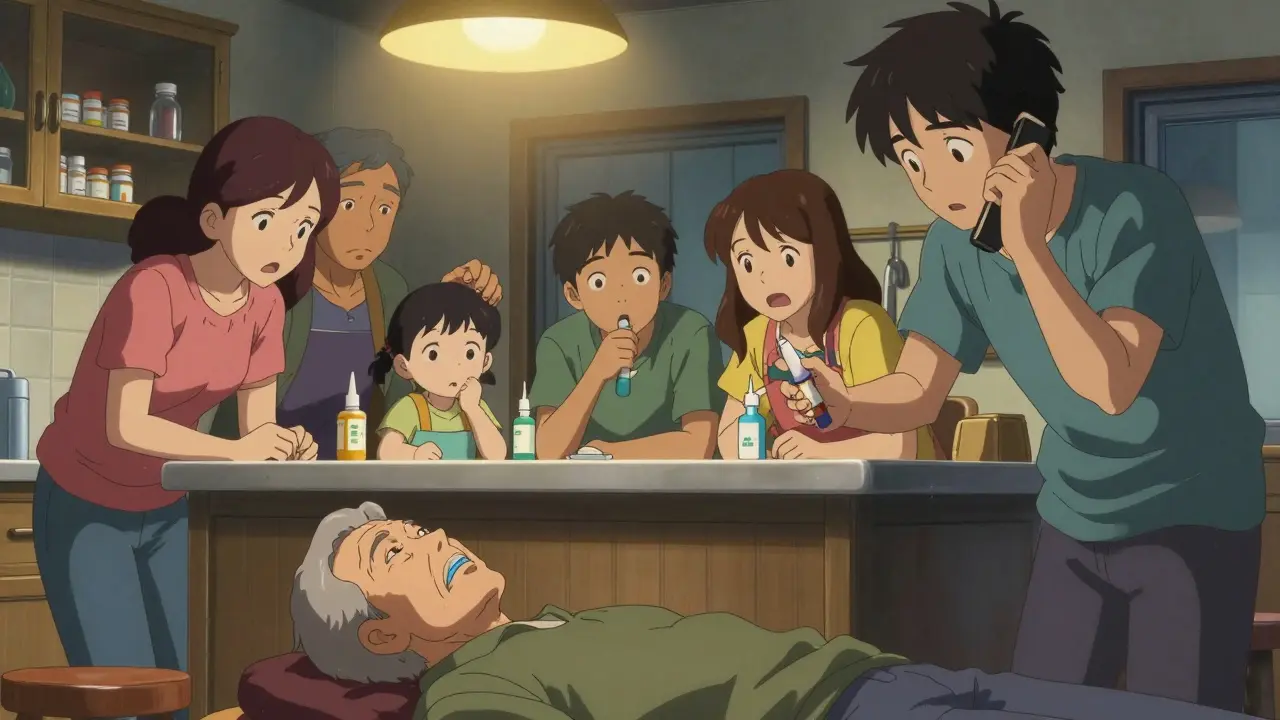
Every year, thousands of families are caught off guard when someone they love stops breathing after taking too much of a medication. It doesn’t always happen to someone with a history of addiction. Sometimes it’s an older parent taking pain pills, a teenager experimenting with leftover prescriptions, or a relative who accidentally mixed medications. The difference between life and death often comes down to minutes-and having a plan in place.
Why This Plan Isn’t Optional
In 2022, over 107,000 people in the U.S. died from drug overdoses. Eighty percent of those deaths involved synthetic opioids like fentanyl. Fentanyl is so powerful that a dose the size of a few grains of salt can kill. And it’s often mixed into other pills without the user knowing. The clock starts ticking the moment someone stops breathing. Brain damage can begin in under three minutes. Death can follow in six. Naloxone, the overdose-reversing drug, works in 2 to 5 minutes when given correctly. But only if it’s nearby and someone knows how to use it. Studies show that when families have a plan and naloxone on hand, they save lives 93% of the time. That’s not luck. That’s preparation.Step 1: Know Who’s at Risk
Not every household needs this plan-but many more do than you think. You should create one if anyone in your home:- Takes prescription opioids (oxycodone, hydrocodone, morphine, fentanyl patches)
- Has chronic pain and uses pain meds regularly
- Uses benzodiazepines (like Xanax or Valium) with pain pills
- Has a history of substance use or mental health struggles
- Is elderly and takes multiple medications
- Has teens or young adults who might access leftover pills
Step 2: Get Naloxone-Now
Naloxone (sold as Narcan or Kloxxado) is safe, easy to use, and legal to carry in every state. You don’t need a prescription in 46 states. Most pharmacies give it out for free or for under $25 with insurance. Where to get it:- CVS, Walgreens, Rite Aid-ask at the pharmacy counter
- Your doctor’s office-if they prescribe opioids, they should offer naloxone too
- Local health departments or community centers-many give out free kits
- Online through nonprofit programs like Naloxone4All or Harm Reduction Coalition
Step 3: Learn the Signs of Overdose
An overdose doesn’t always look like what you see in movies. People don’t always collapse dramatically. Here’s what to look for:- Unresponsive: Shake their shoulders hard. Yell their name. If they don’t wake up, it’s an emergency.
- Slow or stopped breathing: Count breaths for 15 seconds. If they take fewer than 4 breaths, they’re in danger.
- Pinpoint pupils: Shine a light in their eye. If the black part is tiny like a pinhead, it’s a sign of opioid overdose.
- Blue or gray lips/fingernails: This means they’re not getting enough oxygen.
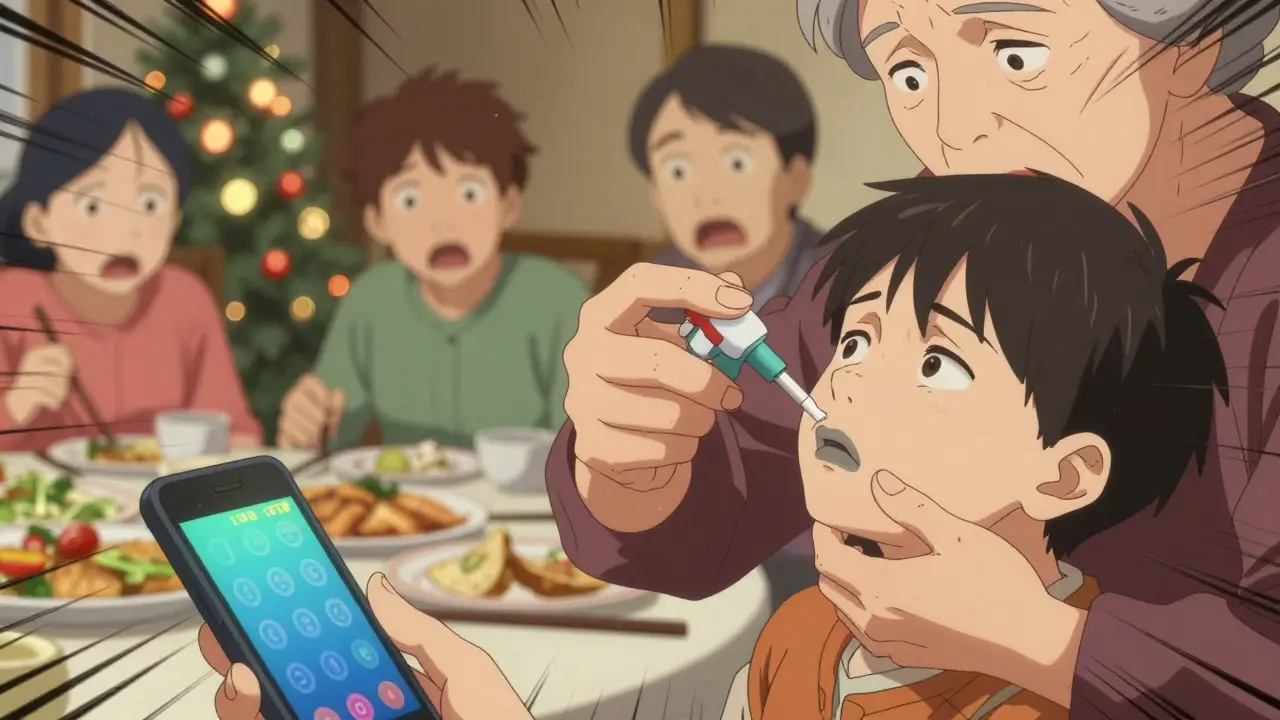
Step 4: Use the A.N.C.H.O.R. Protocol
This is the simple, proven sequence used by emergency responders and taught by the American Red Cross:- Assess: Check for responsiveness and breathing. If they’re not breathing normally, move to step 2.
- Naloxone: Spray one dose into one nostril (Narcan) or inject into the thigh (if you have the shot version). No need to remove clothing-the spray works through clothes.
- Call 911: Dial immediately after giving naloxone. Say, “Someone has overdosed on opioids. I’ve given naloxone.”
- Have more ready: Keep the second dose in hand. If they don’t wake up in 3 to 5 minutes, give the second dose.
- Observe: Stay with them. Even if they wake up, they can crash again. Overdose symptoms can return after naloxone wears off-this is called renarcotization.
- Review: After EMS arrives, talk to them about what happened. Write down the time, what you did, and how they responded. This helps doctors treat them better.
Step 5: Store Naloxone Right
Naloxone doesn’t need refrigeration. But it does need to be ready.- Keep it at room temperature (between 68°F and 77°F)
- Avoid direct sunlight or heat (don’t leave it in the car)
- Check the expiration date every 6 months. Most kits last 18 to 24 months
- Store it where everyone can find it-on the fridge, in a drawer by the bed, in the glove compartment
- Don’t lock it up. If someone’s overdosing, you don’t have time to find the key
Step 6: Train Everyone in the House
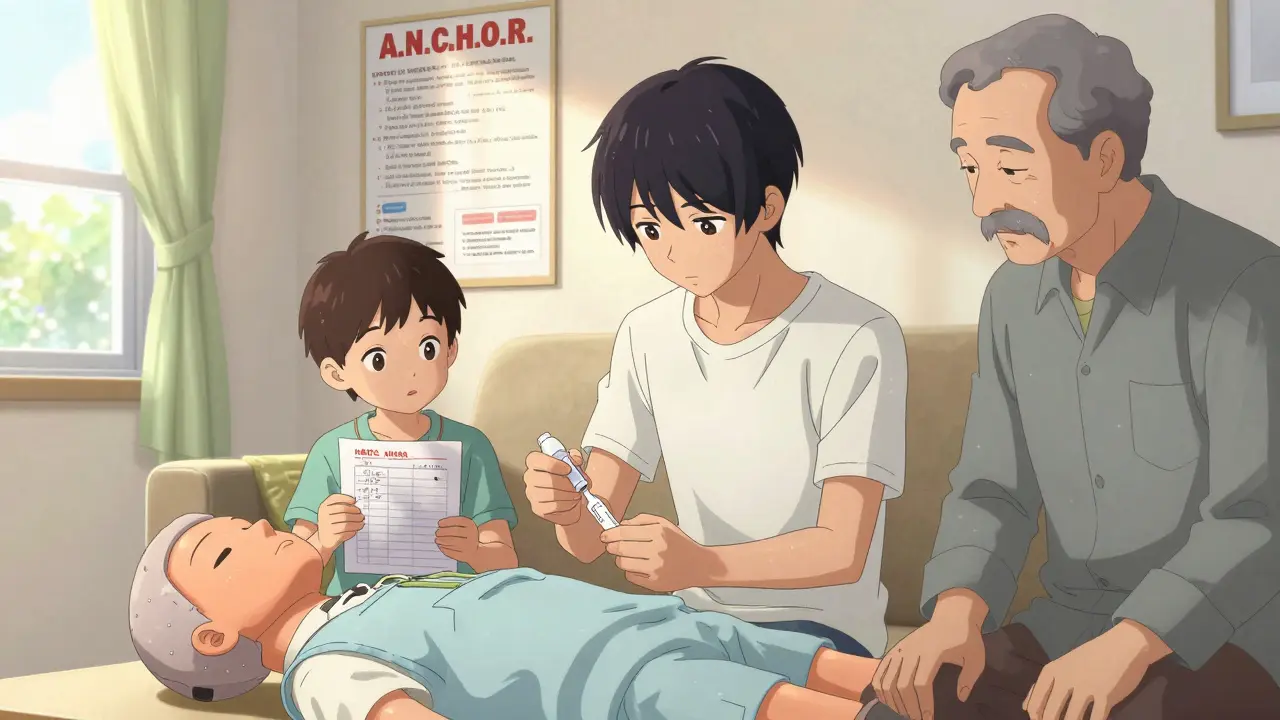
This isn’t just for adults. Teens, grandparents, even kids who might be home alone need to know what to do.- Watch a 15-minute training video from the American Red Cross or CDC
- Practice with a training kit (many pharmacies give these out for free)
- Run a 5-minute drill once a month: “What if Mom doesn’t wake up? Where’s the naloxone?”
- Teach kids how to call 911 and say their address clearly
What to Do After the Emergency
If naloxone works and the person wakes up, they might be confused, angry, or scared. That’s normal. Naloxone can cause sudden withdrawal symptoms-sweating, shaking, nausea.- Stay calm. Reassure them they’re safe
- Don’t argue or blame them
- Encourage them to get help-many people who survive overdose go into treatment
- Call their doctor to discuss next steps
Common Mistakes and How to Avoid Them
Most failed responses aren’t because people didn’t care. They just didn’t know what to do.- Mistake: Waiting to call 911 until after giving naloxone
- Fix: Call 911 at the same time you give the dose. EMS needs to come anyway.
- Mistake: Thinking naloxone is a cure
- Fix: It’s a temporary fix. The person still needs medical care.
- Mistake: Not checking the expiration date
- Fix: Set a phone reminder every 6 months to check your kit.
- Mistake: Assuming it won’t happen to us
- Fix: Overdose doesn’t care about income, education, or background. It happens to families like yours.
Real Stories, Real Impact
In Ohio, a 16-year-old girl saved her father after finding him blue and not breathing. She’d learned how to use Narcan in school. She gave him one spray, called 911, and gave him the second dose when he didn’t wake up. He’s alive today. In New York, a grandmother kept naloxone in her purse. When her grandson overdosed at a family dinner, she pulled it out before anyone else could react. He woke up before the ambulance arrived. These aren’t miracles. They’re results of a simple plan.What’s Next?
By 2025, federal health centers will be required to offer overdose plans to every patient prescribed opioids. Insurance companies are now required to cover naloxone with no copay. But until then, the power is in your hands. Start today. Get the naloxone. Teach your family. Write down the steps. Put it on the fridge. You might never need it. But if you do, you’ll be the reason someone lives to see tomorrow.Can I get naloxone without a prescription?
Yes. In 46 states, you can walk into a pharmacy like CVS or Walgreens and ask for naloxone without a prescription. Many pharmacies offer it for free or for under $25, especially if you have insurance. Some local health departments give out free kits too.
Is naloxone safe to use if I’m not sure it’s an overdose?
Absolutely. Naloxone only works on opioids. If someone has overdosed on alcohol, benzos, or other drugs, it won’t hurt them-it just won’t do anything. If you’re unsure and they’re unresponsive and not breathing normally, give it anyway. It’s safer to use it when not needed than to wait and risk death.
How long does naloxone last, and can the overdose come back?
Naloxone lasts 30 to 90 minutes, but many opioids-especially fentanyl-last much longer. That means the person can stop breathing again after the naloxone wears off. This is called renarcotization. That’s why you must keep monitoring them for at least 2 to 4 hours, even if they wake up. Always call 911 and stay with them until help arrives.
What if I’m afraid to call 911 because of legal trouble?
All 50 states have Good Samaritan laws that protect people who call for help during an overdose. You won’t be arrested for calling 911, even if drugs or drug paraphernalia are present. Emergency responders are there to save lives, not punish people. Calling 911 is the most important step you can take.
Can I train my kids to use naloxone?
Yes. Children as young as 10 can learn to recognize the signs of overdose and how to use a nasal spray. Many schools now include overdose response in health classes. Teach them how to call 911, where the naloxone is kept, and what to say to the dispatcher. Their quick action could save a parent, sibling, or friend.
What if I can’t afford naloxone?
You don’t have to pay. Many pharmacies offer free naloxone through public health programs. You can also order free kits online from nonprofits like Naloxone4All, The Harm Reduction Coalition, or your local health department. The 2024 Inflation Reduction Act also requires Medicare to cover naloxone with $0 copay, and many private insurers now follow suit.

Posts Comments
Ryan Riesterer January 22, 2026 AT 23:41
Naloxone availability has improved significantly since the 2018 FDA OTC decision, but distribution disparities persist in rural counties. The CDC’s 2023 surveillance data shows a 47% gap in kit access between urban and non-metropolitan areas, despite federal funding. Pharmacies in Appalachia and the Deep South still require proactive outreach to stock it reliably.
Implementation isn’t just about supply-it’s about training cadres of lay responders. Community health workers, not just EMS, must be integrated into the response chain. The American Red Cross model works, but only when scaled with local partnerships.
Also, storage recommendations should clarify that heat degradation is non-linear. A kit left in a 95°F car for 48 hours loses up to 30% potency, even if unexpired. Temperature logs matter.
And yes, children as young as 10 can be trained effectively. Neurocognitive studies confirm that basic motor memory for nasal spray administration is retained with monthly drills. No need to wait for adolescence.
This isn’t activism. It’s public health engineering.
Tatiana Bandurina January 23, 2026 AT 00:39
Let’s be honest-this whole plan is just a Band-Aid on a bullet wound. We’re treating the symptom while ignoring the root cause: the pharmaceutical industry’s decades-long push to normalize opioids, the DEA’s failure to regulate pill mills, and the complete lack of mental health infrastructure in this country. Naloxone doesn’t fix trauma, addiction, or poverty. It just buys time before the next crisis.
Meanwhile, the same people pushing this plan won’t support harm reduction centers or safe injection sites. They want the moral comfort of being the hero with a nasal spray while refusing to fund real solutions. It’s performative compassion wrapped in a medical kit.
And don’t get me started on the corporate sponsors of these ‘awareness campaigns.’ Big Pharma donates naloxone kits to look good while still pushing opioids to the elderly. It’s disgusting.
Malik Ronquillo January 24, 2026 AT 06:59
Just got my second Narcan kit today. Free at the Walgreens by the gas station. Took five minutes. No ID, no questions. My neighbor’s kid is 14 and already knows where it is. He says he’s gonna teach his little sister too.
Don’t overthink it. Just get it. Put it next to the coffee maker. Teach your kids to call 911. That’s it. You don’t need a degree. You just need to care enough to act.
Philip House January 25, 2026 AT 10:33
It’s funny how everyone acts like this is some groundbreaking innovation. The A.N.C.H.O.R. protocol is just a rebranded version of the 1990s harm reduction guidelines from San Francisco. We’ve known this since the crack epidemic. What’s new is the marketing.
Also, the claim that 93% of families save lives with naloxone? That’s from a 2021 Johns Hopkins study with a tiny sample size and no control group. Real-world data from CDC’s overdose surveillance shows a 68% success rate when administered by non-professionals.
And yes, fentanyl is scary. But so is the narrative that every accidental overdose is preventable. What about the 15% of cases where people are alone? Where no one’s home? Where the kid is in the bathroom and doesn’t hear the fall?
Preparation helps. But it’s not a panacea. And pretending it is just creates false security.
Alec Amiri January 26, 2026 AT 02:32
Oh wow. Another feel-good checklist for people who think they’re doing their part. You know what’s better than naloxone? Not giving people opioids in the first place. Or fixing the broken mental health system. Or paying people enough to not self-medicate with pills they steal from Grandma’s cabinet.
But no. Let’s just hand out nasal sprays like party favors and call it a day. Meanwhile, the opioid crisis keeps growing because we’d rather fix the symptom than fix the system.
Also, why is every example in this post a white family? What about Black and Brown communities where overdoses are higher but resources are scarcer? This feels like performative allyship with a pharmacy receipt.
Brenda King January 27, 2026 AT 06:57
I’m a nurse and I’ve seen this too many times. Last month, a 68-year-old woman took her husband’s pain pill by accident-she thought it was her blood pressure med. Her daughter used Narcan. They’re both alive.
But here’s the thing-no one in that family had ever talked about meds. Not once. Not even at Thanksgiving.
This plan isn’t about the spray. It’s about talking. About saying, ‘Hey, I’m worried about these pills.’ About asking, ‘Do you know what this is?’ About putting the spray where everyone can reach it, not locked in a drawer.
We don’t need more pamphlets. We need more courage to have the hard conversation. And then, yes-get the spray. But start with the talk.
And if you’re scared to bring it up? Start with, ‘I saw a story on the news…’ It’s easier than you think.
Keith Helm January 28, 2026 AT 15:16
Expiration dates are not suggestions. They are medical facts.
Storage above 77°F reduces efficacy by 15% per month.
Do not store in vehicles.
Do not rely on memory. Label the kit.
One dose is insufficient for fentanyl.
Call 911 before administering.
Renarcotization is real.
Training is mandatory, not optional.
Compliance is the difference between life and death.
Kenji Gaerlan January 28, 2026 AT 15:34
lol i just got narcan from cvs and they gave me a lanyard with it like im at a concert. my grandma has like 12 different meds in a drawer and i have no idea what half of them are. im gonna put the narcan next to the cereal. if she stops breathing i guess ill just spray it and hope for the best. 🤷♂️
Oren Prettyman January 28, 2026 AT 21:53
One must question the underlying assumption that every opioid-related incident is preventable through individual action. The state has abdicated its responsibility to regulate pharmaceutical marketing, to fund addiction treatment, and to address socioeconomic precarity. To place the burden of survival on the family unit is not empowerment-it is neoliberal abandonment dressed in medical jargon.
Moreover, the emphasis on naloxone as a solution implicitly endorses the continued legal availability of Schedule II opioids. One cannot simultaneously advocate for harm reduction while defending the structural conditions that necessitate it.
There is a moral contradiction here: we are told to arm families with life-saving tools while our legislators refuse to dismantle the systems that create the need for such tools in the first place.
One must ask: Is this plan a shield, or a smokescreen?
Akriti Jain January 29, 2026 AT 03:26
Wait… so now the government is giving out free narcan… but they’re also pushing 5G and vaccines? 🤔
Who’s really behind this? Big Pharma? The CDC? The Illuminati? They want us to think we’re safe so we don’t ask questions about why fentanyl is in EVERYTHING now. It’s not an accident. It’s a control mechanism.
Also, why are all the examples white people? Where are the Black and Latino families? Did they get the memo? Or is this just for people who still have medicine cabinets?
And don’t even get me started on the ‘Good Samaritan’ laws. They say you won’t get arrested… but what about immigration? What about your record? What about the cops who don’t read the law?
Trust no one. Keep your narcan… but keep your eyes open too. 🕵️♀️💉
Mike P January 29, 2026 AT 10:58
My cousin OD’d last year. We had Narcan. We used it. He woke up. Then he yelled at us for ‘ruining his peace.’ He went back to using. Two months later, he was dead. No second dose this time.
So yeah, the plan works. But only if the person wants to live.
And here’s the truth no one says: most people who OD don’t want to die. They just want the pain to stop. The pills? The alcohol? The fentanyl? It’s not a choice. It’s an escape.
So give ‘em the spray. But also give ‘em therapy. Give ‘em housing. Give ‘em a job. Otherwise, you’re just delaying the inevitable.
This isn’t a fix. It’s a holding pattern. And we’re running out of time.
Hilary Miller January 30, 2026 AT 21:04
Just returned from a trip to rural Kentucky. Saw a community center handing out naloxone kits with free coffee and a 10-minute demo. People lined up. Grandparents, teens, church volunteers.
One woman said, ‘I used to hide my son’s pills. Now I keep his Narcan in my purse. I’m not ashamed anymore.’
That’s the real story. Not the stats. Not the protocols. The moment people stop seeing this as ‘those people’s problem’ and start seeing it as ‘our problem.’
That’s how change happens. Not in policy. In people.
Margaret Khaemba January 31, 2026 AT 00:11
My mom has chronic pain and takes oxycodone. I was scared to talk to her about this. Then I found out her neighbor’s son died from a pill he found in his dad’s drawer.
So I just said, ‘Hey, can we talk about your meds? I’m not judging-I just want to make sure we’re safe.’ She cried. Then we went to the pharmacy together.
We got two kits. One for the house. One for her purse.
She says she feels less alone now.
It didn’t take a lecture. Just a quiet moment. And courage.
You don’t need to be an expert. Just be there.
Ryan Riesterer February 1, 2026 AT 01:53
Regarding the comment about rural access: I’ve coordinated distribution in 14 counties in West Virginia. The real barrier isn’t availability-it’s stigma. Many elderly patients refuse to take the kit because they believe it signals ‘you’re an addict.’ We’ve had to rebrand it as ‘emergency respiratory support device’ to get compliance.
Also, training videos don’t work for seniors with dementia. We switched to laminated step cards with pictures. Success rate tripled.
And yes-fentanyl contamination in stimulants is rising. Cocaine and meth now account for 22% of overdose deaths. Naloxone works on those too, if opioids are mixed in. That’s why we now recommend universal distribution, not just opioid-prescribed households.
This isn’t just an opioid issue anymore. It’s a public health emergency that demands universal preparedness.
Write a comment