
Every year, thousands of people in the U.S. end up in the hospital-or worse-because they took the wrong pill. Not because they didn’t mean to. Not because they were careless. But because they didn’t check the label. It’s easy to assume you know what’s in that bottle. You’ve taken it for months. Maybe years. But pills change. Doses change. Pharmacies change. And one wrong guess can cost you your health.
Checking your medication label before every single dose isn’t just a good idea. It’s the single most effective thing you can do to avoid a dangerous mistake. Studies show that people who check every time reduce their risk of a medication error by up to 76%. That’s more than double the protection you get from pill organizers or medication apps alone. And yet, most people skip it. Why? Because it feels like a hassle. Because they think, "I’ve done this a hundred times." But habits don’t form from willpower. They form from repetition, cues, and simple systems.
Why Checking Labels Saves Lives
Medication errors aren’t rare. They’re common-and deadly. The FDA estimates that between 7,000 and 9,000 people die each year in the U.S. from mistakes involving prescription drugs. Many of these happen because someone took the wrong medicine, the wrong dose, or took it at the wrong time. And a shocking 33% of those errors come from confusion over the label itself.
Think about it: You might have three different pills that all look alike. One’s for blood pressure. One’s for diabetes. One’s a vitamin. The bottles look similar. The caps are the same color. The labels are small. If you’re rushing in the morning, juggling coffee, kids, or a commute, it’s easy to grab the wrong one. Especially if you’re over 65. Nearly two in five older adults take five or more medications. And 21% of them have vision problems that make reading tiny print a challenge.
That’s why the FDA updated labeling rules in January 2025. New prescriptions now come with larger fonts (minimum 6-point for key info, 8-point for warnings), high-contrast colors, and clear spacing. No more tiny abbreviations like "q.d." or "BID." They’re gone. Now, labels say "once daily" and "twice daily." They spell out your full name. They list the exact dose in milligrams. This isn’t just for show. It’s designed so you can read it-even if your eyes aren’t what they used to be.
The Ten Things You Must Check Every Time
You don’t need to memorize a long list. But you do need to scan for these ten critical details every time you reach for a pill:
- Your full name - Is it spelled exactly right? Even one letter wrong can mean the wrong person’s medicine.
- Drug name - Both brand and generic. If it says "Lisinopril" but you thought it was "Zestril," you’re looking at the same thing. Good. But if it says "Insulin" and you expected "Metformin," that’s a red flag.
- Prescriber’s name - Does it match the doctor who ordered it? If it’s a new doctor, that’s fine. If it’s someone you’ve never seen, ask.
- Dosage and strength - Is it 5 mg? 10 mg? 500 mg? Don’t guess. Read it. A 10 mg tablet is not the same as a 50 mg tablet.
- Quantity and refills - How many pills are left? If you’re out of refills and still have pills, double-check the bottle. Maybe it’s a different medication.
- Warnings - "Avoid alcohol." "Take with food." "May cause dizziness." These aren’t suggestions. They’re safety rules.
- Date filled - Is it within the last 30 days? If it’s older, the pharmacy might have filled the wrong bottle.
- Expiration date - Never take expired medicine. It can lose effectiveness-or become harmful.
- Pharmacy name and number - If something feels off, call them. Pharmacists are trained to catch mistakes.
- Instructions - "Take one by mouth at bedtime." Not "take one at night." Be precise.
You don’t need to say all ten out loud every time. But you should touch each one as you read it. That’s the key.
The Three-Touch Method: How to Make It Stick
Trying to remember to check your label is like trying to remember to brush your teeth without a routine. It fails. But if you attach it to something you already do every day, it becomes automatic.
The American Society of Health-System Pharmacists (ASHP) recommends the Three-Touch Method:
- Touch the label with your finger as you pick up the bottle.
- Touch the pill as you take it out.
- Touch your mouth as you swallow.
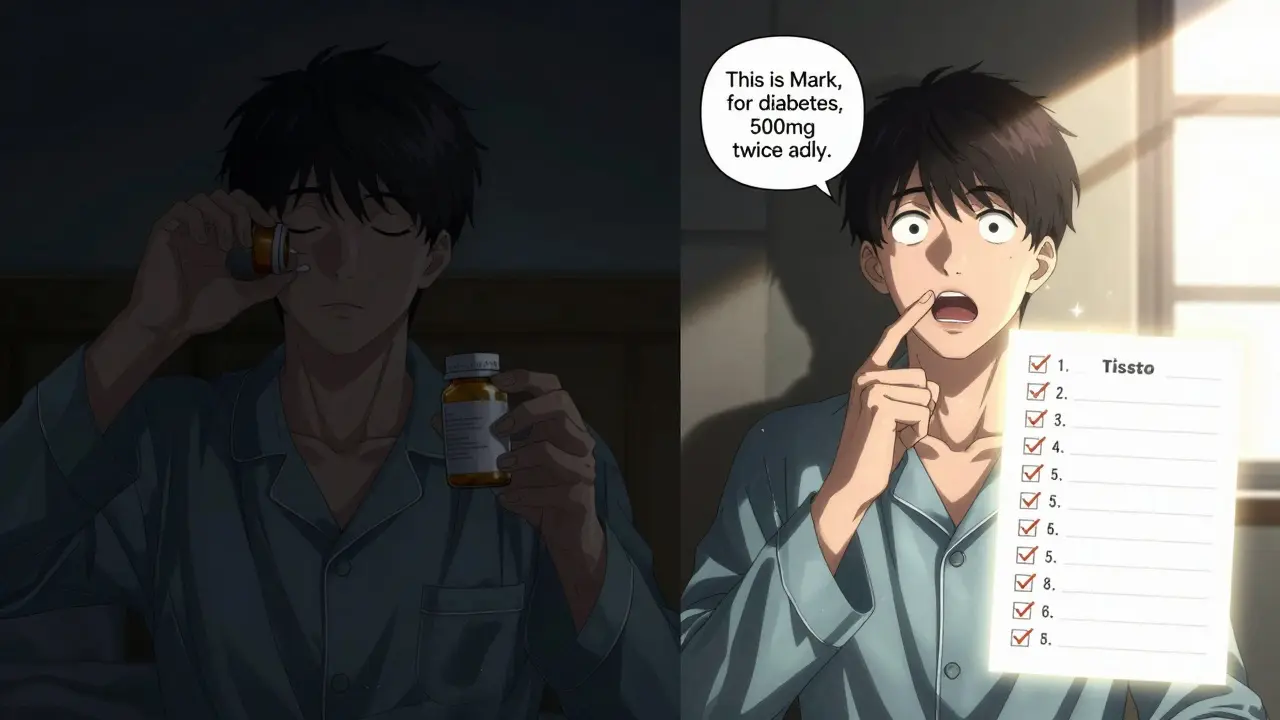
While you do this, say out loud: "This is [Your Name], for [condition], [dose] [times per day]." For example: "This is Sarah Johnson, for high blood pressure, 10 milligrams once daily."
Why does this work? Because it combines movement, speech, and focus. You’re not just looking-you’re engaging your body and your brain. Studies show this method boosts adherence to 92% after 30 days. Silent checking? Only 64%.
Do this for 21 days. That’s how long it takes for most people to turn it into a habit. Don’t skip a day. Even if you’re sure you know what’s in the bottle. Even if you’ve taken it for 10 years. Even if you’re tired. This is your safety net.
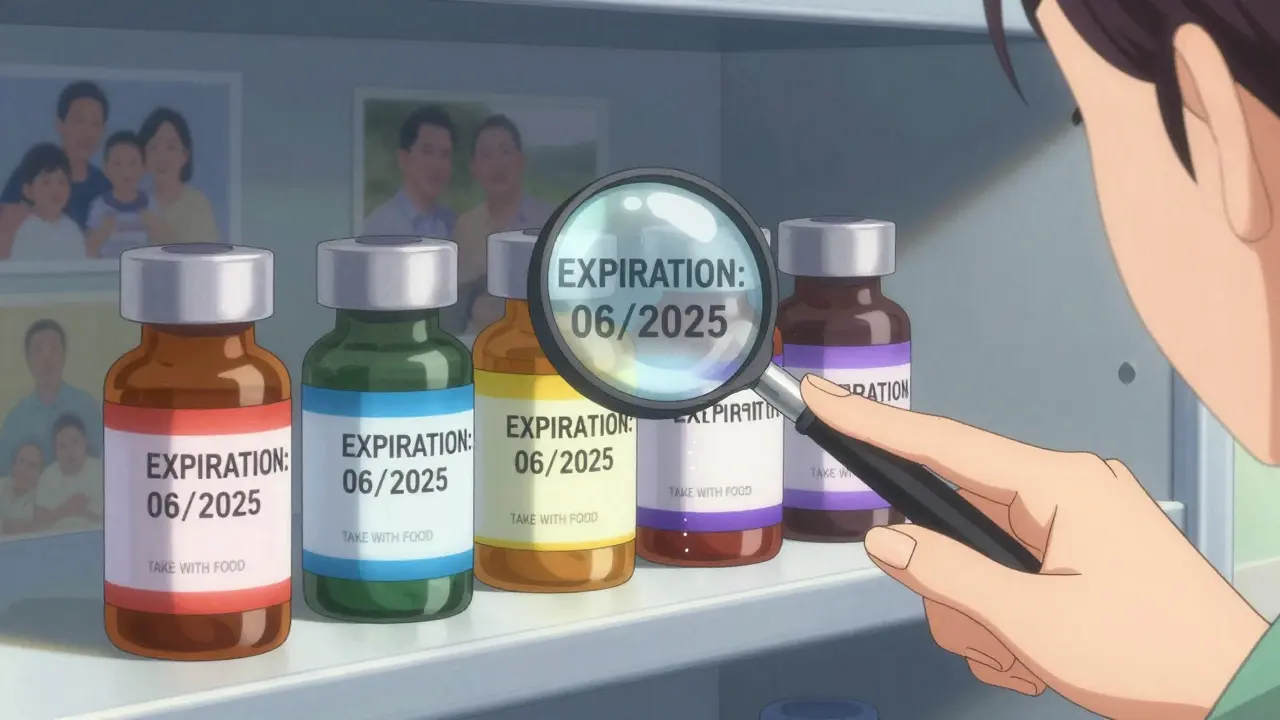
What If You Can’t Read the Label?
If your eyesight isn’t what it used to be, or if the print is still too small, you’re not alone. And you don’t have to guess.
- Ask your pharmacist for a magnifying label. Many pharmacies now offer larger-print labels for free. Just ask.
- Use a phone magnifier app. Turn on the camera zoom. Hold it over the label. You’ll see details you missed.
- Color-code your bottles. Put a colored sticker on the bottle for each type of medicine. Red for blood pressure. Blue for diabetes. Green for vitamins. Make sure your caregiver or family member knows the system.
- Ask someone to read it to you. A family member, friend, or even a pharmacy technician can read the label over the phone. Most pharmacies will do this for free.
One woman in Bristol, UK, told her pharmacist she kept confusing her insulin with saline solution. He gave her a red cap for the insulin and a white cap for the saline. She hasn’t made a mistake since.
Where It Fails-and How to Fix It
Label checking works brilliantly-for most people. But it doesn’t work if:
- You’re rushing in the morning. Solution: Place your pill bottle right next to your coffee maker, toothbrush, or keys. If it’s in your path, you can’t skip it.
- You have memory problems. Solution: Use a checklist taped to your medicine cabinet. Check off each item as you verify it.
- You rely on memory. Solution: Dr. Angela Smith of Carolinas HealthCare System found that 83% of people who skip checking after two weeks do so because they think they "remember." Memory fails. Labels don’t.
- You’re overwhelmed by too many pills. Solution: Ask your pharmacist for a medication review. Sometimes, you can reduce the number of pills you take.
One study found that people who placed their meds next to their morning coffee were 53% less likely to miss a label check. Simple. Effective. No tech. No app. Just placement.
What About Medication Apps?
There are hundreds of apps that remind you to take your pills. But here’s the catch: 63% of users stick with apps that require you to photograph the label before logging a dose. Why? Because it forces you to check. Most apps just beep. This one makes you engage.
Amazon reviews for these apps show they have 63% higher retention at 90 days than apps that just remind you. The best ones even let you save a photo of the label so you can review it later. If you use an app, make sure it has this step. Don’t settle for a simple timer.
Real Stories: Success and Tragedy
On Reddit, a mom named "MedSafetyMom" shared how her family went from three medication errors a month to zero. She started the Three-Touch Method with her kids. Within three weeks, they were doing it without being reminded. Her 12-year-old now checks his own ADHD meds. "It’s just part of the routine," she said.
But not all stories end well. A man in Ohio confused his insulin with saline solution because he didn’t check the label. He ended up in the ER with dangerously low blood sugar. His family said he’d taken insulin for 15 years. "I knew what it looked like," he said. But the bottle changed. The label changed. And he didn’t look.
That’s the point. You don’t need to know what it looks like. You need to read what it says.
The Bigger Picture
Medication errors cost the U.S. healthcare system $42 billion a year. That’s not just money. It’s hospital stays. Lost work. Missed birthdays. Deaths that could have been prevented.
And the problem is getting worse. The average Medicare patient now takes over five prescriptions. One in five older adults takes eight or more. With that many pills, a single mistake can cascade into disaster.
That’s why hospitals now train patients before discharge. Why 92% of hospital systems require label verification before sending someone home. Why the FDA launched a national "Check Before You Take" campaign in January 2024.
This isn’t about being paranoid. It’s about being smart. You wouldn’t drive a car without checking the brakes. Why would you take a pill without checking the label?
It’s not hard. It’s not time-consuming. It takes 3 to 5 seconds. But those seconds could save your life-or someone you love.
What if I forget to check the label one day?
If you forget once, don’t panic-but don’t make it a habit. The goal is consistency, not perfection. If you miss a check, pause before taking the next dose. Use the Three-Touch Method right then. The more you do it, the less likely you are to forget. Think of it like buckling your seatbelt. You don’t think about it anymore. You just do it.
Can I rely on my pharmacist to catch mistakes?
Pharmacists are trained to spot errors, but they’re not mind readers. They fill hundreds of prescriptions a day. They can’t check every bottle against every patient’s history. You are your own best defense. Your pharmacist will thank you for checking-it makes their job easier and safer for everyone.
Is it okay to transfer pills to a pill organizer?
Yes-but only if you check the label first. Never transfer pills without verifying the name, dose, and instructions. Once they’re in the organizer, you can’t read the label anymore. Always check before you move them. And if you use an organizer, keep the original bottles in a visible spot as backup.
What if the label looks different from last time?
Always call your pharmacy. A change in color, shape, or wording could mean a new generic version, a dosage change, or a mistake. Never assume it’s the same. Even small changes matter. Your pharmacist can confirm whether it’s correct or if there’s been an error.
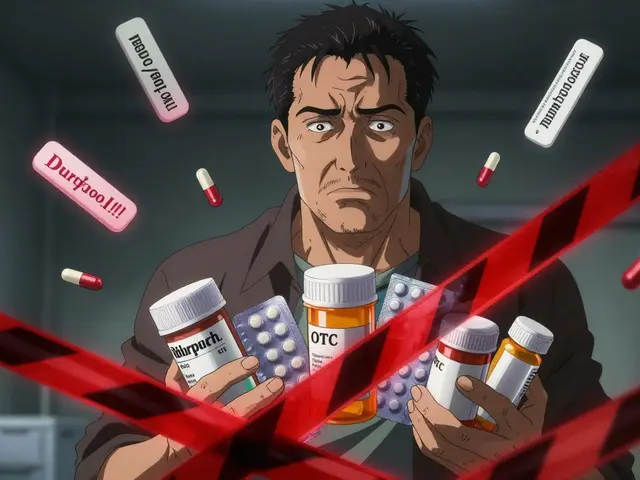
Do I need to check labels for over-the-counter meds too?
Yes. Many people don’t realize that OTC drugs can interact with prescriptions. A common painkiller like ibuprofen can raise blood pressure or cause stomach bleeding if you’re on blood thinners. Always read the OTC label-especially if you’re taking other medications. The same rules apply: name, dose, warnings, expiration.




Posts Comments
Tom Sanders March 8, 2026 AT 23:45
Look, I get it. Check the label. Whatever. But let’s be real-how many of us are actually doing this when we’re half-asleep at 6 a.m. with a screaming kid and a spilled coffee? I’ve been on the same med for 8 years. It’s the same bottle. Same color. Same damn shape. I’m not gonna stop and read tiny print every single time. That’s not habit formation-that’s OCD with a side of paranoia.
Jazminn Jones March 10, 2026 AT 18:34
While the intent behind this article is laudable, the underlying epistemological framework is fundamentally flawed. One cannot reduce complex pharmacological adherence to a triadic tactile ritual without acknowledging the structural inequities in pharmaceutical labeling accessibility. The assumption that ‘three touches’ compensate for systemic failures-such as inadequate visual accommodations for geriatric populations or inconsistent FDA enforcement-is not merely naive, it is ethically indefensible. Moreover, the glorification of individual responsibility obscures the necessity for institutional reform.
Stephen Rudd March 11, 2026 AT 19:53
Oh please. The FDA updated labels? Since when did government bureaucracy become your personal savior? You think big fonts and spelling out ‘once daily’ stops people from mixing up pills? That’s like putting a sticker on a bomb that says ‘don’t pull this’. The real problem? Pharmacies don’t train staff to verify prescriptions against patient history. They don’t scan barcodes against your profile. They don’t even cross-check drug interactions. You’re being sold a placebo solution wrapped in feel-good branding. The system is broken. Your three-touch method? A Band-Aid on a hemorrhage.
Erica Santos March 13, 2026 AT 05:37
Wow. So the solution to avoiding death by pill is to say your name out loud while touching your mouth? Congrats, you’ve invented a cult ritual. Next you’ll be chanting ‘I am Sarah Johnson’ while swallowing. Did you also consider that some people have dysphagia? Or aphasia? Or dementia? Or are you just here to pat yourself on the back for not being a dumbass? The real tragedy isn’t people forgetting to read labels-it’s that we’ve turned healthcare into a self-help seminar where the only thing that matters is whether you ‘did the thing’.
George Vou March 14, 2026 AT 04:47
you know what i think? i think the gov is putting tracking chips in the pills now. that’s why they made the labels bigger. so they can see who’s taking what. and why they want you to say your name out loud? so they can link it to your phone. and the pharmacy number? that’s a backdoor to your data. i’m not touching no label. i’m using my old bottle from 2019. they can’t track that. i’m not a lab rat. #checkyourlabels #notthelabel
Scott Easterling March 15, 2026 AT 05:56
Oh, so now you’re telling me I need to TOUCH the bottle, TOUCH the pill, TOUCH MY MOUTH?? Like I’m some kind of zombie doing a ritual? And you think this works? I’ve got 14 different meds. I can’t even remember if I took my blood pressure pill this morning. I just shake the bottle. If it rattles, I take it. If it doesn’t, I don’t. That’s my system. And it’s worked for 12 years. You think your ‘three-touch’ thing is better? Please. I’ve seen people on TikTok doing this. It’s not safety-it’s performance. And don’t even get me started on the ‘color-coded stickers’-you think someone’s gonna remember red = blood pressure? What if they’re colorblind? What if they’re blind? What if they’re just lazy? Stop pretending this is science. It’s a gimmick.
Mantooth Lehto March 15, 2026 AT 15:31
This is so important!! I’m so glad someone finally said it!! 😭 I almost died last year because I didn’t check the label on my new insulin bottle. I thought it was the same one!! I was shaking, sweating, felt like I was gonna pass out… I called my mom crying and she read the label to me and it was 2x the dose!! I’ve been doing the three-touch method ever since and I feel so much safer now. Please, please, please do this. Your life matters. 💙
Melba Miller March 15, 2026 AT 22:16
Let’s be honest-this whole thing is a symptom of a broken system. We’re telling people to check labels because the pharmacies won’t do their job. We’re telling old folks to use magnifiers because the FDA didn’t mandate readable fonts until 2025. We’re telling families to color-code bottles because no one thought about dementia patients before. This isn’t about personal responsibility. It’s about society giving up on people who need care. And now we’re calling it a ‘habit’? No. It’s damage control. And we’re all just trying not to die while the system pretends it’s not failing.
Write a comment