
Getting a call from your doctor saying your blood work is 'abnormal' sends a jolt of fear through anyone. For men over 50, that abnormal result often points to one specific marker: PSA, or Prostate-Specific Antigen. It is the most common screening tool for prostate cancer, a disease affecting one in eight men in their lifetime. But here is the hard truth that many doctors don't have time to explain fully: a high PSA does not automatically mean you have cancer. It means you need more investigation. The journey from that first blood test to a final diagnosis-and potentially treatment-is filled with gray areas, difficult choices, and rapidly evolving technology.
In this guide, we will walk you through what the numbers actually mean, why biopsies are no longer the immediate next step they used to be, and how modern treatments have shifted from 'cut it all out' to precise, targeted approaches. Whether you are sitting in a waiting room right now or planning ahead for your father or husband, understanding these steps can reduce anxiety and help you make informed decisions.
Understanding the PSA Test: More Than Just a Number
The PSA test measures a protein produced by the prostate gland. While it was originally approved by the FDA in 1986 to monitor known cancer patients, it became the standard screening tool in 1994. Today, approximately 30 million PSA tests are performed annually in the United States alone. However, interpreting the result is tricky because the prostate is not just a cancer factory; it is also prone to benign enlargement (BPH) and inflammation (prostatitis), both of which raise PSA levels.
For decades, the magic number was 4.0 ng/ml. Anything above that triggered alarm bells. But medical guidelines have shifted. The National Comprehensive Cancer Network (NCCN) now recommends considering further evaluation at a threshold of ≥3.0 ng/ml. This change reflects research showing that cancer risk exists on a gradient, not a switch. Dr. Andrew Vickers of Memorial Sloan Kettering notes that even levels between 0-3 ng/ml carry some risk, though low.
The problem with lowering the threshold is specificity. At the traditional 4.0 ng/ml cutoff, the test has high sensitivity (it catches most cancers) but very low specificity (0.20). This means that if your PSA is 4.0, there is only a 20% chance it is due to cancer. The other 80% of the time, it is something else. When thresholds drop to 2.0 ng/ml, sensitivity jumps to 95%, but the false-positive rate skyrockets to 80%. This creates a dilemma: do we catch every cancer, including those that would never hurt us, or do we spare men from unnecessary procedures?
| PSA Threshold (ng/ml) | Sensitivity (Cancer Detection) | Specificity (Non-Cancer Correctly Identified) | False Positive Rate |
|---|---|---|---|
| ≥ 4.0 | 93% | 20% | 80% |
| ≥ 3.0 | ~97% | <15% | >85% |
| ≥ 2.0 | 95% | 20% | 80% |
If your PSA falls into the 'gray zone' of 4-10 ng/ml, you are in the largest group of concerned men. Historically, this meant a biopsy. Today, it means you should ask about advanced biomarker tests. These include the Prostate Health Index (PHI) and the 4Kscore test. Unlike standard PSA, these tests analyze different forms of the antigen and other markers to predict the likelihood of aggressive cancer. Studies show they outperform traditional ratios in detecting clinically significant disease, potentially sparing thousands of men from invasive procedures.
The Biopsy Dilemma: Why MRI Comes First Now
A decade ago, an elevated PSA almost always led directly to a transrectal ultrasound-guided biopsy. This procedure involves inserting a needle through the rectum into the prostate to take tissue samples. It is uncomfortable, carries a risk of infection (including sepsis in rare cases), and often misses tumors located in the front of the gland.
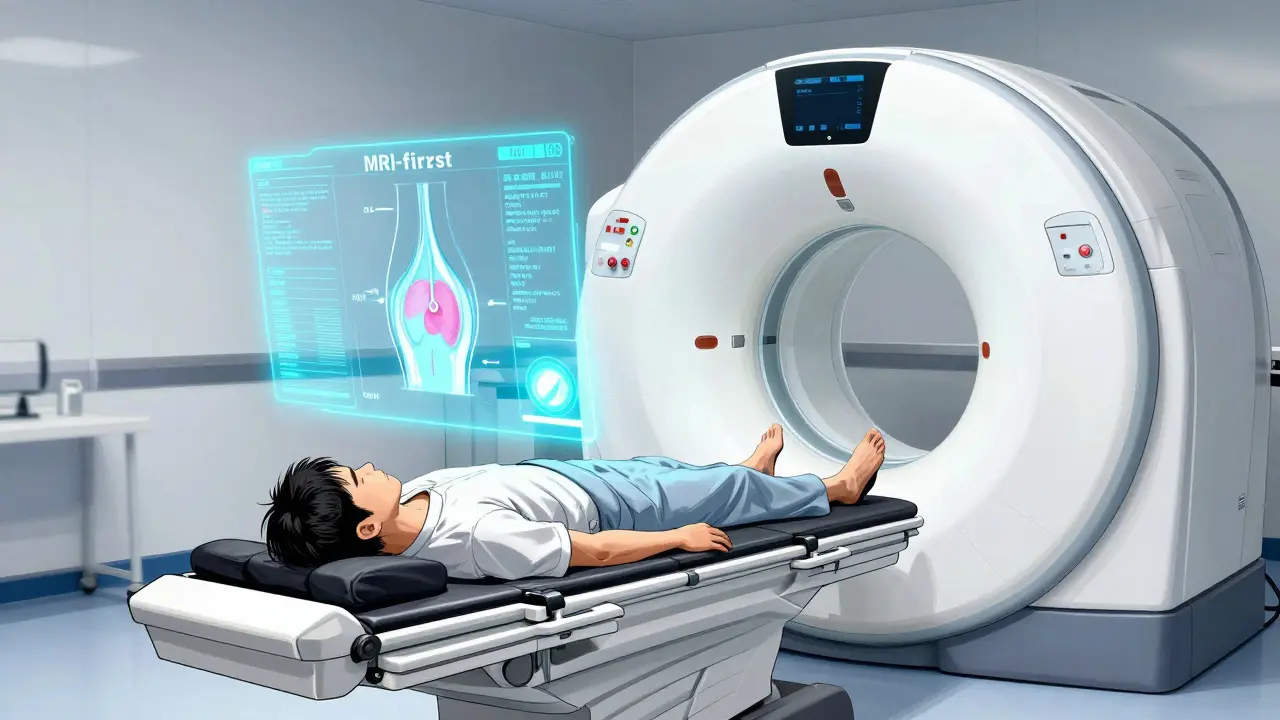
The landscape has changed dramatically with the introduction of multiparametric MRI (mpMRI). Current guidelines from the European Association of Urology (EAU) and others increasingly recommend an MRI *before* any biopsy. This 'MRI-first' approach allows radiologists to visualize suspicious lesions. If the MRI is clean, you may avoid a biopsy entirely. If it shows abnormalities, the biopsy can be targeted specifically to those areas, either via fusion biopsy (combining MRI images with real-time ultrasound) or template mapping.
The PICTURE trial, currently underway, aims to prove whether this MRI-first strategy can safely reduce biopsy rates by 50% without missing significant cancers. Early data suggests it works. In fact, combining MRI with newer imaging like PSMA-PET/CT achieves a negative predictive value of 91%, meaning if both scans are clear, you are highly unlikely to have significant cancer. However, access remains a barrier. PSMA-PET/CT costs over $3,000 and is available only at specialized centers, while mpMRI ranges from $1,200 to $2,500. Insurance coverage varies, and prior authorization is often required.
It is also crucial to address disparities in care. Research from Duke University Medical Center highlights that Black men with PSA levels between 3-4 ng/ml are 2.3 times more likely than White men to undergo biopsy but have 18% lower cancer detection rates. This suggests that systemic biases may lead to over-testing in minority populations. Shared decision-making conversations must account for individual risk factors, including family history and race, to ensure equitable care.
Treatment Options: From Watchful Waiting to Precision Therapy
If cancer is diagnosed, the next question is: what do we do? The answer depends heavily on the stage and grade of the tumor. Not all prostate cancers are created equal. Many are indolent-slow-growing and unlikely to cause symptoms or death during a man's lifetime. Treating these aggressively leads to 'overdiagnosis' and overtreatment, causing harm without benefit.
For low-risk cancers, Active Surveillance is the gold standard. This is not 'doing nothing.' It involves regular PSA tests, MRIs, and occasional repeat biopsies to monitor the cancer. If it shows signs of aggression, treatment begins. This approach preserves quality of life, avoiding side effects like urinary incontinence and erectile dysfunction, which occur in up to 50% of men after radical surgery.
When treatment is necessary, options include:
- Radiation Therapy: External beam radiation (EBRT) or brachytherapy (internal seeds). Modern techniques like IMRT and proton therapy allow for higher precision, sparing surrounding tissues.
- Radical Prostatectomy: Surgical removal of the prostate. Robotic-assisted laparoscopic surgery has reduced recovery time and blood loss compared to open surgery, though functional outcomes vary by surgeon experience.
- Hormone Therapy (ADT): Used for advanced or metastatic cancer, this reduces testosterone levels to starve cancer cells. Newer agents like abiraterone and enzalutamide offer more potent suppression with fewer side effects than older drugs.
- Immunotherapy and Targeted Therapy: For metastatic castration-resistant prostate cancer (mCRPC), drugs like pembrolizumab (for MSI-High tumors) and PARP inhibitors (for BRCA-mutated cancers) represent breakthroughs in personalized medicine.
The choice between surgery and radiation is often debated. Both have similar long-term survival rates for localized cancer. The decision usually comes down to personal preference, age, and potential side effects. Younger men might prefer surgery to avoid long-term radiation risks, while older men might choose radiation to avoid surgical recovery. A second opinion from a multidisciplinary team-including a urologist, radiation oncologist, and medical oncologist-is highly recommended.

Navigating the Emotional and Practical Journey
The psychological impact of a prostate cancer diagnosis cannot be overstated. A study published in the *Journal of Urology* found that 38% of men who underwent unnecessary biopsies reported moderate to severe anxiety lasting more than six months. Another survey revealed that 62% of patients felt 'misled' by initial PSA results when subsequent tests showed no cancer.
This emotional toll underscores the importance of counseling. The American Urological Association recommends that shared decision-making conversations take 15-20 minutes. Use this time to ask questions: What is my baseline PSA? What is my risk score based on family history? Are advanced biomarkers covered by my insurance? What are the chances I will need treatment within five years?
Practical implementation also involves understanding costs. Standard PSA tests cost $25-$50. Advanced tests like PHI ($350) and 4Kscore ($450) add expense but may save money long-term by avoiding unnecessary biopsies and treatments. Medicare covers these advanced tests, but private insurers may require prior authorization. Always check your plan's details before proceeding.
Finally, remember that prostate cancer screening is a marathon, not a sprint. Establishing a baseline PSA at age 40-45 helps track trends over time. A rising PSA velocity (rate of increase) is often more concerning than a single static number. Regular follow-ups, healthy lifestyle choices (diet rich in lycopene, exercise), and open communication with your healthcare provider are your best defenses.
At what age should men start getting PSA tested?
The American Urological Association recommends that men discuss PSA screening starting at age 50. However, men at higher risk-including those with a family history of prostate cancer or African American men-should consider starting earlier, around age 40-45. This baseline helps establish a personal trend line rather than relying on population averages.
Is a PSA level of 4.0 ng/ml definitely cancer?
No. A PSA level of 4.0 ng/ml is considered the upper limit of normal, but it is not diagnostic of cancer. Benign prostatic hyperplasia (BPH) and prostatitis are far more common causes of elevated PSA. Only about 25% of men who undergo biopsy due to elevated PSA are actually diagnosed with prostate cancer. Further testing, such as MRI or advanced biomarkers, is recommended before proceeding to biopsy.
What is Active Surveillance, and who is it for?
Active Surveillance is a management strategy for low-risk, slow-growing prostate cancer. Instead of immediate surgery or radiation, patients undergo regular monitoring with PSA tests, MRIs, and periodic biopsies. It is ideal for men with small, low-grade tumors who wish to avoid the side effects of treatment, such as incontinence and erectile dysfunction, while ensuring cancer is treated if it becomes aggressive.
How does an MRI help before a biopsy?
An MRI provides detailed images of the prostate, allowing doctors to identify suspicious areas that may not be visible on ultrasound. This enables 'targeted biopsies,' where needles are guided specifically to these lesions, increasing the accuracy of detection and reducing the risk of missing significant cancer or sampling benign tissue. It can also help avoid unnecessary biopsies if the scan is clear.
Are advanced tests like PHI or 4Kscore worth the extra cost?
For men with PSA levels in the 'gray zone' (4-10 ng/ml), yes. These tests provide better specificity than standard PSA, helping to distinguish between benign conditions and clinically significant cancer. While they cost $300-$450 more upfront, they can prevent unnecessary biopsies and associated complications, saving money and stress in the long run. Coverage varies by insurer, so check with your provider.
What are the side effects of prostate cancer treatment?
Common side effects include urinary incontinence, erectile dysfunction, and bowel changes. Surgery (prostatectomy) carries a higher risk of immediate incontinence, while radiation may cause delayed issues. Hormone therapy can lead to hot flashes, fatigue, and loss of muscle mass. The severity varies by individual and treatment type, making shared decision-making critical to align treatment with quality-of-life goals.
Does diet affect PSA levels or prostate cancer risk?
While no specific food cures prostate cancer, a diet rich in fruits, vegetables, and healthy fats (like the Mediterranean diet) is associated with lower risk. Lycopene, found in tomatoes, and cruciferous vegetables like broccoli may have protective effects. Conversely, high intake of red meat and dairy has been linked to increased risk. Maintaining a healthy weight also contributes to better outcomes.