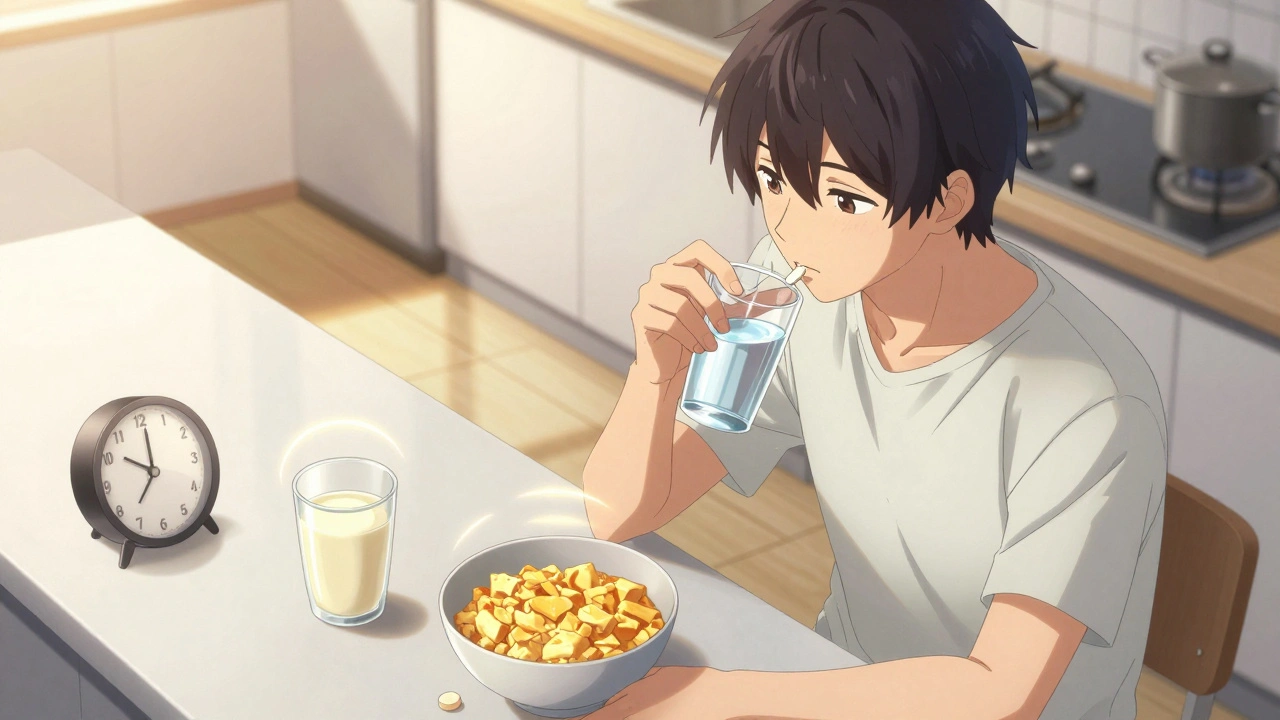
If you're taking levothyroxine for hypothyroidism and you eat tofu, drink soy milk, or snack on edamame, you might be wondering: is soy messing with my medication? The answer isn’t yes or no-it’s timing. Soy doesn’t make your thyroid worse. It doesn’t cancel out your pills. But it can block your body from absorbing the full dose-enough to throw your TSH levels out of whack if you’re not careful.
How Soy Interferes With Thyroid Medication
Soy contains compounds called isoflavones-mainly genistein and daidzein-that bind to levothyroxine in your gut. Think of it like Velcro: the soy sticks to the medication before your body can absorb it. This isn’t a myth. It’s been documented since the 1960s, when babies on soy formula needed higher doses of thyroid meds just to stay stable.Studies show soy can reduce levothyroxine absorption by 9% to 30%, depending on how much you eat and when. A 2006 case report in the Journal of Clinical Endocrinology & Metabolism tracked a woman who took 200 mcg of levothyroxine daily but still had high TSH levels-until she stopped drinking soy protein shakes right after her pill. Once she waited four hours, her levels normalized.
It’s not just supplements. Whole soy foods like tofu, tempeh, and soy milk have the same effect. In fact, they’re often worse than isolated isoflavone pills because the whole protein matrix holds onto the medication more tightly. One study found soy reduced absorption more than fiber supplements like psyllium.
How Much Does It Really Matter?
Not everyone sees a change. Some people take soy with their meds for years and never have an issue. Others see their TSH jump from 2.0 to 6.0 in just a few months after starting daily soy milk. Why the difference?It comes down to three things: how much soy you eat, how often, and how closely you time it with your pill. The European Thyroid Journal published a 2023 study showing that if you wait just two hours after taking levothyroxine before having soy milk, absorption interference drops to almost nothing-TSH changes were under 0.1 mIU/L. That’s a big shift from the old advice to wait four hours.
But here’s the catch: those results were for adults. For kids, pregnant women, or people with severe hypothyroidism, the margin for error is smaller. The Mayo Clinic still recommends a 3-hour gap for children and anyone with unstable thyroid levels. The American Thyroid Association says 2-3 hours is fine for most adults. The European Food Safety Authority says soy is safe for healthy people-but if you’re on medication, you’re not in the “healthy” group anymore.
How Soy Compares to Other Food Interactions
Soy isn’t the only thing that messes with levothyroxine. Calcium, iron, coffee, and high-fiber foods all interfere too. Here’s how they stack up:| Substance | Absorption Reduction | Recommended Separation Time |
|---|---|---|
| Calcium supplements | 25-36% | 4 hours |
| Iron supplements | 30-40% | 4 hours |
| Soy products | 9-30% | 2-3 hours |
| Coffee | ~20% | 60 minutes |
| High-fiber foods | 15-25% | 1-2 hours |
So soy isn’t the worst offender-but it’s up there. And unlike calcium or iron, you can’t just stop eating soy. It’s in everything: plant-based burgers, protein powders, baby formula, even some cereals. That’s why timing matters more than elimination.
What the Experts Actually Recommend
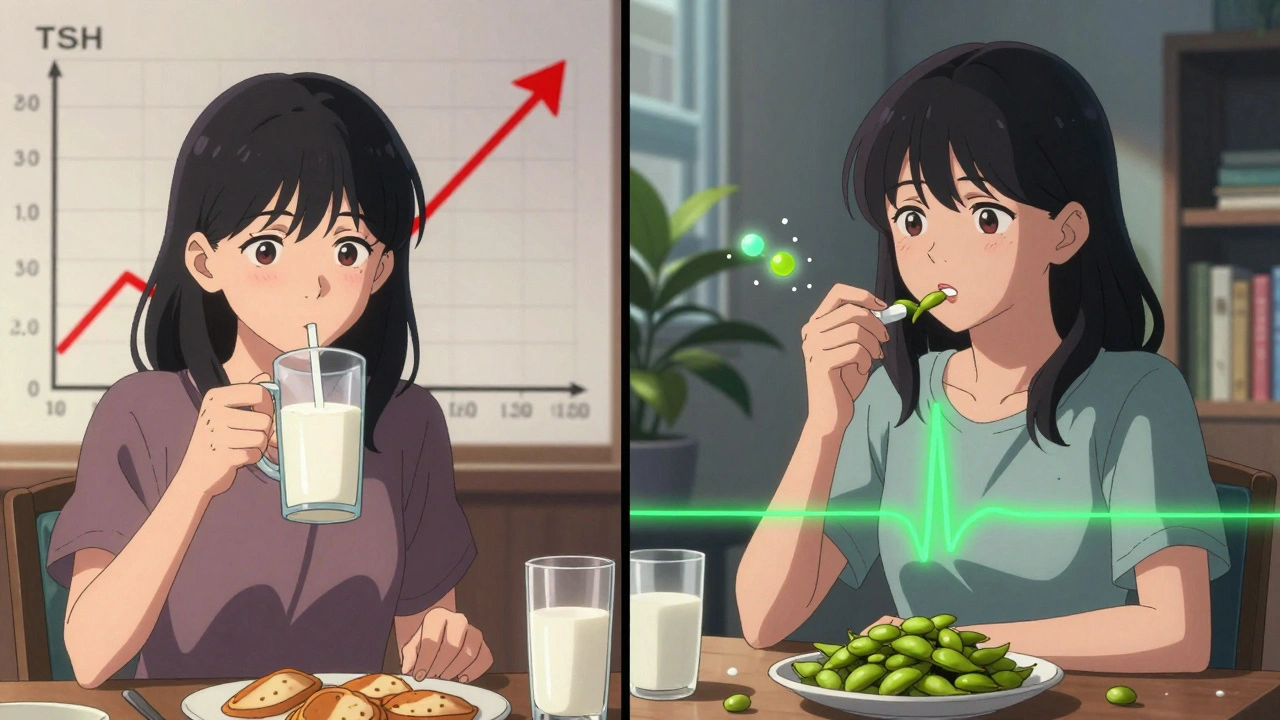
There’s no single rule. Different doctors say different things. Dr. David Heber at UCLA says wait four hours. The Mayo Clinic says two to three. The American Thyroid Association says two to three for adults. Dr. Mario Skugor at Cleveland Clinic says, “We’ve seen cases where daily soy milk required a 50 mcg dose increase.”The real consensus? Consistency is key. If you take your pill at 7 a.m., don’t have soy at 7:30 a.m. one day and 8:30 a.m. the next. Pick a routine and stick to it.
Here are the two most common and effective strategies:
- Morning routine: Take your pill on an empty stomach with water. Wait 60 minutes before eating anything. Then wait another 2-3 hours before eating soy. That means no tofu scramble at breakfast. Save it for lunch or dinner.
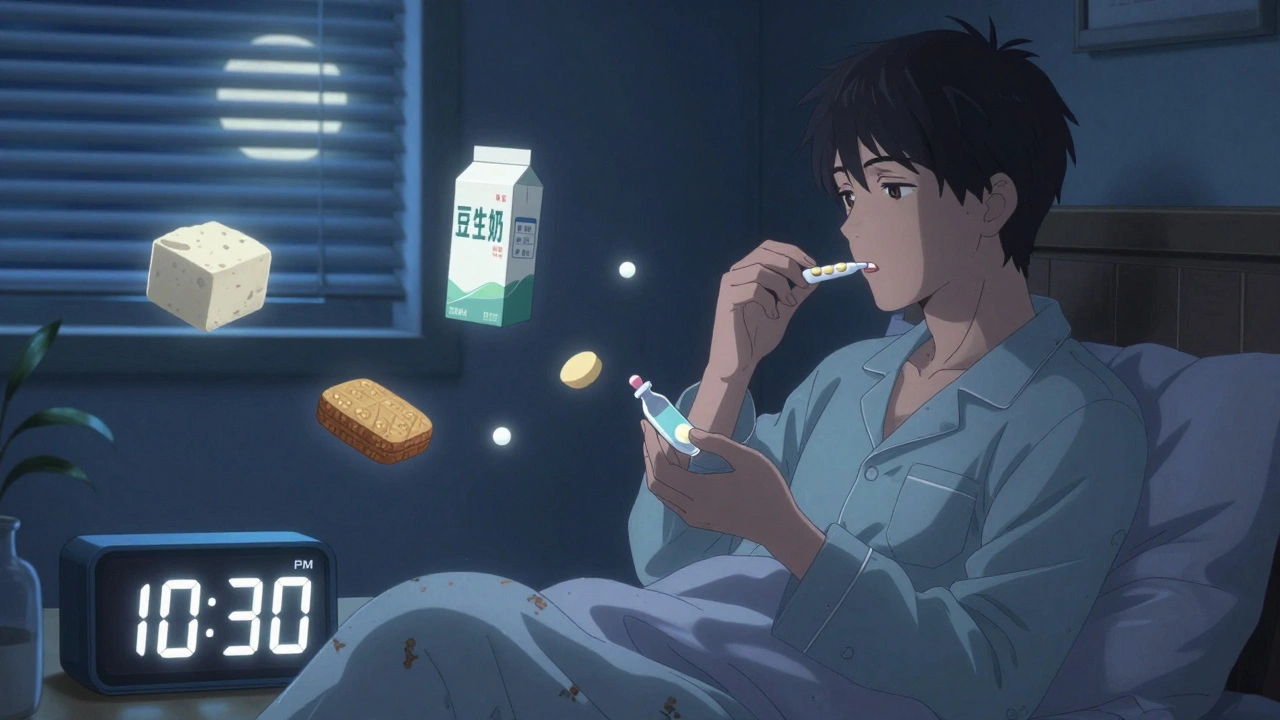
- Bedtime routine: Take your pill at least 2 hours after your last meal. This avoids interference from soy, coffee, and fiber all at once. Many patients find this easier-especially if they’re used to eating soy at night.
A 2022 survey of endocrinologists found that 78% recommend one of these two methods. The rest? They tell patients to avoid soy altogether. But that’s not realistic for vegans, vegetarians, or anyone who loves miso soup.
Real Stories: What Patients Experience
Reddit’s r/Thyroid community has hundreds of posts about this. One user, HypoWarrior42, started drinking soy milk every morning with breakfast. Three months later, their TSH jumped from 1.8 to 5.2. Their doctor upped their dose from 75 mcg to 100 mcg. They switched to almond milk and waited three hours after their pill to eat soy-TSH dropped back to 1.9.But another user, SoyLoverHypo, has been taking Synthroid with soy milk for five years. Their TSH stays at 1.5. Their endocrinologist says it’s fine because they take the pill at night and the soy is in their morning smoothie.
That’s the point: it’s not about soy. It’s about timing. Some people’s bodies absorb the drug differently. Some have slower digestion. Some take their pill with food sometimes. Those variables change everything.
What You Should Do Right Now
You don’t need to quit soy. You don’t need to panic. But you do need to act.- Check your last TSH level. If it’s above 3.0 and you eat soy regularly, timing might be the issue.
- Track your soy intake. Write down when you eat soy and when you take your pill. Do they overlap?
- Try the 2-hour rule. If you take your pill in the morning, don’t eat soy until at least 2 hours later. If you take it at night, don’t eat soy within 2 hours of bedtime.
- Wait 60 minutes after your pill before eating anything else. Water is fine. Coffee? Wait an hour. Breakfast? Wait two hours.
- Ask your doctor for a TSH test in 6-8 weeks. If your levels improve, you’ve solved it. If not, there may be another issue.
And if you’re on a plant-based diet? You’re not alone. A 2022 survey found 74% of vegetarians and vegans with hypothyroidism have been counseled on this issue. Your doctor should know this. If they don’t, bring them the Mayo Clinic guidelines.
The Bottom Line
Soy doesn’t destroy thyroid medication. But it can block it-enough to make you feel tired, gain weight, or struggle to focus. The fix isn’t cutting out tofu. It’s changing when you eat it. Two to three hours after your pill is enough for most adults. For kids, pregnant women, or those with unstable levels, go with three to four.Take your pill the same way every day. Don’t skip doses. Don’t switch brands without checking. And don’t assume your doctor knows everything about soy. Bring this info to your next appointment. You’re not being difficult-you’re being smart.
Can I eat soy if I take levothyroxine?
Yes, you can eat soy, but not right before or right after taking your medication. Soy can reduce how much levothyroxine your body absorbs. Wait at least 2-3 hours after taking your pill before eating soy products like tofu, soy milk, or edamame.
Does soy make hypothyroidism worse?
No, soy doesn’t make hypothyroidism worse. It doesn’t damage your thyroid. It just interferes with how well your body absorbs the medication. Once you fix the timing, your thyroid function should stay stable.
How long should I wait after taking levothyroxine before eating soy?
Wait at least 2 hours. For children, pregnant women, or people with unstable thyroid levels, wait 3-4 hours. Studies show that after 2 hours, soy’s interference drops to nearly zero in healthy adults.
Is soy milk worse than tofu for thyroid medication?
Not necessarily. Both contain the same isoflavones that interfere with absorption. Whole soy foods like tofu may have slightly more interference because of their protein structure, but the difference isn’t large enough to change your strategy. Focus on timing, not the form.
Can I take levothyroxine at night instead of in the morning?
Yes, many people find nighttime dosing easier. Take it at least 2 hours after your last meal, and avoid soy within that window. This often helps avoid interference from breakfast foods like coffee, fiber, and soy. Always check with your doctor before switching.
Do I need to avoid soy completely?
No. Complete avoidance isn’t necessary or practical for most people. The goal is to separate your medication from soy by a few hours. Many patients successfully manage both without giving up their favorite soy foods.
What if I accidentally eat soy right after my pill?
One mistake won’t ruin your treatment. But if it happens often, your TSH levels may rise over time. Don’t double your dose. Just get your thyroid levels checked in 6-8 weeks and talk to your doctor about adjusting your routine.
Are soy supplements more dangerous than whole soy foods?
No. Whole soy foods like tofu and soy milk have more consistent interference because of their protein content. Isolated soy isoflavone supplements may have less impact, but the evidence isn’t clear. Play it safe and wait 2-3 hours after your pill before taking any soy supplement.



Posts Comments
Lauren Dare December 10, 2025 AT 17:51
Let me get this straight - we’re treating soy like it’s a rogue CIA agent infiltrating my levothyroxine? I’ve been swallowing tofu smoothies with my pill since 2018 and my TSH is still in the sweet spot. The real villain? Inconsistent dosing. Not the edamame.
Also, ‘isoflavones bind like Velcro’? That’s not science, that’s a bad ad script. Please stop anthropomorphizing phytochemicals.
Gilbert Lacasandile December 11, 2025 AT 04:18
I appreciate the breakdown - really helpful. I switched from morning to night dosing last month after reading this, and my TSH dropped from 4.1 to 2.3 in six weeks. I still have soy milk in my oatmeal, but now it’s at 8 a.m. and my pill’s at 11 p.m. No more anxiety about every bite.
Thanks for making it feel manageable, not scary.
Morgan Tait December 12, 2025 AT 10:58
Okay but have you considered that soy isn’t the real issue? It’s the glyphosate. Big Ag plants the GMO soy, sprays it with Roundup, and then we eat it with our meds - the herbicide is what’s really screwing with your thyroid, not the isoflavones. The FDA knows this. The AMA knows this. They just don’t want you to panic.
I switched to organic, fermented soy only. And I take my pill with distilled water under a full moon. My TSH? Perfect. Coincidence? I think not.
Also - coffee is worse. They’re covering that up too. It’s all connected.
Christian Landry December 14, 2025 AT 03:23
so i tried the 2hr thing after my pill and honestly? life changed. i used to eat soy yogurt right after my med and felt like a zombie for 3 hours. now i wait, have coffee, then eat soy - boom, energy. no more brain fog.
also, i spell ‘levothyroxine’ wrong every time. sorry. but i’m alive and not dead so that’s a win lol 😅
Katie Harrison December 14, 2025 AT 22:05
Thank you for citing the European Thyroid Journal - it’s refreshing to see evidence-based guidance, not fear-mongering.
As a Canadian vegan with Hashimoto’s, I’ve been told by three different doctors to ‘avoid soy entirely.’ One even suggested I ‘go back to dairy.’
It’s not about elimination. It’s about rhythm. Timing > restriction. This is the message that needs to be louder.
Mona Schmidt December 16, 2025 AT 08:10
One of the most balanced, clinically grounded pieces I’ve read on this topic in years. The table comparing interference levels is particularly useful - I’ll be printing this for my endocrinologist.
Also, the point about consistency being more important than perfection is critical. Patients don’t need to be flawless; they need to be predictable. That’s what stabilizes TSH, not dietary purity.
Well done.
Guylaine Lapointe December 17, 2025 AT 15:30
Ugh. Another ‘just wait two hours’ article. Have you met the average person? Most people take their pill with their morning coffee, then eat a soy latte and a granola bar by 7:30 a.m. This advice is for people who have a 9-to-5 and a personal chef.
Meanwhile, my 72-year-old aunt takes her pill at 6 a.m. and eats miso soup at 6:05. Her TSH? 1.4. She’s fine. Why are we pathologizing normal behavior?
Sarah Gray December 18, 2025 AT 10:37
Oh, so now soy is the villain? Let me guess - next you’ll be telling us that kale causes hypothyroidism, and that we should all be drinking bone broth like it’s holy water.
Real doctors don’t worry about soy. They worry about compliance, autoimmune flares, and TSH variability. This is nutrition theater. You’re giving people permission to obsess over food instead of managing their disease.
And if you’re taking 200 mcg of levothyroxine and still having issues - maybe your diagnosis is wrong.
Kathy Haverly December 19, 2025 AT 12:09
So let me get this straight - you’re telling people to change their entire diet and schedule around a 9% absorption drop? That’s like telling someone to stop eating bread because it might make them 0.1% more tired.
And yet you cite a single 2006 case report like it’s gospel. Where’s the RCT? Where’s the meta-analysis? Where’s the control group?
This isn’t medicine. It’s fear marketing disguised as ‘expert advice.’
Also - I’ve been eating soy with my pill for 12 years. I’m not dead. I’m not fat. I’m not tired. So what’s your point?
Andrea Petrov December 20, 2025 AT 10:55
Did you know that soy is engineered to mimic estrogen? And estrogen disrupts thyroid function. So even if you wait two hours, the phytoestrogens are still in your system. They’re not just blocking absorption - they’re reprogramming your endocrine axis.
And the FDA? They’re in bed with Big Soy. The same people who said trans fats were safe. The same people who said cigarettes were fine.
I stopped all soy. And my hair stopped falling out. Coincidence? I think not.
Suzanne Johnston December 21, 2025 AT 13:12
There’s a deeper philosophical question here: when does a dietary interaction become a medical imperative? Is it the 9% reduction? The 30%? The anecdote of the woman whose TSH jumped?
Medicine often treats biological variability as error - but perhaps it’s just diversity. Some bodies tolerate soy. Others don’t. The solution isn’t a universal rule, but personalized monitoring.
And perhaps we should stop treating patients like they’re malfunctioning machines that need to be calibrated by rigid rules.
Just a thought.
Graham Abbas December 22, 2025 AT 00:37
I’ve been on levothyroxine for 18 years. I’ve had every kind of diet: keto, vegan, carnivore, intermittent fasting.
Only one thing made my energy return? Taking my pill at 11 p.m., after my last bite of food - no coffee, no soy, no calcium, no fiber.
It’s not glamorous. It’s not trendy. But I wake up feeling like I did at 22.
And yes - I cry a little every time I eat tofu now. But I’m alive. And I’m not tired.
So I’ll wait. I’ll wait forever if I have to.
Write a comment