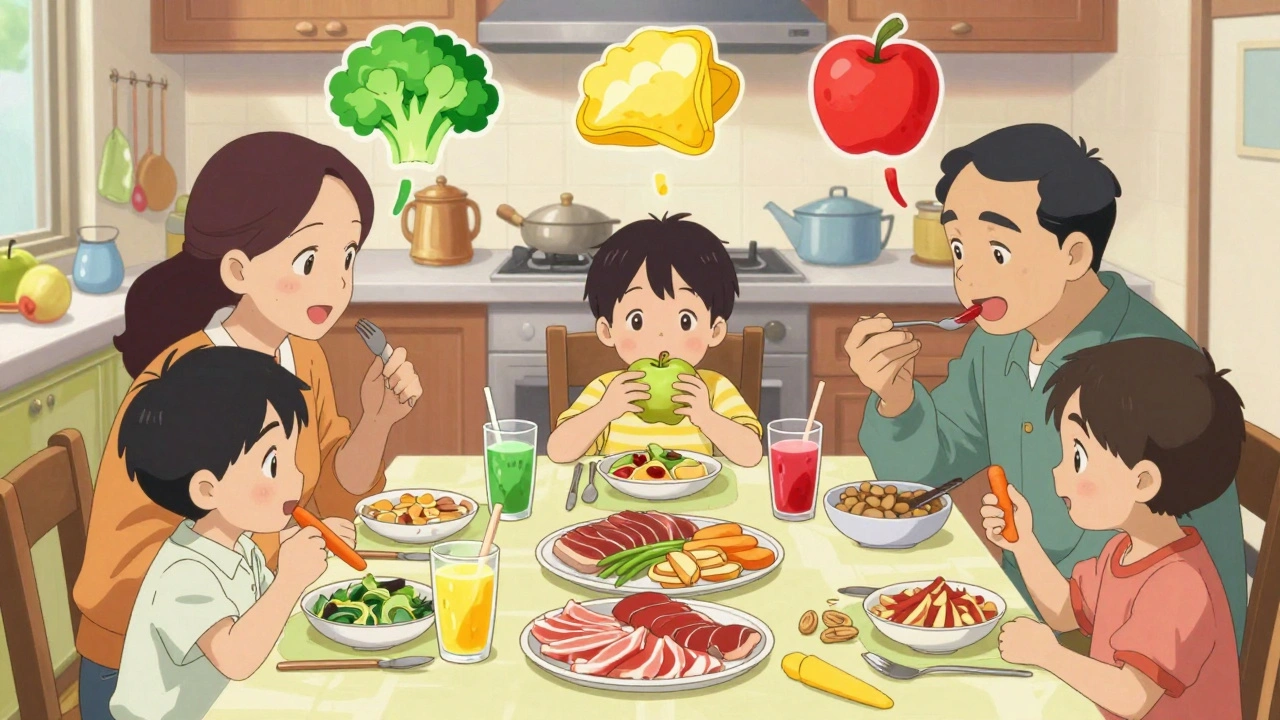
One in five children in the U.S. now has obesity. That’s not a distant statistic-it’s your neighbor’s kid, your child’s classmate, maybe even your own child. And it’s not just about weight. It’s about sleep, mood, energy, and long-term health. The good news? Childhood obesity isn’t inevitable. And the best way to turn it around isn’t with diets or pills-it’s with your family.
Why Family-Based Treatment Is the Gold Standard
For decades, doctors tried treating childhood obesity by focusing only on the child: eat less, move more, keep a food diary. It rarely worked. Kids don’t live in isolation. They eat what’s served at home, watch TV while snacking, and copy how their parents behave. If Mom’s drinking soda every night or Dad’s sitting on the couch after work, the child learns that’s normal. Family-based behavioral treatment (FBT) flips the script. Instead of blaming the child, it changes the whole environment. Research since the 1980s, led by Dr. Leonard Epstein at the University at Buffalo, shows FBT works better than any other method. A major 2023 trial in JAMA Network Open followed 306 families for two years. Kids in FBT lost 12.3% more of their excess weight than those in usual care. Parents lost weight too-5.7% on average. Even siblings who weren’t directly in the program improved by 7.2%. This isn’t magic. It’s science. FBT treats the family as the system that needs to change-not just the child.What Happens in a Family-Based Treatment Program?
Most FBT programs run for 6 to 24 months and include 16 to 32 sessions. You don’t need to travel to a specialty clinic. The most successful programs now happen right in your pediatrician’s office, led by trained health coaches. Here’s what you’ll actually do:- The Stoplight Diet: Foods are grouped into three colors. Green = eat freely (fruits, veggies, whole grains). Yellow = eat in moderation (dairy, lean meats, nuts). Red = eat sparingly (sugary drinks, fried foods, processed snacks). This isn’t about banning food-it’s about balance. Studies show kids on this plan reduce their percentage overweight by nearly 10% in just six months.
- 60 minutes of movement daily: It doesn’t have to be soccer practice. Dancing in the kitchen, walking the dog, riding bikes after dinner-any activity that gets the heart pumping counts. The goal is consistency, not intensity.
- Food and activity journals: Families track what they eat and how they move for a week at a time. Not to judge, but to spot patterns. Are snacks happening after screen time? Are meals rushed because everyone’s running late?
- Parenting skills training: Learning how to say “no” without a fight, how to praise effort over results, and how to set limits without guilt. It’s not about being strict-it’s about being clear and calm.
- Social facilitation: Planning how to handle parties, school events, and holidays without falling off track. Maybe it’s bringing a healthy dish to share, or agreeing on one treat per outing.
Why This Works Better Than Child-Only Programs
A 2019 review by the American Psychological Association analyzed 37 studies. The results were clear: when parents are involved, kids lose 0.55 standard deviations more weight than in programs that only target the child. That’s not a small difference-it’s the difference between losing 10 pounds and losing 25. Why? Because kids don’t control the grocery cart. They don’t pick the TV shows. They don’t decide when dinner is served. Parents do. When parents change their own habits, kids follow-not because they’re told to, but because the environment changes. And here’s something surprising: when one child in the family starts FBT, siblings often lose weight too-even if they weren’t the focus. That’s because the whole household eats better, moves more, and sleeps better. It’s a ripple effect.What About Cost? Is It Worth It?
You might think this sounds expensive. But here’s the truth: FBT costs about $3,200 per family over two years. That’s less than a new smartphone. Compare that to specialty clinic care, which averages $4,100-and often has longer wait times and harder access. Medicare and Medicaid now cover intensive behavioral therapy for obesity (code G0447). Each 15-minute session is reimbursable. Yet, fewer than 5% of eligible kids are getting it. Why? Because most pediatric offices haven’t integrated it into their workflow. The good news? Programs that embed FBT into regular check-ups have 87% completion rates. That’s way higher than specialty clinics, where only 63% of families stick with it. If your doctor doesn’t offer it, ask. Demand it. The infrastructure is there-it just needs to be used.
Early Intervention Is Everything
Waiting until a child is severely obese makes treatment harder. The American Academy of Pediatrics now recommends starting FBT as early as age 4 or 5-even before a child hits the 95th percentile on the growth chart. If your child is on a rising weight trajectory, don’t wait for them to become “overweight.” Dr. Stephen Cook from the University of Rochester puts it bluntly: “If you make a slight change now, you will have a much better long-term projection for the child than when they have severe obesity later and small changes won’t matter as much.” The earlier you start, the easier it is. A 5-year-old learning to choose an apple over a cookie is more likely to keep that habit into adulthood than a 14-year-old trying to undo years of habits.Barriers and How to Overcome Them
FBT isn’t perfect. It’s not easy. Here are the biggest hurdles-and how to get past them:- Scheduling conflicts: 38% of families struggle to find time. Solution: Treat sessions like doctor’s appointments-non-negotiable. Even 30 minutes a week makes a difference.
- Parental resistance: 29% of parents don’t want to change their own habits. Solution: Start small. Swap one sugary drink for water. Take a 10-minute walk after dinner. You don’t have to be perfect-you just have to show up.
- Cost and access: Low-income families, especially Black and Hispanic households, are disproportionately affected by obesity but underrepresented in FBT programs. Community health centers and school-based programs are starting to fill this gap. Ask your local health department.
- Cultural food norms: Some families worry FBT means giving up traditional meals. It doesn’t. The Stoplight Diet works with any cuisine. Beans and rice? Green. Fried plantains? Yellow. Sweetened tea? Red. Adapt, don’t abandon.
What Doesn’t Work
Don’t waste time on these:- Weight-loss supplements for kids
- Extreme diets or fasting
- Shaming or blaming
- Only focusing on the child
- Waiting to see if they “grow into it”

What You Can Do Today
You don’t need to wait for a formal program to start. Here’s how to begin right now:- Remove sugar-sweetened drinks. That single change can drop a child’s BMI by 1.0 unit in 12 months.
- Have at least three family meals a week without screens. This lowers obesity risk by 12%.
- Limit screen time to under two hours a day. It’s linked to a 0.8 BMI unit reduction.
- Keep fruits and veggies visible and easy to grab. Put a bowl of apples on the counter.
- Move together. Walk after dinner. Dance while cooking. Play tag in the yard.
- Ask your pediatrician: “Do you offer family-based obesity treatment?” If not, ask how to get it.
What’s Next for FBT?
New research is making FBT even better. The National Institutes of Health is funding a $4.2 million study testing Family Systems Therapy-looking at how family communication, boundaries, and emotional support affect weight outcomes. Early results show that when families talk more openly and support each other’s goals, weight loss sticks longer. Digital tools are also helping. Apps that let families log meals, track steps, and get reminders are boosting engagement by 32%. Some programs now mix in-person sessions with app-based coaching-giving families flexibility without losing support. The future isn’t about more pills or surgery. It’s about better support. The 2023 Inflation Reduction Act now funds community obesity prevention programs. Insurance coverage is expanding. Pediatricians are being trained. Change is coming-but it starts in your home.Final Thought
Childhood obesity isn’t a failure of willpower. It’s a failure of systems. The food environment, the screen culture, the lack of time, the stress-all of it adds up. FBT doesn’t ask the child to fix it alone. It asks the family to fix it together. And that’s the most powerful thing about it: you’re not just helping your child lose weight. You’re helping your whole family live better.What is the Stoplight Diet and how does it work for kids?
The Stoplight Diet is a simple food classification system used in family-based obesity treatment. Green foods (like fruits, vegetables, and whole grains) can be eaten freely. Yellow foods (like dairy, lean meats, and nuts) should be eaten in moderation. Red foods (like sugary drinks, fried foods, and processed snacks) should be eaten sparingly. It’s not about banning foods-it’s about teaching balance. Studies show kids on this plan reduce their excess weight by nearly 10% within six months, and families find it easier to follow than strict diets.
Can family-based treatment help siblings who aren’t overweight?
Yes. In a major 2023 trial, siblings who weren’t directly in the program still improved their weight outcomes by 7.2% compared to siblings in control families. When the whole household eats healthier, moves more, and reduces screen time, everyone benefits-even those not targeted by the treatment. This makes FBT a powerful tool for families with multiple children.
Is family-based treatment covered by insurance?
Yes. Medicare and Medicaid cover intensive behavioral therapy for obesity (CPT code G0447) for children and adults. Each 15-minute session is reimbursable when delivered by a qualified provider. However, only about 5% of eligible children are currently receiving it, mostly because pediatric offices haven’t integrated the service into routine care. Ask your child’s doctor if they offer it-or ask how to get it added.
At what age should I start family-based treatment for my child?
The American Academy of Pediatrics recommends starting as early as age 4 or 5, even before a child reaches the 95th percentile on growth charts. Early intervention is key because habits formed in early childhood are easier to change. Waiting until a child is severely obese makes treatment harder and less effective. If your child is on a rising weight trend, don’t wait for a diagnosis-act now.
What if my child has severe obesity? Is FBT still enough?
For children with BMI ≥120% of the 95th percentile, FBT is still the first step-but it may not be enough on its own. The 2023 AAP guidelines say that about 40% of these children won’t lose 5% of their weight with lifestyle changes alone. In those cases, doctors may add medications approved for adolescents or, in rare cases, consider metabolic surgery. But FBT should still be part of the plan-it helps with long-term maintenance and mental health.
How can I make FBT work if I have a busy schedule?
Start small. You don’t need 60-minute sessions or perfect meals. Swap one sugary drink for water. Take a 10-minute walk after dinner. Have one screen-free meal a week. The goal is consistency, not perfection. Many successful programs now combine in-person coaching with app-based tracking, which fits better into busy lives. Even 30 minutes a week of focused family time around food and movement can make a difference over time.







Posts Comments
Lynette Myles December 6, 2025 AT 09:41
The Stoplight Diet? More like a government psyop to normalize processed food substitution. They don't want you to know real nutrition comes from meat, fat, and silence.
James Moore December 7, 2025 AT 02:05
Let us not forget-the American family, the bedrock of civilization, has been systematically undermined by corporate agribusiness, media saturation, and the erosion of parental authority! We have traded home-cooked meals for neon-colored, sugar-laced, algorithmically engineered poison-sold as ‘convenience’-and now we wonder why our children are bloated, listless, and spiritually hollow? This is not obesity-it is cultural surrender! The solution? Reclaim the kitchen. Reassert the patriarchal structure. Restore the dinner table as a temple of discipline, not a battleground of passive-aggressive snack requests. And for God’s sake-turn off the screens. They are not ‘educational.’ They are neural pacifiers.
Laura Saye December 8, 2025 AT 06:38
There's something deeply healing about framing this as a family system issue rather than an individual failing. When we stop pathologizing the child and start examining the relational ecology-the rhythms of meals, the unspoken tensions around food, the emotional voids filled with snacks-we begin to see obesity not as a symptom of laziness, but as a language of unmet needs. FBT doesn’t just change habits; it rebuilds trust. And that’s the real intervention.
Krishan Patel December 9, 2025 AT 22:36
You people are pathetic. In India, we don’t need ‘programs’-we have grandparents who cooked real food and made kids walk to school. You’ve turned parenting into a corporate consulting gig. Stop outsourcing responsibility to ‘health coaches’ and just feed your kids roti and dal. No one needs a ‘stoplight’ to know that candy is not food. You’ve been manipulated by Big Pharma and their insurance middlemen.
sean whitfield December 11, 2025 AT 11:01
Wow. So the solution to childhood obesity is… more parenting? Groundbreaking. Next they’ll tell us water is wet and the sky is blue. I’m sure this is in the 2024 Democrat Family Wellness Act. Send me the form. I’ll fill it out between my Zoom yoga and my organic kale smoothie.
Carole Nkosi December 13, 2025 AT 07:33
This is what happens when you let capitalism dictate your child’s plate. The same corporations that sell the soda are the ones funding the ‘research’ that says ‘balance’ is enough. They want you to think you’re doing something good while they keep raking in billions. FBT is just a gentler leash.
Manish Shankar December 14, 2025 AT 18:56
Respectfully, the empirical evidence presented herein is both robust and commendable. The integration of behavioral modification within familial contexts represents a paradigmatic shift from individual-centric interventions to systemic, ecological approaches. It is imperative that healthcare delivery models be restructured to accommodate such evidence-based protocols at the primary care level, thereby ensuring equitable access across socioeconomic strata.
luke newton December 15, 2025 AT 09:18
My kid’s school just banned cupcakes. They’re calling it ‘health.’ I call it tyranny. You want to fix obesity? Fix the schools. Fix the lunch lines. Fix the fact that no one has time to cook anymore because everyone’s working two jobs just to afford rent. Don’t blame the mom for buying cereal. Blame the system that made her choose between gas and groceries.
an mo December 16, 2025 AT 21:54
Let’s quantify the emotional labor here. 7.2% weight reduction in siblings? That’s not ‘ripple effect’-that’s unacknowledged labor. The non-targeted child is internalizing dietary discipline, suppressing cravings, and modeling restraint without reward. This isn’t family wellness-it’s emotional extraction. Who’s compensating the kid who eats salad while their sibling gets the treat? The system is exploiting empathy as a tool.
aditya dixit December 18, 2025 AT 01:34
Start with one change. One. Not a whole program. Swap soda for sparkling water. Walk after dinner. Turn off the TV during meals. You don’t need to be perfect-you just need to show up. And if you miss a day? That’s okay. Just show up again tomorrow. This isn’t a race. It’s a rhythm. And rhythm, over time, becomes habit. Habit becomes identity. Identity becomes legacy.
Mark Ziegenbein December 19, 2025 AT 10:26
I mean… this whole thing feels like a Netflix docu-series sponsored by Whole Foods. ‘Oh no! Our kids are fat! Let’s hire a life coach who uses color-coded charts and tells us to dance in the kitchen while we cry into our quinoa!’ Meanwhile, the real problem is that we live in a society that rewards burnout, monetizes childhood, and treats food like a moral test. You can’t fix systemic collapse with a sticky note on the fridge. But hey-great podcast episode. I’ll subscribe.
Juliet Morgan December 20, 2025 AT 05:27
i’ve been doing the stoplight thing with my 6yo and honestly? it’s changed everything. no more battles at dinner. she picks the green stuff first. i didn’t even have to yell. just put the fruit out and let her choose. it’s not perfect, but it’s peaceful. and that’s more than i had before.
Norene Fulwiler December 20, 2025 AT 22:20
As a Nigerian-American mom, I’m so glad this doesn’t ask us to abandon our food. My kids still get jollof rice-but we use less oil, add more veggies, and skip the sugary drinks. The stoplight works with culture, not against it. Thank you for seeing us.
Write a comment