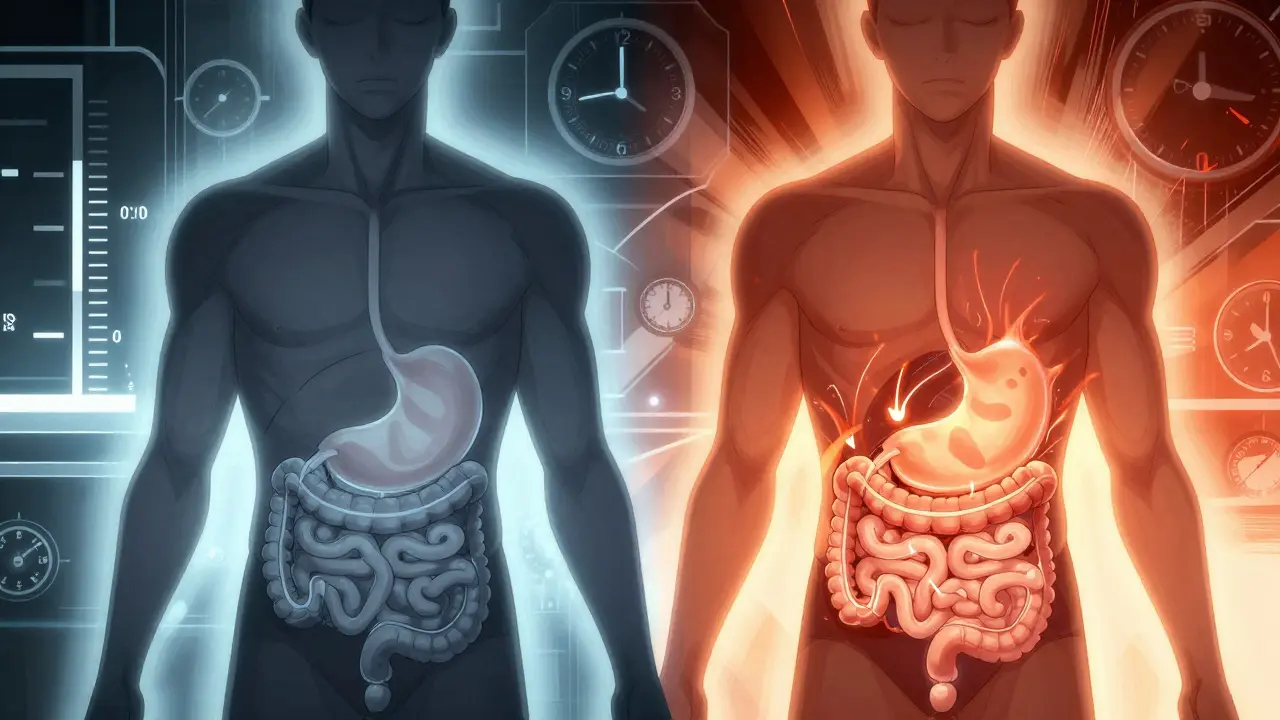
Imagine taking a life-saving pill after a heavy breakfast versus on an empty stomach. For some drugs, that meal could double the amount of medicine entering your bloodstream. For others, it might block half of it from being absorbed at all. This isn't just a minor detail; it is the difference between a treatment working perfectly or failing completely. The same principle applies to athletes wondering whether to eat before a workout. The body operates under two distinct metabolic modes: the fasted state, defined as 8-12 hours without caloric intake, and the fed state, occurring within 2-4 hours after eating.
In both pharmaceutical development and exercise science, relying on only one of these conditions creates blind spots. Regulatory bodies like the FDA and EMA now mandate dual-condition testing because physiological responses are not static-they shift dramatically based on what’s in your gut. Understanding why both states matter reveals how we optimize drug safety and athletic performance.
The Physiology of the Gut: Empty vs. Full
To understand why testing conditions matter, you have to look at what happens inside the gastrointestinal tract. The environment changes drastically depending on whether you have eaten recently. When you are in a fasted state, your stomach is relatively quiet. Studies using SmartPill capsules (Koziolek et al., 2016) show that gastric residence time-the time food or pills stay in the stomach-averages just 13.7 minutes when fasting. The pH level hovers around a median minimum of 2.5, which is acidic but manageable for many compounds.
Now, imagine consuming a high-fat meal. The dynamics flip. Gastric residence time jumps to an average of 78.3 minutes. The pH drops further to a median minimum of 1.5, creating a harsher acidic environment. More importantly, the pressure variations during gastric emptying change significantly. In a fasted state, pressures range widely from 30 to 304 mbar, reflecting irregular motility complexes. In a fed state, pressures consistently exceed 240 mbar, indicating a more controlled, slower release of contents into the small intestine.
These physical changes dictate how substances move through your body. A drug designed to dissolve quickly might sit in the stomach for over an hour if taken with food, delaying its effect. Conversely, a nutrient meant to fuel immediate energy might be processed too slowly if the gut is overwhelmed by a large meal. This is why standardized testing protocols are non-negotiable in scientific research.
Bioequivalence Standards: The Regulatory Requirement
In the pharmaceutical industry, bioequivalence ensures that a generic drug performs identically to the brand-name original. However, "identically" depends heavily on context. The FDA established guidance for food-effect bioavailability studies in 1997, recognizing that gastrointestinal conditions impact drug absorption. By 2023, dual-condition testing became mandatory for most new drug applications.
The stakes are high. Food can increase the bioavailability of certain lipophilic (fat-loving) compounds by 200-300%. Fenofibrate, a medication used to lower cholesterol, is a prime example. Taking it with food dramatically improves how much of the drug enters the bloodstream. On the flip side, other drugs like griseofulvin see their absorption decrease by 50-70% when taken with meals. If researchers only tested griseofulvin in a fasted state, they might recommend a dose that turns out to be ineffective for patients who take it with dinner.
To standardize this, the FDA defines a specific "high-fat, high-calorie meal" for fed-state studies. This meal must contain approximately 800-1,000 calories, with 500-600 of those calories coming from fat (about 150% of the total caloric content). This rigorous standard allows scientists to compare results across different trials. Without it, data would be inconsistent, making it impossible to determine safe dosing guidelines.
| Parameter | Fasted State | Fed State (High-Fat Meal) |
|---|---|---|
| Gastric Residence Time | ~13.7 minutes | ~78.3 minutes |
| Intragastric pH (Median Min) | 2.5 | 1.5 |
| Pressure Variations | 30-304 mbar | >240 mbar (consistent) |
| Caloric Intake | None (8-12 hrs prior) | 800-1,000 kcal |
| Fat Content | 0% | ~500-600 kcal from fat |
Exercise Physiology: Fueling Performance vs. Adaptation
While pharma focuses on drug delivery, exercise science uses these states to manipulate how the body burns fuel. The debate here is less about safety and more about optimization. Should you train fasted to burn more fat, or fed to perform better? The answer, supported by a 2018 meta-analysis by Lundsgaard et al., is that both serve different purposes.
In a fasted state, your body has depleted its glycogen stores overnight. To compensate, it increases lipolysis-the breakdown of fats for energy. Research shows that free fatty acid (FFA) availability is 30-50% higher in fasted states compared to fed states. This triggers molecular adaptations, such as upregulating PGC-1α expression by 40-50%, which supports mitochondrial biogenesis (the creation of new energy-producing mitochondria). For sedentary individuals looking to improve metabolic health, this adaptation can be beneficial.
However, there is a trade-off. High-intensity performance relies on glycogen, not fat. Fed-state protocols typically involve consuming 1-4 g/kg of carbohydrate 1-4 hours before exercise. This ensures muscles have ample fuel. The Lundsgaard meta-analysis found that fed-state exercise enhances prolonged aerobic performance by 8.3%. If you are training for a marathon or a high-intensity interval session, skipping pre-workout nutrition can reduce your work capacity by 12-15%.
The key insight is that fasted training may enhance fat oxidation adaptations but should be periodized to avoid compromising high-intensity performance. Dr. John Hawley, Professor of Exercise and Nutrition, notes that while fasted training potentiates fat burning, it must be balanced with fed sessions to maintain peak power output.

Why Dual-Condition Testing Is Non-Negotiable
You might wonder if we can’t just pick one "best" condition. The problem is that human variability is too great. In pharmaceuticals, the European Medicines Agency (EMA) requires fed-state testing for all oral drugs where the food effect is unknown. A 2019 analysis of 1,200 New Drug Applications revealed that 35% of drugs show clinically significant food interactions. Ignoring the fed state would leave millions of patients with incorrect dosing instructions.
In exercise science, individual responses vary wildly. A 2022 Reddit survey of fitness enthusiasts showed that 68% reported better endurance performance when fed, while 42% preferred fasted training for fat loss. However, 31% of those trying fasted training reported dizziness, and 22% noted reduced workout intensity. Genetic factors also play a role; a 2022 study found that variants in the PPARGC1A gene explain 33% of the variability in how people respond to fasted versus fed training.
Furthermore, demographic differences matter. Recent FDA draft guidance highlights that Asian subjects exhibit 18-22% slower gastric emptying times than Caucasian subjects in fed conditions. This means a "standard" fed-state protocol might not reflect reality for diverse populations. Dual-condition testing, combined with diverse participant pools, helps mitigate these risks.
Practical Implementation: Controlling the Variables
Whether you are designing a clinical trial or structuring a training plan, controlling variables is crucial. In pharmaceutical trials, adherence to meal composition standards must be within ±10% of specified calorie and macronutrient values. Even slight deviations can skew bioavailability data.
For exercise studies, control goes beyond just food. Researchers must account for sleep duration (minimum 7 hours), hydration status (urine specific gravity <1.020), and pre-test activity (a 24-hour sedentary period). These factors influence baseline metabolism and can confound results if not standardized.
If you are an athlete applying this knowledge, start by identifying your goal. Are you aiming for maximal power output? Eat a carbohydrate-rich meal 2-3 hours before training. Are you focusing on metabolic flexibility and fat adaptation? Consider occasional fasted morning sessions, but monitor for signs of fatigue or dizziness. Listen to your body, as individual tolerance varies significantly.
What is the definition of a fasted state in clinical trials?
In clinical trials, a fasted state is typically defined as having no caloric intake for 8 to 12 hours prior to the administration of a drug or test. Only water is permitted during this period to ensure the gastrointestinal tract is empty and baseline metabolic conditions are stable.
How does food affect drug absorption?
Food can either increase or decrease drug absorption depending on the drug's chemical properties. Lipophilic drugs may see bioavailability increase by 200-300% due to bile secretion aiding dissolution. Conversely, some drugs experience delayed gastric emptying, reducing their absorption rate by 50-70%. This variability necessitates testing in both fed and fasted states.
Is fasted cardio better for fat loss?
Fasted cardio increases acute fat oxidation during the workout by raising free fatty acid availability. However, long-term body composition changes depend on total daily energy balance. While fasted training may offer metabolic adaptations, studies show no significant difference in overall fat loss compared to fed training over several weeks if calories are matched.
What constitutes a "high-fat meal" in bioequivalence studies?
According to FDA guidelines, a high-fat meal for bioequivalence studies contains approximately 800-1,000 calories, with 500-600 calories derived from fat (about 50-60% of total calories). The remaining calories come from carbohydrates and protein. This standardized meal ensures consistent gastric emptying delays across study participants.
Why do regulatory agencies require both fasted and fed testing?
Regulatory agencies require dual testing because patients do not always take medications exactly as prescribed regarding food intake. Since 35% of drugs show clinically significant food interactions, testing both conditions ensures that labeling instructions accurately reflect how food impacts efficacy and safety, preventing under-dosing or toxicity.