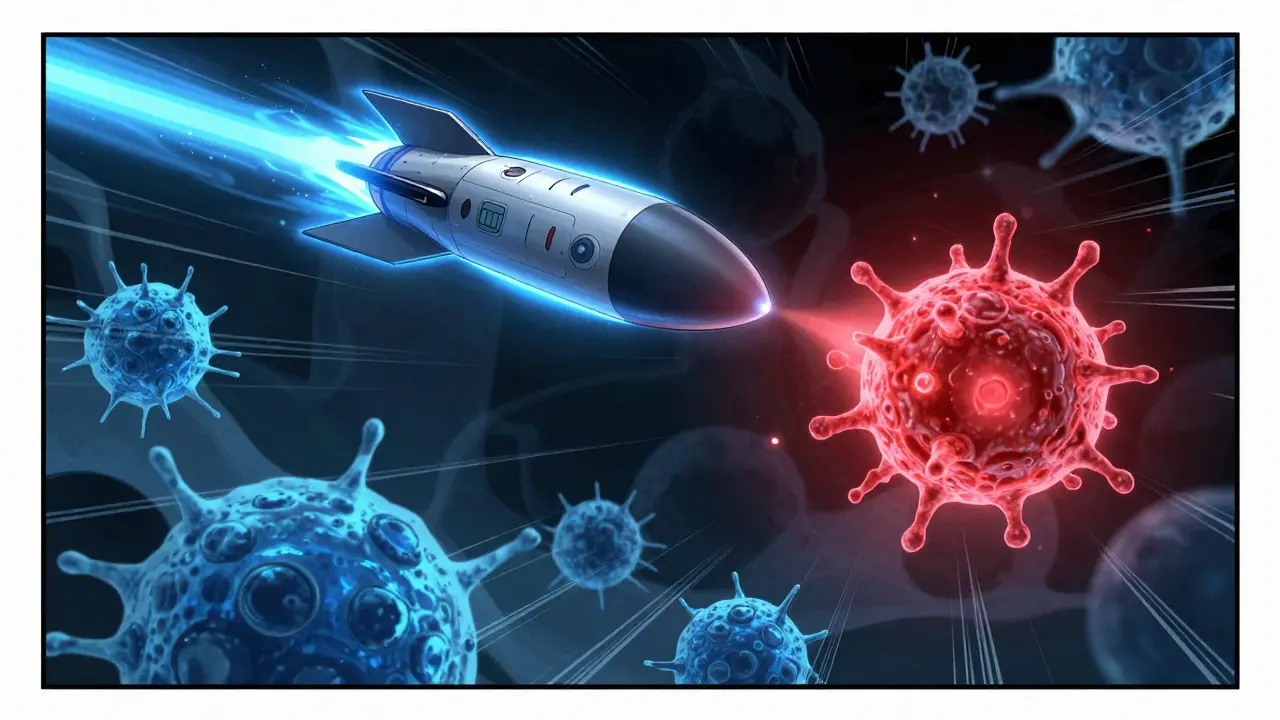
Imagine treating cancer not by blasting the entire body with toxic chemicals, but by sending a precise missile to hit only the cells that are out of control. That is exactly what targeted therapy is a type of cancer treatment that uses drugs or other substances to precisely identify and attack cancer cells based on their specific molecular characteristics while minimizing damage to normal cells. It marks a massive shift from the "one-size-fits-all" approach of traditional chemotherapy to a personalized strategy known as precision medicine is a medical approach that tailors treatment to individual characteristics of each patient's tumor, often using genetic information.
If you or a loved one has been diagnosed with cancer, you have likely heard these terms thrown around in doctor’s offices or online forums. But what do they actually mean for your treatment plan? The short answer is that targeted therapies look at the unique genetic fingerprint of your tumor to find the best drug match. This article breaks down how this works, who qualifies, and what you need to know about costs and side effects.
How Targeted Therapy Differs from Chemotherapy
To understand why targeted therapy is such a big deal, you first need to see how it differs from standard care. Traditional chemotherapy is like a carpet bomb; it attacks any cell that divides quickly. This includes cancer cells, but also healthy cells like those in your hair follicles, gut lining, and bone marrow. That is why chemo often causes severe nausea, hair loss, and fatigue.
Targeted therapy, on the other hand, acts more like a sniper. It focuses on specific molecules or genes that drive cancer growth. These drugs block the signals that tell cancer cells to multiply or survive. Because they ignore healthy cells that don’t have those specific targets, the side effects are usually much milder. For example, patients on targeted therapies experience severe (grade 3-4) adverse events at rates of 15-30%, compared to 50-70% with conventional chemotherapy.
The history of this approach started gaining traction early in the 21st century. The first major breakthrough was imatinib (Gleevec), approved by the FDA in 2001 for chronic myeloid leukemia. Before Gleevec, one-year survival rates were only 20-30%. With this targeted drug, those rates jumped to 89%. Today, 73% of new cancer drug approvals by the FDA are targeted therapies, showing just how dominant this model has become.
The Role of Tumor Genetics and Biomarkers
You cannot use targeted therapy without knowing the genetic makeup of the tumor. This is where biomarker testing is the process of analyzing tumor tissue to identify specific genetic mutations or protein expressions that can guide treatment decisions. becomes essential. Doctors don't just guess which drug might work; they test the tumor for specific changes in DNA.
There are two main types of genetic alterations doctors look for:
- Gain-of-function mutations: These occur in oncogenes (like EGFR, ALK, or BRAF) and act like a gas pedal stuck to the floor, telling the cell to grow uncontrollably. About 92% of approved targeted therapies address these because it is easier to block an overactive signal than to fix a broken one.
- Loss-of-function mutations: These happen in tumor suppressor genes (like TP53 or PTEN). Think of these as brakes that have failed. Restoring function to lost tumor suppressors is pharmacologically difficult, so there are fewer drugs targeting these yet.
The foundation for mapping these genetic changes came from projects like The Cancer Genome Atlas (TCGA), launched in 2006. This initiative mapped genomic alterations across 33 cancer types, helping scientists identify which mutations matter most. Now, comprehensive genomic profiling is becoming standard practice for many advanced cancers.
Getting Tested: What to Expect
If your doctor suggests targeted therapy, the next step is almost always a biopsy. They will take a sample of your tumor tissue and send it to a lab for next-generation sequencing (NGS) is a high-throughput technology used to sequence large amounts of DNA simultaneously, allowing for the identification of multiple genetic mutations in a single test.. Popular commercial panels include FoundationOne CDx and MSK-IMPACT, which analyze anywhere from 300 to 500 cancer-related genes.
Here is what the process typically looks like:
- Tissue Sample: The lab needs about 20-50ng of DNA with at least 20% tumor cellularity for reliable results. If the initial biopsy doesn't have enough tumor cells, they may need to repeat it.
- Turnaround Time: According to MD Anderson Cancer Center, results usually take 14-21 days. This wait can feel agonizing, but accuracy is critical.
- Cost: As of 2023, these tests cost approximately $5,500. While expensive, insurance often covers them if the test is deemed medically necessary for treatment selection.
In some cases, if a tissue biopsy is too risky or impossible, doctors might use a liquid biopsy is a non-invasive blood test that detects circulating tumor DNA (ctDNA) shed by tumors into the bloodstream.. Guardant Health’s Guardant360, approved by the FDA in 2023, allows doctors to detect resistance mutations 3-6 months earlier than imaging scans can show tumor growth. This dynamic monitoring helps switch treatments before the cancer progresses visibly.

Success Stories and Real-World Outcomes
When a match is found between the mutation and the drug, the results can be dramatic. Let’s look at a few specific examples:
| Cancer Type / Mutation | Targeted Drug | Response Rate / Outcome | Chemotherapy Comparison |
|---|---|---|---|
| Lung Cancer (RET mutation) | Selpercatinib | 85% overall response rate | 30-40% response rate |
| Multiple Tumors (NTRK fusion) | Larotrectinib | 75% objective response rate | Variable, often lower |
| Lung Cancer (EGFR mutation) | Osimertinib | 18.9 months progression-free survival | 10.2 months progression-free survival |
| Breast Cancer (HER2-positive) | Trastuzumab | Significantly improved survival | Higher toxicity, lower efficacy |
Notice the NTRK fusion example. Larotrectinib works regardless of where the tumor is located-lung, brain, thyroid, etc. This is called a "histology-agnostic" approval, meaning the genetic mutation matters more than the organ origin. The NCI-MATCH trial showed that 35% of patients with rare cancers responded to targeted therapies based on these molecular alterations rather than tumor location.
The Challenges: Resistance and Access
It isn’t all good news. One of the biggest hurdles is tumor heterogeneity. A tumor isn’t a uniform mass; different parts of it can have different mutations. In fact, 63% of metastatic cancers show significant spatial heterogeneity. A biopsy from one spot might miss the mutation driving growth in another spot.
Then there is the issue of resistance. Even when a targeted drug works initially, cancer cells are clever. They evolve. Between 70-90% of patients develop acquired resistance within 9-14 months. The cancer finds a workaround, and the drug stops working. This is why combination therapies-using two targeted drugs or mixing targeted therapy with immunotherapy-are a hot area of research.
Access is another major pain point. Only about 13.8% of cancer patients currently qualify for genomically matched therapies, according to AACR Project GENIE data. Why so low? Many tumors simply don’t have "actionable" mutations yet. We still lack drugs for many common mutations. Additionally, adoption varies wildly by region. A 2023 ESMO survey found that 65% of advanced cancer patients in the US get genomic profiling, compared to only 22% in Europe and 8% in Asia.

Financial Toxicity and Insurance Hurdles
Let’s talk money, because it is a huge stressor. Targeted therapies are expensive. The average cost ranges from $15,000 to $30,000 per month, compared to $5,000-$10,000 for generic chemotherapy. A University of Chicago study found that 40% of patients on targeted therapies report financial hardship related to treatment.
Insurance denials are common. In ASCO’s 2022 survey, 55% of patients cited insurance denials for genomic testing. Some insurers argue that a specific targeted drug is "not standard" for a particular cancer type, even if the genetic mutation matches. For instance, a patient with an NTRK fusion might be denied larotrectinib coverage if their insurer hasn’t updated its policies to recognize histology-agnostic approvals. Patients often have to fight for prior authorizations, waiting weeks or months while their disease progresses.
Who Is a Good Candidate?
Not everyone needs or benefits from targeted therapy. Here is a quick checklist to discuss with your oncologist:
- Advanced or Metastatic Cancer: Targeted therapies are most commonly used when cancer has spread and surgery is no longer an option.
- Actionable Mutation Found: Your tumor must have a specific genetic change that a drug can target. If your NGS report says "no actionable variants," targeted therapy may not be an option.
- Specific Cancer Types: Lung, breast, colon, melanoma, and leukemia have the most established targeted options. Rare cancers are increasingly being treated this way too, thanks to basket trials.
- Good Performance Status: You need to be strong enough to handle the treatment, though targeted therapy is generally better tolerated than chemo.
If you fall into these categories, ask your doctor about a molecular tumor board is a multidisciplinary team of experts including oncologists, pathologists, and genetic counselors who review complex cancer cases to recommend personalized treatment strategies.. These boards, now present in 89% of NCI-designated cancer centers, help interpret complex genomic reports and find clinical trials if standard options are exhausted.
Future Directions: AI and New Targets
The field is moving fast. Artificial intelligence is starting to play a role in interpreting genomic data. IBM Watson for Oncology, for example, showed 93% concordance with human molecular tumor boards in a 2024 study. AI can help sift through thousands of genetic variations to find the needle in the haystack faster.
Researchers are also tackling the "undruggable" targets. Dr. Levi Garraway, President of R&D at Genentech, notes that tumor suppressor genes account for 80% of driver mutations but have no approved therapies yet. Breaking this barrier could double the number of eligible patients. Meanwhile, initiatives like the NCI’s RESPOND program are working to reduce racial disparities in precision oncology, ensuring that diverse populations benefit from these advances.
Is targeted therapy better than chemotherapy?
For patients with specific biomarker-matched mutations, targeted therapy is often superior. It tends to have fewer severe side effects and higher response rates. For example, osimertinib reduced the risk of progression by 54% compared to chemotherapy in EGFR-mutant lung cancer. However, if your tumor lacks a targetable mutation, chemotherapy or immunotherapy may be more effective. It depends entirely on your tumor’s genetic profile.
How long does targeted therapy last?
The duration varies widely. Some patients respond for several years, turning cancer into a chronic condition. However, resistance is common. On average, 70-90% of patients develop resistance within 9-14 months. When resistance occurs, doctors may switch to a different targeted drug, combine therapies, or move to chemotherapy or immunotherapy.
Does insurance cover genetic testing for cancer?
Coverage varies. Many insurers cover next-generation sequencing (NGS) for advanced cancers, especially if it guides treatment decisions. However, prior authorization is often required. If denied, you can appeal or seek assistance from patient advocacy groups. The cost of testing is around $5,500, which is significantly less than the monthly cost of the drugs themselves.
What are the side effects of targeted therapy?
Side effects depend on the specific drug and target. Common issues include skin rashes, diarrhea, high blood pressure, and liver enzyme changes. Unlike chemotherapy, targeted therapy rarely causes hair loss or severe nausea. Most side effects are manageable with dose adjustments or supportive medications.
Can I get targeted therapy if my cancer is early-stage?
Traditionally, targeted therapy was reserved for advanced stages. However, recent studies are exploring its use in early-stage settings to prevent recurrence after surgery. For example, adjuvant osimertinib is now approved for some early-stage NSCLC patients with EGFR mutations. Ask your oncologist if clinical trials or emerging guidelines apply to your case.