Bleeding Risk Assessment Tool
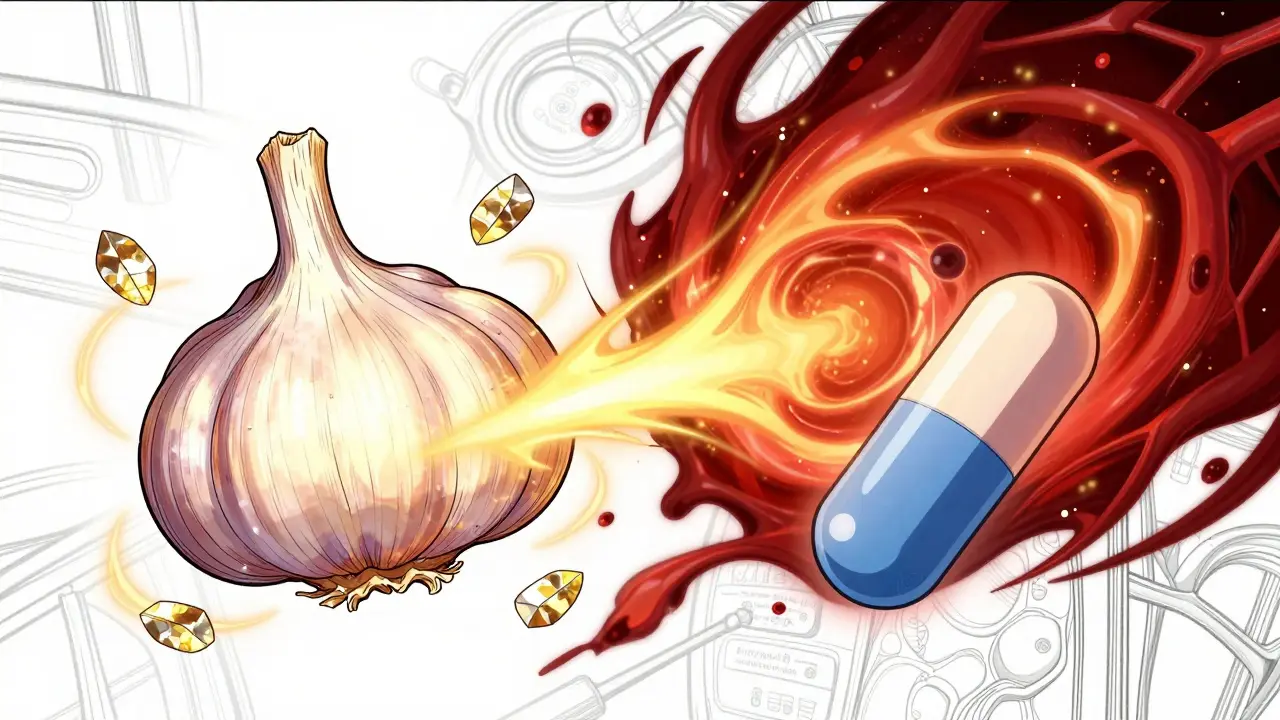
You might think of garlic as just a kitchen staple or a natural way to support your heart, but when you're taking blood thinners, it becomes a much more complex story. Many people reach for garlic capsules to lower their blood pressure or improve cholesterol, assuming that because it's "natural," it's inherently safe. However, combining high-dose garlic extracts with medications designed to prevent clots can create a dangerous synergy that makes your blood too thin, significantly increasing the risk of internal bleeding.
The Science of Why Garlic Thins Your Blood
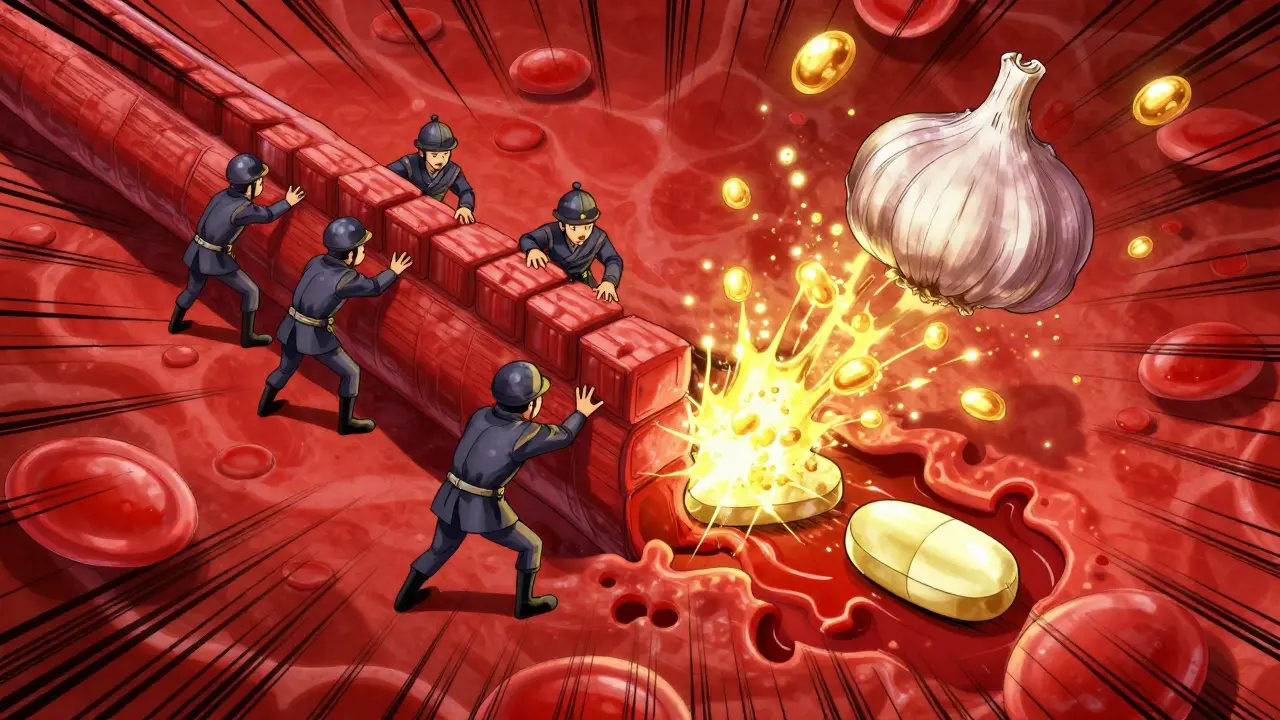
To understand the risk, we have to look at the chemistry. Garlic is a plant species (Allium sativum) containing sulfur-based compounds that act as natural antiplatelet agents. The real culprit in supplement form is a compound called ajoene is a sulfur-containing derivative that irreversibly inhibits platelet aggregation by blocking cyclooxygenase (COX) and fibrinogen receptors.
Essentially, ajoene tells your platelets-the tiny cells responsible for plugging leaks in your blood vessels-not to stick together. While this sounds great for preventing a heart attack, it's a problem if you're already taking an anticoagulant. When you add a supplement that stops platelets from working to a drug that slows down the clotting process, you're attacking the body's ability to stop bleeding from two different angles. This double-hit can lead to everything from a stubborn nosebleed to a life-threatening hemorrhage.
How Garlic Interacts With Common Blood Thinners
Not all blood thinners are the same, but garlic supplements can interfere with most of them. For those taking warfarin is a vitamin K antagonist used to prevent blood clots by inhibiting the synthesis of clotting factors , the interaction is particularly measurable. Research has shown that garlic can push the International Normalized Ratio (INR)-the measurement of how long it takes your blood to clot-up by 1.0 to 2.5 points. If your target INR is 2.0 to 3.0, a sudden jump to 4.0 or higher puts you in a high-risk zone for spontaneous bleeding.
It's not just the older drugs. Newer medications known as DOACs (Direct Oral Anticoagulants), such as apixaban, also interact with garlic's antiplatelet effects. Because garlic's inhibition of platelets is often irreversible, your body has to grow entirely new platelets before the effect wears off. This means the risk doesn't disappear the moment you stop taking the pill; it lingers for several days.
Comparing Garlic to Other Risky Supplements
Garlic isn't the only herbal supplement that can mess with your clotting. Many people take a "heart health stack" that includes fish oil or ginkgo, not realizing they are compounding their risk. While some supplements have a stronger effect on a per-milligram basis, garlic is dangerous because of how common it is and how long its effects last.
| Supplement | Mechanism | Relative Risk Level | Platelet Inhibition |
|---|---|---|---|
| Ginkgo Biloba | Strong antiplatelet | Highest | 30-50% |
| Garlic Supplements | Ajoene-driven inhibition | Moderate-High | 20-40% |
| Fish Oil (Omega-3) | Mild antiplatelet | Moderate | 10-20% |
| Ginseng | Variable effects | Moderate-Low | Low/Varies |
The Danger Zone: Surgery and Procedures
The most critical time to worry about garlic supplements is leading up to a medical procedure. Whether it's a major heart surgery or a simple dental cleaning, any cut or incision requires your blood to clot to heal. If you've been taking high-dose garlic, your platelets simply won't respond.
There are documented cases where patients experienced "generalized capillary ooze" during laparoscopic surgery, forcing surgeons to switch to open surgery because they couldn't stop the bleeding. In more severe cases, such as neurosurgery or prostate surgery, the inability to achieve hemostasis (stopping the flow of blood) can lead to hematomas or prolonged postoperative hemorrhage. Because many people don't view garlic as a "drug," they often forget to mention it during preoperative screenings, which leaves the surgical team in the dark.

Not All Garlic is Created Equal
If you're wondering if the garlic in your pasta is the same as the garlic in a bottle, the answer is: mostly, no. The risk is primarily tied to concentrated supplements. Raw garlic contains some antiplatelet properties, but the levels of ajoene are far lower than in processed oil macerates.
- Oil Macerates: These contain the highest concentrations of ajoene (0.5-1.0 mg/g) and pose the highest risk.
- Powdered Garlic: Lower concentrations (0.1-0.3 mg/g), but still significant when taken in high-dose capsules.
- Aged Garlic Extract: These typically have negligible ajoene levels and are generally considered lower risk, though they should still be discussed with a doctor.
The problem is that the supplement industry isn't strictly regulated. One brand's "standard dose" might be 15 times more potent than another's. This inconsistency makes it nearly impossible for a patient to self-calculate their risk based on the label alone.
Practical Steps for Staying Safe
If you are taking an anticoagulant, the safest bet is to avoid concentrated garlic supplements entirely. However, if you choose to use them or are already doing so, there are a few non-negotiable rules to follow:
- The 14-Day Rule: If you have a scheduled surgery or dental procedure, stop taking garlic supplements at least 14 days in advance. This gives your body enough time to produce a fresh batch of functioning platelets.
- Be Specific with Your Doctor: Don't just say you take "herbs." Tell your provider specifically that you use "garlic oil," "garlic extract," or "garlic pills."
- Monitor Your INR: If you're on warfarin, request more frequent blood tests when starting or changing the dose of any supplement.
- Watch for Red Flags: Keep an eye out for easy bruising, nosebleeds that won't stop, or blood in your stool or urine. These are signs that your blood is too thin.
Is eating fresh garlic in food dangerous for people on blood thinners?
Generally, using garlic as a seasoning in normal culinary amounts is considered safe for most people on anticoagulants. The danger lies in concentrated supplements (like oils and extracts) that provide doses equivalent to several cloves of garlic in a single pill, which significantly increases the concentration of ajoene in your system.
How long does it take for garlic's blood-thinning effect to go away?
Because ajoene inhibits platelets irreversibly, the effect lasts until your body creates new platelets. This recovery period typically takes about 7 to 10 days. This is why surgeons recommend stopping these supplements two weeks before a procedure.
Can I take aged garlic extract if I'm on warfarin?
Aged garlic extracts generally contain very little to no ajoene, making them a lower risk than garlic oil. However, you should still consult your doctor first, as any supplement can potentially affect how your medication is metabolized in the liver.
What are the signs that my garlic supplement is interacting with my medication?
Look for signs of excessive bleeding: frequent or heavy nosebleeds, bleeding gums when brushing teeth, bruising easily without a known cause, or prolonged bleeding from a small cut. If you notice these, contact your healthcare provider immediately.
Why is garlic considered a "high-risk" supplement by anesthesiologists?
Anesthesiologists categorize it as high-risk because of the potential for severe perioperative bleeding. If a patient's platelets are inhibited, the surgical team cannot easily stop bleeding during the operation, which can lead to complications like the need for emergency blood transfusions or unplanned open surgeries.






Posts Comments
Rebekah Korak May 2, 2026 AT 02:51
It's honestly fascinating how people just blindly trust whatever is in a bottle simply because it says 'natural' on the front, as if nature isn't full of poisons. We live in an era of cognitive dissonance where the desire for a 'holistic' lifestyle outweighs the basic biological reality that chemicals are chemicals, regardless of whether they come from a lab or a bulb of garlic. Most people aren't actually looking for health, they're looking for a narrative that makes them feel superior to the pharmaceutical complex while ignoring the actual biochemistry of platelet aggregation. This isn't just about garlic; it's about the systemic failure of the modern individual to understand the delicate equilibrium of the human body. If you can't grasp that a concentrated extract is fundamentally different from a clove in a pasta dish, you're essentially playing Russian roulette with your own circulatory system for the sake of a trend.
Tallulah Sandison May 2, 2026 AT 17:44
Stay safe evryone!! Always check wth ur doc before tryng new sups!
Srinivas Komakula May 2, 2026 AT 22:00
The emphasis on ajoene is a convenient distraction from the systemic pharmacological hegemony...!! These interactions are likely amplified by the clandestine addition of synthetic catalysts in mass-produced supplements to increase bioavailability...!! Why is the synergy between DOACs and herbal extracts not being scrutinized by an independent commission...!! The biological plausibility of 'irreversible inhibition' is being used to mask a larger pattern of iatrogenic destabilization...!!
Robert Cowley May 4, 2026 AT 17:01
Oh please, the 'danger' here is wildly exaggerated for effect. :P I've known people who basically live on garlic and warfarin and they're just fine. This is just another example of the medical establishment trying to scare us away from everything that doesn't have a patent attached to it. Absolute melodrama. 🙄
Sarah Mifsud May 6, 2026 AT 01:28
I've seen this happen in a clinic setting and it's realy scary when the bleeding won't stop. Many patients just dont think to mention their vitamins or herbs during the pre-op interview because they dont see them as medcine. It's so important to be thourough with the medical history!
Christina Lancey May 7, 2026 AT 00:36
It is helpful to remember that we can always work with our doctors to find safe alternatives that fit our lifestyle.
Leah Sentz May 8, 2026 AT 12:42
USA MADE supplements are the only ones I trust! 🇺🇸 These foreign warnings are just trying to keep us down! 😡💥 Keep your blood flowing the American way!! 🦅🇺🇸
Halle Dagley May 10, 2026 AT 05:58
The lack of rigourous oversight in the supplement industry is a disgrace to the Greatest Nation on Earth. It is imperitive that we mandate strikter standards for all domestic produucts to protect our citizins. 🇺🇸
Preety Singh May 11, 2026 AT 11:07
The sheer lack of sophistication in the general public's approach to nutraceuticals is quite telling. One would assume the distinction between a culinary ingredient and a pharmacological extract would be common knowledge among the educated elite
Lando Neal May 11, 2026 AT 12:53
Wow... this is some really intense stuff!!! I never knew garlic could do that to your blood...!! Thanks for sharing this info...!!
Write a comment