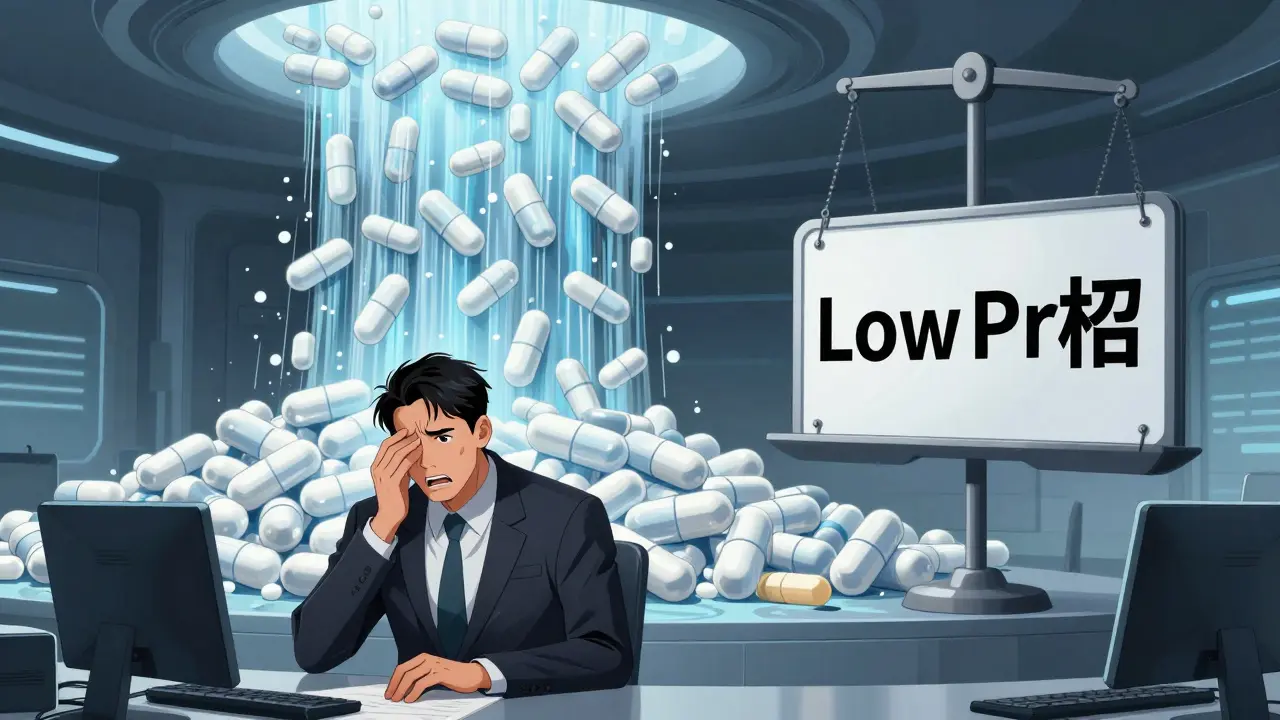
It seems like a win-win: patents expire, generic drugs hit the market, and healthcare costs plummet. But there is a hidden side to this success story. While the healthcare system saves billions, the companies actually making these drugs are fighting for their lives. When a drug becomes a "commodity," the only way to win is to be the cheapest, which often means profit margins vanish. If these companies go under or stop producing essential medicines because they can't make a dime, we get drug shortages. That is the paradox of generic manufacturer profitability: the more efficient the market becomes at lowering prices, the more fragile the supply chain gets.
The Brutal Reality of Commodity Generics
For decades, the go-to strategy for generic firms was simple: wait for a patent to expire, launch a therapeutically equivalent version, and capture a slice of the market. This worked well until the market became oversaturated. Today, Commodity Generics is a business model focused on producing simple, off-patent small-molecule drugs with numerous competitors . In this space, price is the only differentiator.
The numbers are sobering. Gross margins that used to sit comfortably between 50% and 60% have crashed, with many manufacturers now seeing margins below 30%. Consider the case of Teva Pharmaceutical Industries Ltd is one of the world's largest generic pharmaceutical companies . In 2025, they reported a negative profit margin of -4.6%, resulting in a loss of $174.6 million despite bringing in nearly $3.8 billion in revenue. When your business model relies on volume but the price per unit is plummeting, you can actually lose money by selling more.
The Shift Toward Complex Generics and Biosimilars
To escape the "race to the bottom," smart manufacturers are moving up the value chain. Instead of making basic pills that everyone else can copy, they are investing in Complex Generics is pharmaceuticals that are difficult to formulate, such as combination products or those requiring specialized delivery systems . Because these drugs are harder to make, there are fewer competitors, which allows companies to maintain healthier profit margins.
We are also seeing a massive push into Biosimilars is biologically derived medications that are highly similar to an approved reference biological product . Unlike simple chemical generics, biosimilars are grown in living cells, making the manufacturing process incredibly expensive and technical. However, this high barrier to entry protects the profit. Teva, for instance, has pivoted toward a "Pivot to Growth" strategy, pumping $998 million into R&D in 2024 to target neuroscience and immuno-oncology.
| Model Type | Technical Difficulty | Profit Margin | Market Competition |
|---|---|---|---|
| Commodity Generics | Low | Very Low / Negative | Extremely High |
| Complex Generics | Medium-High | Moderate to High | Low to Medium |
| Biosimilars | Very High | High | Very Low |
The Rise of the CMO Model
Another way companies are hedging their bets is by stopping the attempt to own the entire process. Enter the Contract Manufacturing Organization is a company that provides drug manufacturing services to other pharmaceutical companies on a contract basis , or CMO. Instead of betting on which drug will sell, CMOs sell their expertise and facility capacity.
This segment is booming. While traditional U.S. manufacturing is shrinking, the global generic contract manufacturing market is projected to grow from $56.53 billion in 2025 to $90.95 billion by 2030. By becoming a service provider, companies can diversify their income and avoid the volatility of direct-to-market drug pricing. Egis Pharmaceuticals, for example, recently expanded into API (Active Pharmaceutical Ingredient) contract development to capitalize on this trend.
Barriers to Entry and the "Death Valley" for Newcomers
You might think that with so many patents expiring, it's a great time to start a generic drug company. In reality, the entry costs are staggering. To get a single Abbreviated New Drug Application is the regulatory pathway used by generic drug manufacturers to obtain FDA approval (ANDA) approved, the average cost is around $2.6 million. That doesn't even include the $100 million+ needed to build a facility that meets current Good Manufacturing Practices (cGMP).
For a new player, the first 18 to 24 months are a nightmare of regulatory hurdles and formulary negotiations. According to a 2024 McKinsey analysis, over 65% of companies that focus solely on commodity generics fail. It is simply too expensive to enter a market where the winning strategy is to be the cheapest.
The Role of PBMs and Market Distortions
We can't talk about profitability without mentioning the middleman. In the U.S., Pharmacy Benefit Managers is third-party administrators of pharmacy programs, managed by health insurers or employers (PBMs) hold immense power. They decide which drugs are on the "preferred" list. To get that spot, manufacturers are often forced to offer massive rebates, which further eats into their margins.
Then there is the "pay-for-delay" phenomenon. This is when a brand-name company pays a generic manufacturer to keep their cheaper version off the market for a few more years. While this sounds like a payday for the generic firm, it creates a distorted market. Some studies suggest that banning these practices could save the healthcare system $45 billion over a decade, but it also changes the risk-reward calculus for manufacturers.
Finding a Sustainable Path Forward
Is the industry doomed to a cycle of crashes and consolidations? Not necessarily. The goal now is strategic realignment. Viatris is a global healthcare company formed by the merger of Mylan and Upjohn provides a case study in this. Instead of trying to do everything, they divested non-core assets-like their biosimilars unit and OTC arm-to focus on a leaner, more sustainable pipeline.
The future of sustainability in this sector rests on three pillars: an emphasis on specialty assets (like lenalidomide for multiple myeloma), expanding into emerging markets to offset U.S. pricing pressure, and continuing the shift toward the CMO model. If manufacturers can move away from the "commodity trap," they can ensure that life-saving medicines remain both affordable for patients and profitable enough to actually produce.
Why are generic drug companies losing money if they sell so many drugs?
It comes down to extreme price competition. When multiple companies produce the same basic drug, the price drops to near the cost of production. In some cases, the cost of maintaining regulatory compliance and manufacturing facilities exceeds the revenue generated from the low sale price, leading to negative profit margins.
What is the difference between a simple generic and a complex generic?
Simple generics are usually small-molecule drugs that are easy to replicate. Complex generics involve difficult-to-formulate delivery systems, combination products, or biological components. Because they are harder to make, they have fewer competitors and higher profit margins.
How does the CMO model help pharmaceutical companies?
Contract Manufacturing Organizations (CMOs) act as service providers. Instead of taking the risk of developing a drug and selling it in a competitive market, they get paid to manufacture drugs for other companies. This creates a more stable, fee-based revenue stream.
What are the biggest risks for a new generic manufacturer?
The primary risks include the massive upfront cost of FDA approval (averaging $2.6 million per ANDA) and the high cost of cGMP-compliant facilities. There is also a high failure rate (over 65%) for those who only target commodity generics due to fierce price wars.
Will the generic drug market continue to grow despite these challenges?
Yes, the global market is projected to reach $600 billion by 2033. This growth will be driven by a wave of upcoming patent expirations on "blockbuster" drugs and an increasing global demand for affordable healthcare, though the profitability will shift toward more complex and specialty products.






Posts Comments
Sam Hayes April 5, 2026 AT 14:58
the move toward biosimilars is definitely the right play for long term stability since the technical barrier actually keeps the sharks out of the pool for a bit
Beth LeCours April 6, 2026 AT 02:02
too long didnt read
Joey Petelle April 6, 2026 AT 02:23
Oh look, another heartbreaking tale of poor corporations losing their precious margins. Truly a tragedy of Shakespearean proportions that these behemoths have to actually strategize for once instead of just printing money via a government-sanctioned monopoly. It's just so quaint how we're supposed to weep for the 'fragile supply chain' while PBMs treat the healthcare system like their own personal piggy bank. Pure poetry in corporate greed.
Will Baker April 7, 2026 AT 22:39
I love how everyone is acting like the supply chain is actually fragile. Maybe it's just naturally evolving to weed out the companies that can't handle a little price competition. Who cares if a few generic firms go bust? It's just basic survival of the fittest, or in this case, the cheapest.
Brian Shiroma April 8, 2026 AT 16:11
Yeah, because nothing says "saving the world" like shifting to complex generics just so you can keep your profit margins high. I'm sure the patients are thrilled that the companies are "moving up the value chain" while the basic stuff stays in shortage. Truly heartwarming stuff.
angel sharma April 9, 2026 AT 11:59
This is such an incredible look at the resilience of the pharmaceutical sector and it really shows that with a bold vision and a willingness to invest in R&D like Teva is doing, any company can pivot from a loss to a legacy of growth! We should all be looking at this as a blueprint for how to overcome market saturation by simply out-innovating the competition and pushing the boundaries of what is possible in biotechnology because the future of medicine is not just about copying what exists but about perfecting the delivery of care to every single person on the planet regardless of where they live!
Jenna Carpenter April 9, 2026 AT 13:56
honestly these companys are just bad at manageing thier cost structures if they are losing money on volume it's just basic math fail. they need to stop whining about PBMs and actually optimze thier ops if they want to survive in a real market
Ace Kalagui April 10, 2026 AT 18:40
It is honestly so fascinating to see how the global landscape of medicine is shifting toward these CMO models because it allows for a much more collaborative environment where the focus is on the actual mastery of chemistry and production rather than just the gamble of market speculation, and I think it's wonderful that companies like Egis are leading the way in API development since it creates a more stable foundation for everyone involved in the process, ultimately helping a wider range of people get their meds without the constant fear of a sudden market crash based on one single drug's profitability!
Joseph Rutakangwa April 10, 2026 AT 23:28
cmo model is a smart hedge
Dee McDonald April 11, 2026 AT 03:23
The PBM section is the real core of the problem here! Why are we letting middlemen dictate the survival of manufacturers through rebates? It's an absolute disaster for the patient and the provider! We need a total overhaul of how formulary negotiations work right now or we are just waiting for the next massive drug shortage to hit the shelves! This is the kind of systemic failure that needs aggressive correction before we lose the entire domestic manufacturing base to the highest bidder who doesn't even make the product!
Write a comment