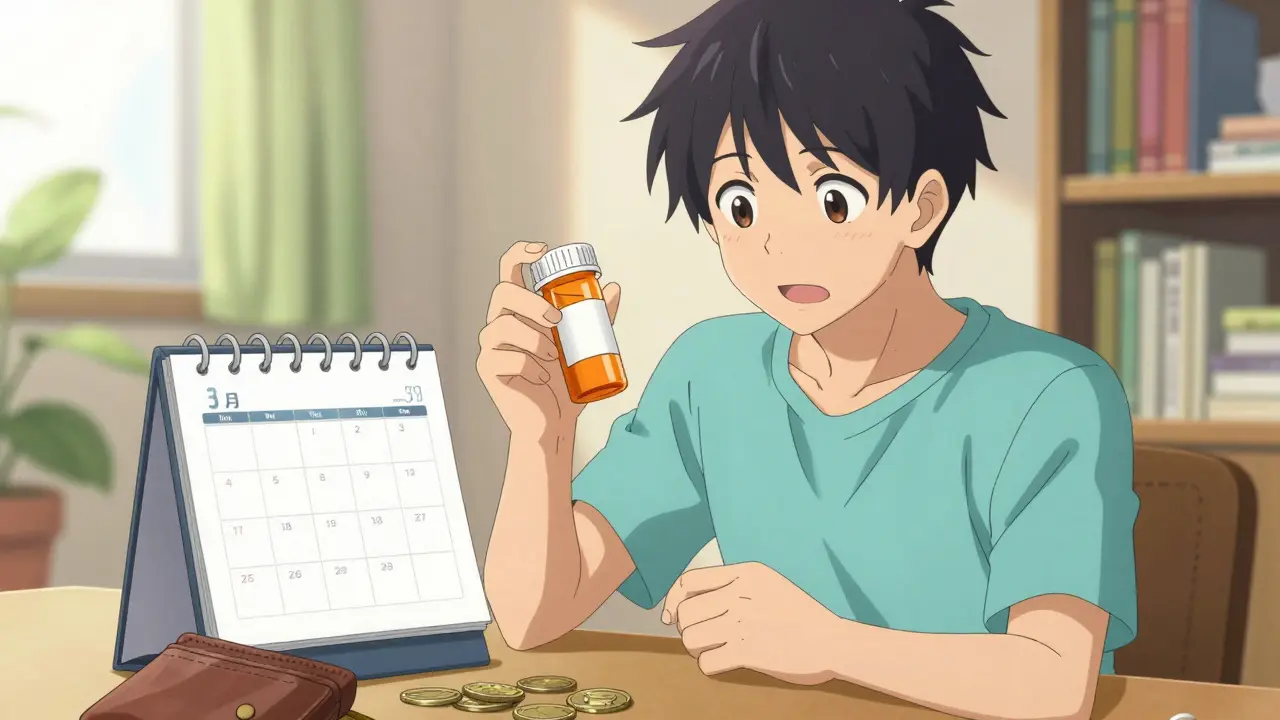
Imagine this: you take medication for high blood pressure every day. Instead of visiting the pharmacy every month for a 30-day supply, you get three months' worth in one go. And guess what? Your copay stays the same. That's the power of a 90-day prescription fill a medication dispensing practice where patients receive a three-month supply of medication instead of the standard 30-day supply, primarily designed to reduce out-of-pocket costs and improve medication adherence for chronic conditions. In fact, many people save over $39 a year just by switching to this option. Let's break down exactly how it works.
What is a 90-day prescription fill?
A 90-day prescription fill is a medication dispensing practice where patients receive a three-month supply of medication instead of the standard 30-day supply, primarily designed to reduce out-of-pocket costs and improve medication adherence for chronic conditions. Unlike a 30-day refill, which requires monthly visits, this single prescription covers 90 days of medication. Major U.S. health insurance providers and pharmacy benefit managers (PBMs) now standardize this option, especially for ongoing treatments. For example, Health Plan of San Mateo's CareAdvantage plan shows a $4.90 copay for a 90-day supply-equivalent to three separate 30-day fills that would cost $14.70. That's $9.80 saved per refill cycle, adding up to $39.20 yearly for one medication.
How much can you save with a 90-day fill?
Let's get real about the math. If your monthly copay is $4.90 for a 30-day supply, three separate refills cost $14.70. But with a 90-day fill, you pay $4.90 once. That's $9.80 saved every time you refill. Multiply that by 12 months, and you save nearly $40 annually for one medication. Now think about someone taking three different chronic medications. That's over $120 saved yearly-just by switching to 90-day fills. UnitedHealth Group's 2025 report confirms this trend: current adoption saves consumers and employers $600 million annually. If more people used this option, potential savings could hit $23 billion over a decade.
Who qualifies for a 90-day prescription fill?
Not all medications qualify. You typically need a prescription for a chronic condition long-term health issues like diabetes, high blood pressure, or high cholesterol requiring ongoing treatment. Your doctor must have already confirmed the medication works for you, and your insurance plan must cover it. Most plans require you to have taken the medication for at least 30 days before switching to a 90-day supply. For instance, CVS Caremark only offers 90-day fills for maintenance medications like statins or blood pressure drugs, not short-term treatments like antibiotics. Always check your plan details before requesting this option.
How to get a 90-day prescription fill
Getting a 90-day fill is straightforward. First, talk to your doctor. Explain you want to switch to a 90-day supply for cost savings and convenience. They'll write the prescription accordingly. Next, choose your pharmacy option. You can either:
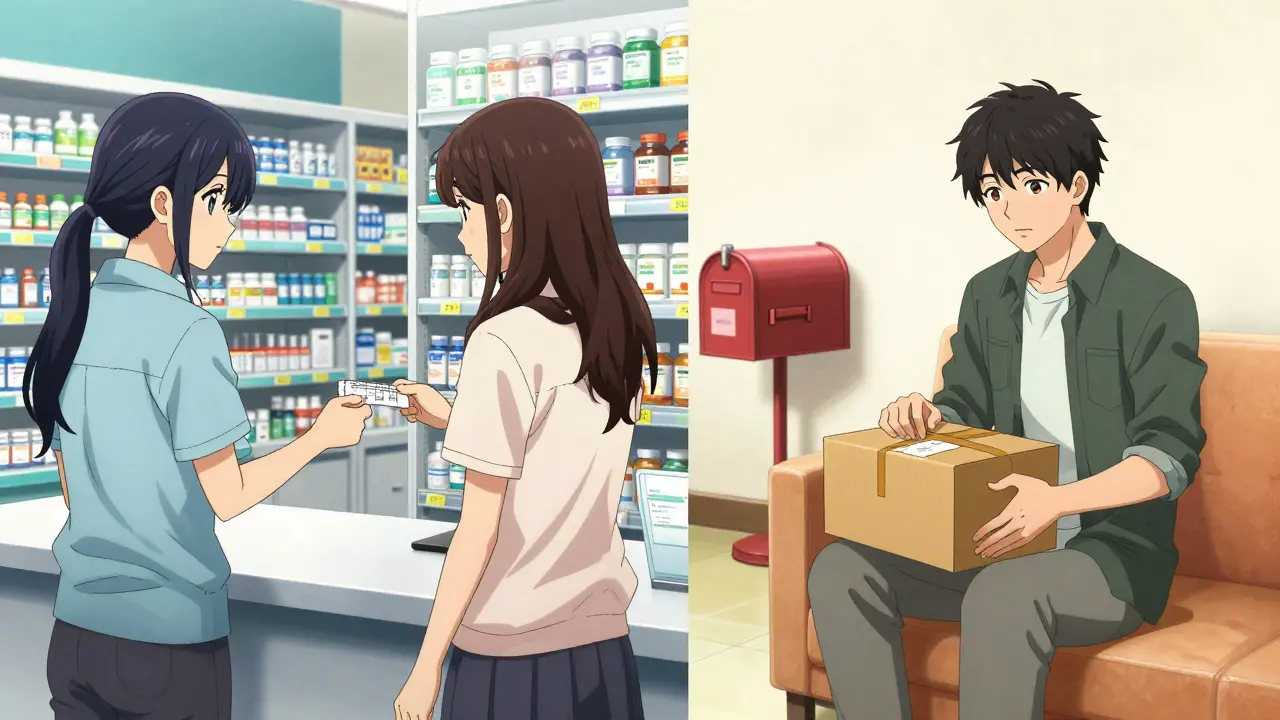
- Retail pharmacy: Visit your local CVS, Walgreens, or other network pharmacy. Many now offer in-store 90-day fills without needing mail-order services.
- Mail-order pharmacy: Use your insurer's partnered mail-order service like Postal Prescription Services (PPSRX). This delivers your medication directly to your home, often with no extra shipping costs.
Both options usually maintain the same flat copay as a 30-day refill. For example, HPSM's CareAdvantage plan shows identical $4.90 copays whether you pick up at a retail pharmacy or get it delivered. Just make sure your prescription has enough refills left. If not, your doctor can adjust it.
Retail pharmacy vs mail-order: which is better?
| Feature | Retail Pharmacy | Mail-Order Pharmacy |
|---|---|---|
| Convenience | Pick up at local pharmacy | Delivered to home |
| Copay | Same as 30-day refill | Often lower or identical |
| Delivery Time | Immediate | 5-7 business days |
| Eligibility | Requires existing prescription with refills | May require specific insurance coverage |
| Best for | Those who prefer in-person service | People wanting fewer trips to the pharmacy |
CVS Caremark's mail-order service exclusively handles 90-day maintenance medications, while retail pharmacies like Walgreens now offer in-store 90-day fills. For most people, mail-order saves time and travel costs-especially if you live far from a pharmacy. But if you need medication immediately, retail is better. Always compare copays between options; sometimes mail-order offers deeper discounts.
Common challenges and how to solve them
Some hurdles might pop up. Your insurance might not cover 90-day fills for certain medications, or your pharmacy could refuse to fill it. Here's how to handle it:
- Insurance restrictions: Call your insurer directly. Ask: "Does my plan cover 90-day fills for [medication name]?" If not, request a prior authorization or switch to a plan that does.
- Pharmacy resistance: Some retail pharmacists prefer 30-day fills because they earn more dispensing fees. Politely explain you want a 90-day supply for cost savings. If they refuse, try another pharmacy or switch to mail-order.
- Missing refills: If your prescription has no refills left, ask your doctor to write a new 90-day prescription. Most doctors are happy to help when they know it saves you money.
Remember: the pharmacy benefit managers organizations that manage prescription drug benefits for insurers, including negotiating drug prices and setting copay structures often set these rules. Always verify coverage with both your insurer and pharmacy before proceeding.
Why this trend is growing
More insurers are pushing 90-day fills because they work. UnitedHealth Group's 2025 report shows adoption has grown steadily, with 12% of maintenance medications now filled via home delivery. This trend will continue as PBMs like CVS Caremark and UnitedHealth expand mail-order networks. For example, Health Plan of San Mateo recently partnered with Postal Prescription Services to offer no-cost home delivery for 90-day supplies. Doctors also support this-Dr. Walid F. Gellad, a leading researcher, confirms "evidence of greater satisfaction and improved adherence with 90-day versus 30-day supplies." The bottom line? More people using this option means lower costs for everyone.
Can I get a 90-day fill for any medication?
No. 90-day fills only apply to medications for chronic conditions like diabetes, high blood pressure, or cholesterol. Short-term treatments like antibiotics or pain relievers usually don't qualify. Always check with your doctor or pharmacist before requesting this option.
Does my insurance cover 90-day prescription fills?
Most major insurance plans do, but it depends on your specific policy. Call your insurer's customer service line and ask: "Does my plan cover 90-day supplies for [medication name]?" They can confirm coverage details and any required steps.
Is mail-order safe for my medications?
Yes. Mail-order pharmacies like Postal Prescription Services follow strict temperature controls and handling protocols. They're regulated by the FDA and state pharmacy boards. Many people find mail-order more reliable than retail pharmacies for consistent medication access.
What if my pharmacy refuses to fill a 90-day supply?
Ask for a supervisor or try another pharmacy. Some retail pharmacies resist 90-day fills because they earn less per dispensing fee. Switching to mail-order or a different pharmacy usually solves this. Always verify coverage with your insurer first to avoid surprises.
Can I switch between retail and mail-order?
Absolutely. Many people use retail for emergencies and mail-order for regular refills. Just make sure your prescription allows it. For example, CVS Caremark's mail-order service handles 90-day maintenance meds, while you can pick up acute medications at retail. Coordinate with your doctor to ensure seamless transitions.





Posts Comments
Arjun Paul February 6, 2026 AT 10:39
This is total nonsense. My pharmacy told me 90-day fills don't save anything for my meds. The cost per pill is the same as 30-day. Just a scam to get you to buy more.
Lisa Scott February 7, 2026 AT 07:28
Big Pharma and PBMs are in cahoots. They want you to take more meds. 90-day fills are just a way to lock you in. Check the fine print.
Elliot Alejo February 7, 2026 AT 10:08
I've used this for years. Saves time and money. Just make sure your doctor writes the prescription correctly. Easy process.
Bella Cullen February 7, 2026 AT 16:28
Not sure if this works for all meds. My pharmacy said no for my antidepressants. Had to do 30-day.
Cullen Bausman February 9, 2026 AT 05:27
This is why America's healthcare is broken. Pharmacies should just give you what you need without all the bureaucracy. But they don't care about you.
Gregory Rodriguez February 9, 2026 AT 18:07
Wow, saving money? Who'da thought? Seriously, this is a no-brainer. Why aren't more people doing this? Lazy, I guess.
Johanna Pan February 11, 2026 AT 02:54
This is great for people in rural areas. Mail-order saves so much time. But sometimes my prescriptions get delayed, which is annoying.
Joyce cuypers February 12, 2026 AT 00:14
I love this option! Saves me so much time. Only thing is sometimes the mail-order takes longer than expected. But worth it.
Brendan Ferguson February 13, 2026 AT 18:23
I've helped many patients switch. It's important to check with your insurance first. Some plans have specific requirements.
jan civil February 15, 2026 AT 02:16
Only for chronic conditions.
Jennifer Aronson February 17, 2026 AT 00:59
This is a smart move for chronic conditions. Many people don't realize the savings. Worth exploring.
Kate Gile February 18, 2026 AT 17:45
I've saved hundreds with this. Just need to confirm with your pharmacy. Easy to do.
Pamela Power February 19, 2026 AT 01:50
Pharmacies don't care about you.
Write a comment