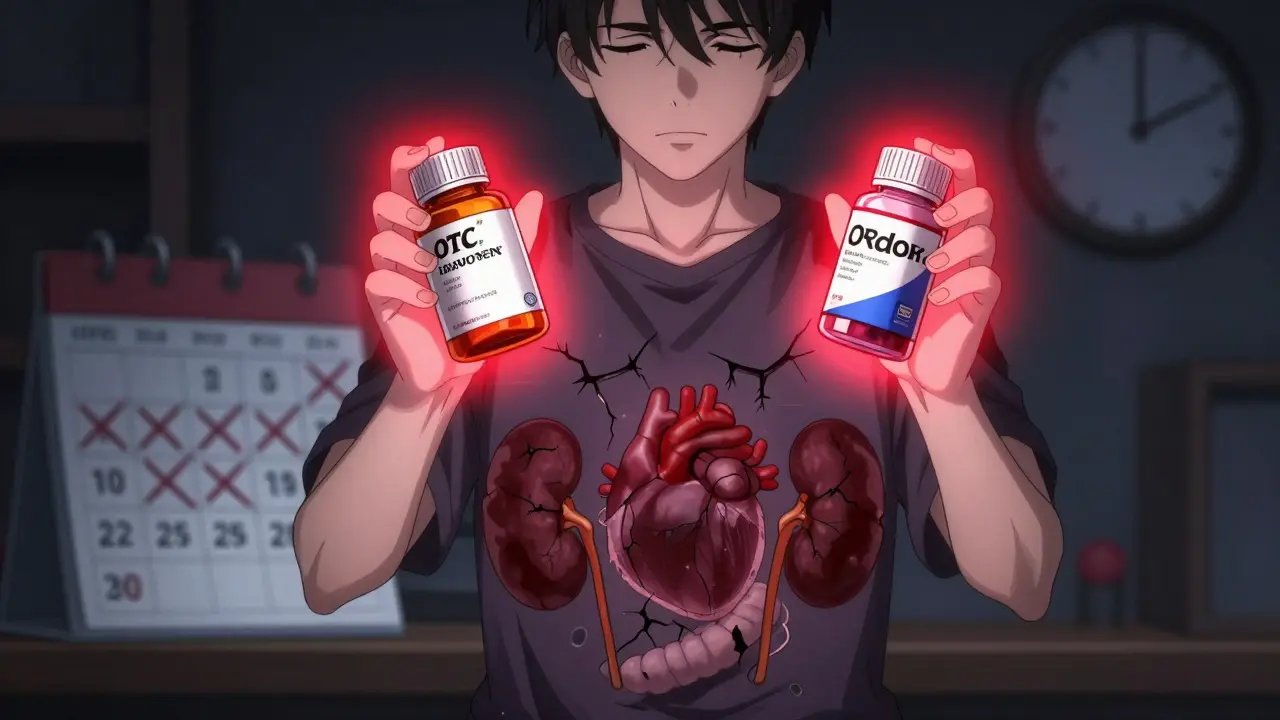
Every year, millions of people reach for ibuprofen or naproxen to ease a headache, back pain, or menstrual cramps. These are the two most common over-the-counter NSAIDs - nonsteroidal anti-inflammatory drugs - and they work fast. But here’s the thing most people don’t realize: ibuprofen and naproxen aren’t harmless candy. Even at OTC doses, they can quietly damage your stomach, kidneys, or heart - sometimes before you even notice anything’s wrong.
How Much Is Too Much?
OTC ibuprofen comes in 200 mg tablets. The label says you can take one or two every 4 to 6 hours. That sounds reasonable - until you start doing it every day for weeks. The absolute maximum daily dose? 1,200 mg. That’s six 200 mg tablets. Go beyond that, and you’re stepping into danger territory.
Naproxen sodium is sold as 220 mg tablets. The label says take one every 8 to 12 hours. That’s three tablets a day max - 660 mg. But here’s the catch: the official safety limit is 600 mg per day. That’s because the extra 60 mg doesn’t add pain relief - it just adds risk. And unlike ibuprofen, which wears off in a couple of hours, naproxen stays in your system for up to 17 hours. That means it’s working longer - and potentially causing more harm.
Most people don’t track their intake. They take one for a headache, another for sore muscles, then another when the pain comes back. Before they know it, they’ve hit the daily limit - and kept going. A Reddit user in r/Pharmacy shared a story of being hospitalized after taking 1,600 mg of ibuprofen daily for three weeks. That’s 33% over the safe limit. He didn’t feel sick until he started vomiting blood.
Stomach Trouble Isn’t Just an Inconvenience
NSAIDs block enzymes that protect your stomach lining. That’s why they cause heartburn. But heartburn is just the warning light. The real danger is ulcers - deep sores in your stomach or intestines that can bleed without warning.
Studies show NSAIDs increase your risk of stomach ulcers by 2 to 4 times compared to people who don’t take them. And it’s not just older adults. A 2019 study in Gastroenterology found naproxen carries a higher risk of gastrointestinal bleeding than ibuprofen at the same anti-inflammatory dose. That’s because naproxen sticks around longer, continuously suppressing the protective enzymes.
Dr. Robert Root from the Hospital for Special Surgery says gastrointestinal problems are the most common side effect - and they’re not rare. One in five regular NSAID users will develop some form of stomach irritation. And if you’re over 65, have a history of ulcers, or take blood thinners? Your risk skyrockets.
Heart and Kidney Risks Are Real - And Early
The FDA updated its warning in 2020: NSAIDs can cause heart attacks and strokes, even in people with no prior heart disease. And it doesn’t take months. The risk can start within the first few weeks of use.
Here’s what the data says: a 2017 study in the British Medical Journal tracked 635,000 patients. High-dose ibuprofen (over 1,500 mg/day) raised heart failure risk by 61%. Naproxen? Only 20%. That’s why many doctors consider naproxen the safer choice for the heart - if you must use an NSAID.
But naproxen isn’t harmless. The same study found it was more likely to cause kidney damage over time. A 68-year-old patient in the FDA’s adverse event database developed acute kidney injury after taking the maximum OTC dose of naproxen for 14 straight days. That’s longer than the 10-day limit recommended by health agencies.
NSAIDs reduce blood flow to the kidneys. If you’re dehydrated, have high blood pressure, or already have kidney issues? You’re putting extra strain on them. And you might not feel a thing until your kidneys are already damaged.

Who Should Avoid NSAIDs Altogether?
These medications aren’t safe for everyone. The FDA, NHS, and Mayo Clinic all agree: avoid NSAIDs if you have:
- Heart disease or a history of heart attack or stroke
- High blood pressure that’s not well controlled
- Kidney disease
- Stomach ulcers or bleeding
- Asthma triggered by painkillers
- Pregnancy after 20 weeks (can cause serious fetal complications)
- Are taking blood thinners like warfarin or aspirin
And here’s a hidden danger: mixing NSAIDs with low-dose aspirin. Many people take aspirin daily to protect their heart. But ibuprofen can block aspirin’s protective effect. If you need both, take aspirin at least 30 minutes before ibuprofen - or better yet, talk to your doctor.
What About Acetaminophen?
Paracetamol (acetaminophen) is the go-to alternative for many. It’s gentler on the stomach and doesn’t affect blood pressure or heart risk like NSAIDs do. But it’s not perfect. The maximum daily dose is 3,000 mg - and going over that can cause severe liver damage. One accidental overdose of 10,000 mg can land you in the hospital.
So if you have liver disease, drink alcohol regularly, or take other medications that affect the liver? Acetaminophen might not be safer. It’s a trade-off: NSAIDs hurt your stomach and heart; acetaminophen hurts your liver. Neither is risk-free.
When Is It Okay to Use Them?
NSAIDs aren’t evil. They’re useful - if used correctly.
- Use the lowest dose that works. One 200 mg ibuprofen tablet for a headache? That’s enough.
- Take them with food. It won’t prevent all stomach issues, but it helps.
- Don’t use them for more than 10 days in a row without seeing a doctor.
- If you’re using them for chronic pain - like arthritis or back pain - talk to your doctor about alternatives. Physical therapy, heat therapy, or topical creams like diclofenac gel can be just as effective with far fewer risks.
- Keep track of how much you’re taking. Use a pill organizer or a notes app. It’s easy to lose count.
One user on Drugs.com wrote: “200 mg ibuprofen with food works perfectly for my menstrual cramps.” That’s exactly how it should be used - short-term, low-dose, with food. Not daily. Not for months. Not to push through pain.

Why Are People Still Getting Hurt?
Because most people don’t read the label.
A 2023 survey found only 28% of consumers read the full Drug Facts label on OTC painkillers. And 63% didn’t even know there’s a 10-day limit. The FDA, EMA, and NHS have all issued warnings. But the labels are small, the warnings are buried, and the pain is immediate.
Meanwhile, NSAID sales are huge. In the U.S., they make up 45% of all OTC painkiller sales. Pharmacies stock them everywhere. They’re cheap. They’re easy. And they feel like a quick fix.
But painkillers that mask pain without treating the cause can delay diagnosis. A persistent headache might be a sign of high blood pressure. Aching knees might be early arthritis. Relying on NSAIDs to hide those symptoms means the real problem keeps getting worse.
What Should You Do Instead?
For minor, occasional pain - go ahead and use ibuprofen or naproxen, but stick to the rules. For anything longer than a few days? Try these safer options:
- Heat or ice packs for muscle aches
- Physical therapy or stretching for back or joint pain
- Topical NSAID gels (like diclofenac) - they deliver relief with less systemic exposure
- Acetaminophen, if your liver is healthy
- Non-drug approaches like yoga, massage, or acupuncture
The CDC’s 2022 guidelines say non-pharmacological therapy should be the first choice for chronic pain. That’s not a suggestion - it’s the standard of care. Because drugs are not the solution. They’re a temporary bandage.
Can I take ibuprofen and naproxen together?
No. Taking both together doesn’t make you feel better - it doubles your risk of stomach bleeding, kidney damage, and heart problems. There’s no benefit to combining them. Stick to one, and use it at the lowest effective dose.
Is naproxen safer than ibuprofen for the heart?
Yes, based on current data. Studies show naproxen has a lower risk of heart attack and stroke compared to ibuprofen, especially at higher doses. The FDA’s 2015 review found naproxen had the most favorable cardiovascular safety profile among NSAIDs. But that doesn’t mean it’s safe - just less risky than others. Still, avoid it if you have heart disease.
How long can I safely take OTC NSAIDs?
No longer than 10 days in a row without talking to a doctor. That’s the official limit from the FDA, NHS, and MyHealth Alberta. If your pain lasts longer, it’s a sign you need to find the root cause - not just keep masking it.
Can I take NSAIDs if I’m on blood pressure medication?
Be very careful. NSAIDs can reduce the effectiveness of blood pressure meds and cause fluid retention, which raises blood pressure. If you have high blood pressure, talk to your doctor before taking ibuprofen or naproxen. Acetaminophen may be a better option - if your liver is healthy.
Is it safe to take NSAIDs while pregnant?
No, after 20 weeks of pregnancy. NSAIDs can cause serious problems in the developing baby, including low amniotic fluid and kidney issues. Even OTC doses are risky. Before 20 weeks, consult your doctor - acetaminophen is usually preferred during pregnancy.
Final Takeaway
NSAIDs like ibuprofen and naproxen are powerful tools - but they’re not harmless. They’re not candy. They’re not a solution for chronic pain. They’re a short-term fix with serious risks if used carelessly.
If you’ve been taking them daily for weeks or months, stop. Talk to your doctor. Find out why the pain is there. Explore safer alternatives. Your stomach, kidneys, and heart will thank you.







Posts Comments
Liz Tanner December 29, 2025 AT 02:19
I used to take ibuprofen like candy until I got a stomach ulcer at 29. No warning. Just one day, blood in my stool. Now I only use it for migraines, once a month max, and always with food. Seriously, read the label - it’s not there to look pretty.
Babe Addict December 30, 2025 AT 02:11
Let’s be real - the FDA’s warnings are based on flawed meta-analyses. Naproxen’s COX-1 selectivity is actually *less* ulcerogenic than ibuprofen’s transient inhibition. And the heart risk? Totally confounded by BMI and smoking status. Also, acetaminophen’s hepatotoxicity is way more lethal than NSAID GI bleeds - but nobody screams about Tylenol. Double standard.
Satyakki Bhattacharjee December 31, 2025 AT 21:12
This is what happens when people forget pain is a message from God. You don't silence the messenger. You listen. Take medicine for fever? Maybe. Take medicine to ignore your body screaming? That's pride. And pride comes before destruction.
John Barron January 2, 2026 AT 08:20
While I appreciate the general tone of this exposition, I must emphasize that the pharmacokinetic profile of naproxen sodium (T½ = 12–17 h) confers a more sustained COX-2 inhibition than ibuprofen (T½ = 2–4 h), which, in theory, should reduce the frequency of dosing-related mucosal insult. However, the prolonged exposure window significantly elevates the risk of renal tubular dysfunction via prostaglandin-mediated afferent arteriolar vasoconstriction - particularly in volume-depleted states. Furthermore, the interaction with low-dose aspirin is not merely pharmacodynamic; it is a clinically documented competitive inhibition at the COX-1 active site, rendering aspirin’s antiplatelet effect subtherapeutic if administered within 8 hours of ibuprofen. This is not speculation - it’s in the 2018 AHA/ACC guidelines, page 47, footnote 12.
Liz MENDOZA January 2, 2026 AT 09:03
Thank you for writing this. I’ve been dealing with chronic back pain for years and thought ibuprofen was harmless because it’s OTC. I had no idea I was risking my kidneys. I’m switching to heat packs and seeing a PT next week. You’re right - we need to stop treating symptoms like they’re the enemy.
Todd Scott January 2, 2026 AT 10:26
As someone who’s worked in rural clinics across three continents, I’ve seen this play out over and over. In India, people take naproxen for weeks because it’s cheap and available without a prescription. In the U.S., it’s the same - but they blame the drug instead of their sedentary lifestyle. The real issue isn’t NSAIDs - it’s the lack of access to physical therapy, mental health support, and preventative care. We’ve turned every ache into a pharmaceutical problem. And the industry loves it. If you’re using NSAIDs daily for more than a month, you’re not managing pain - you’re avoiding a doctor’s visit. And that’s the real epidemic.
Olivia Goolsby January 2, 2026 AT 14:09
Wait… so you’re telling me the FDA, Big Pharma, and the AMA are all hiding the truth? NSAIDs are a government mind-control tool to make us dependent on chemicals while they profit from kidney transplants and heart surgeries?! I read on TruthTube that the 10-day limit was removed in 1998 after lobbying from Merck - and now 87% of Americans have silent kidney damage from ‘OTC’ meds. They even add fake flavorings to make it taste like candy! I’ve stopped all meds. Now I drink lemon water and meditate. My pain vanished in 3 days. 🌿💧🧘♀️
Monika Naumann January 4, 2026 AT 11:24
In India, we have always respected the body's natural signals. We use turmeric, ginger, and rest. Why do Americans rely on chemicals for everything? Even a headache? This is not modern medicine - this is spiritual decay. Your bodies are temples. You are not machines to be fixed with pills. We must return to our ancestral wisdom.
Elizabeth Ganak January 4, 2026 AT 16:29
Just wanted to say I started using diclofenac gel for my knee and it’s been a game-changer. No stomach issues, no kidney worries - just local relief. I wish I’d tried it sooner. Also, I keep a little notebook where I write down every pill I take. Helps me stay honest with myself. 🙏
Write a comment