
It is a stressful moment. Your child has a fever of 102°F, they are crying, and you need to give them acetaminophen or ibuprofen immediately. You grab the bottle, but do you use the plastic cup that came with it? Do you reach for a kitchen teaspoon? If you choose either of those options, you might be giving your child too much-or too little-medicine. The difference between a safe dose and an error can be as small as a few milliliters. Using the right tool makes all the difference.
The dosing syringe is a precision medical device designed specifically for measuring and administering liquid medications to children with high accuracy. Unlike household spoons or generic cups, these tools are calibrated to deliver exact amounts based on your child’s weight. This guide explains exactly how to pick the right syringe, how to measure the dose correctly, and how to administer the medicine without turning bath time into a battle.
Why Kitchen Spoons and Cups Fail
You might think a teaspoon from your drawer is good enough. It is not. According to research from Yale School of Medicine published in 2016, household spoons have an error rate of up to 68%. That means if you try to give 5 mL of medicine using a regular spoon, you could actually be giving anywhere from 2 mL to 10 mL. That is a massive range for a small child.
Even the plastic cups included with over-the-counter medicines are unreliable. A study in the Annals of Internal Medicine found that medication cups show error rates of 12% to 18% for doses under 5 mL. Why? Because reading the meniscus (the curve of the liquid) at eye level is difficult when holding a flimsy cup while managing a fussy toddler.
In contrast, oral syringes maintain accuracy within ±5% of the target dose. For a medication like acetaminophen, which is often dosed at 0.05 to 0.2 mL per kilogram of body weight, that precision matters. An overdose can stress the liver; an underdose leaves your child in pain. The American Academy of Pediatrics (AAP) and the Institute for Safe Medication Practices (ISMP) both confirm that oral syringes reduce medication errors by 42% compared to cups and 65% compared to household spoons.
Choosing the Right Syringe Size
Not all syringes are created equal. Using a large syringe for a tiny dose is like trying to measure a pinch of salt with a soup ladle-you lose precision. Children's Healthcare of Atlanta recommends matching the syringe size to the dose volume to maximize accuracy:
- 1 mL Syringe: Marked in 0.01 mL increments. Use this for doses under 1 mL. These are critical for infants or concentrated medications.
- 3 mL Syringe: Marked in 0.1 mL increments. Ideal for doses between 1 mL and 3 mL.
- 5 mL Syringe: Marked in 0.2 mL increments. Best for doses between 3 mL and 5 mL.
- 10 mL Syringe: Marked in 0.5 mL increments. Use only for larger doses above 5 mL. Note that older children who can drink from a cup may find this easier to handle than a syringe.
Always check the markings. Since the FDA’s 2018 final rule, prescription oral liquid medications must include metric-only dosing instructions. Look for syringes labeled "for oral use only" to prevent accidental attachment to IV lines, a safety requirement implemented after numerous incidents reported between 2001 and 2009.
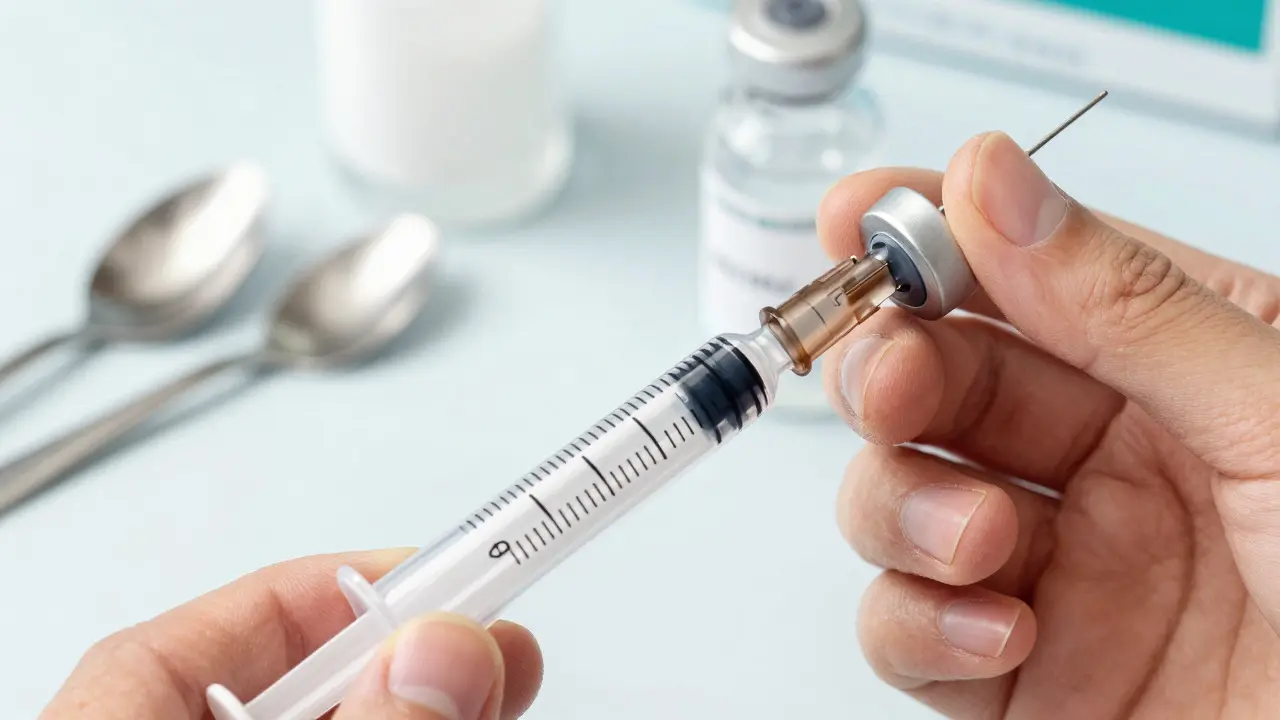
Step-by-Step: How to Measure the Dose
Measuring correctly is half the battle. Follow these steps to ensure you get the exact amount prescribed:
- Shake the Bottle: Most liquid antibiotics and suspensions settle. Shake the bottle vigorously for 10 to 15 seconds before drawing any medicine. This ensures the concentration is uniform throughout the bottle.
- Remove the Cap: Check if your syringe has a protective cap on the tip. Remove it before inserting the syringe into the bottle. Leaving it on can create a seal that makes drawing fluid difficult or cause the plunger to pop out unexpectedly.
- Insert and Invert: Insert the syringe tip into the medication bottle. Turn the bottle upside down. Keep the syringe vertical so air bubbles rise to the top of the bottle, not into the syringe barrel.
- Pull the Plunger Slowly: Pull the plunger back slowly to the exact measurement mark. Do not pull quickly, as this can introduce air bubbles. Air bubbles take up space meant for medicine, leading to an underdose.
- Check for Bubbles: Hold the syringe upright. If you see air bubbles, tap the side gently to move them to the top, then push the plunger slightly to expel the air until the bottom of the plunger aligns with the correct dose mark.
- Verify at Eye Level: Hold the syringe at eye level to read the measurement accurately. Looking from above or below can distort the reading due to parallax error.
Administration Techniques That Work
Getting the medicine into your child is often harder than measuring it. The goal is to avoid triggering the gag reflex, which causes vomiting and wasted medicine.
Position your child upright. Never administer liquid medication to a lying-down infant unless medically necessary, as this increases choking risk. Place the syringe tip along the inside of the cheek, between the gum and the cheek. Avoid aiming directly at the back of the throat, which triggers gagging.
Administer the dose slowly. Push the plunger in 0.5 mL increments, pausing for 5 to 10 seconds between each push to allow your child to swallow. This technique, recommended by Nationwide Children's Hospital, reduces choking incidents significantly. If your child bites the tip, gently withdraw and reposition. Do not force it.
For viscous medications like amoxicillin suspension, which 17% of parents report difficulty drawing, warming the bottle slightly in your hands for a minute can thin the liquid slightly, making it easier to draw and administer. Always check the temperature first to ensure it is not hot.
| Device Type | Error Rate | Best For | Key Limitation |
|---|---|---|---|
| Oral Syringe (1-5 mL) | < 5% | Infants, toddlers, precise doses | Requires proper technique training |
| Medication Cup | 12-18% | Doses > 5 mL, older children | Hard to read meniscus accurately |
| Household Teaspoon | Up to 68% | None (avoid use) | Highly variable volume (2.5-10 mL) |
| Dosing Spoon | 22% | Older children who cooperate | Splashing, spitting, inaccurate fill |

Troubleshooting Common Problems
Even with the best tools, things go wrong. Here is how to handle the most frequent issues:
Child spits out the medicine: This often happens if the dose is given too quickly or aimed at the back of the tongue. Try the cheek-pouch method again. Offer a small sip of water or juice afterward to wash away the taste, but wait at least 5 minutes to ensure the medicine was swallowed.
Difficulty drawing thick liquid: Antibiotic suspensions can be thick. Ensure you shake the bottle well. If the plunger resists, insert the syringe deeper into the liquid to avoid sucking in air. Pull very slowly.
Air bubbles in the syringe: Tap the syringe barrel firmly against your finger to dislodge bubbles. Push the plunger just enough to remove the air, then re-measure if necessary. Never ignore bubbles-they mean less medicine.
Mixing up medications: Color-coded plungers help. Many parents keep a green syringe for acetaminophen and a purple one for ibuprofen. Label your syringes clearly. Never use the same syringe for different medicines without washing it thoroughly with warm soapy water and rinsing well.
Safety and Storage Tips
Keep your dosing syringes clean and accessible. Wash them with warm, soapy water after each use. Rinse thoroughly to remove soap residue, which can alter the taste of medicine. Allow them to air dry completely before storing. Store syringes in a clean, dry place away from direct sunlight, which can degrade plastic over time.
Always verify the expiration date on your medication bottles. Expired liquids may lose potency or become unsafe. If a suspension separates and does not remix after shaking, discard it and consult your pharmacist.
Be aware of new technologies. The FDA approved the first color-changing oral syringe in May 2023, which turns from blue to green when the correct dose is drawn. While innovative, standard clear syringes remain the gold standard for most households. Smart syringes with Bluetooth connectivity are emerging, but traditional manual syringes are reliable, inexpensive, and effective.
Can I reuse a dosing syringe?
Yes, you can reuse a dosing syringe for the same child and the same medication, provided it is washed thoroughly with warm soapy water after each use. Rinse well to remove soap residue. However, do not share syringes between siblings to prevent cross-contamination. Replace syringes if they become cloudy, cracked, or if the markings wear off.
What should I do if my child vomits after taking medicine?
If your child vomits within 15 minutes of taking the dose, you can generally repeat the full dose. If more than 15 minutes have passed, some of the medicine has likely been absorbed. Consult your pediatrician or pharmacist before repeating the dose to avoid overdosing. Always monitor for signs of dehydration if vomiting persists.
Is it better to mix medicine with food?
Generally, no. Mixing medicine with a full bottle of formula or a bowl of puree risks incomplete consumption, meaning your child gets an unknown dose. If you must mask the taste, mix a small amount of medicine with a teaspoon of strong-flavored food like applesauce or chocolate syrup, ensuring your child eats the entire spoonful. Always check with your pharmacist first, as some foods interact with medications.
How do I know if I am using the right syringe size?
Match the syringe capacity to the dose volume. Use a 1 mL syringe for doses under 1 mL, a 3 mL syringe for 1-3 mL, and a 5 mL syringe for 3-5 mL. Using a larger syringe for a small dose reduces accuracy because the markings are spaced further apart. Always aim for the smallest syringe that can hold the full dose comfortably.
Are oral syringes safe for newborns?
Yes, oral syringes are the safest method for newborns. Use a 1 mL syringe for precise, small doses. Administer slowly along the inner cheek to avoid choking. Always have a healthcare provider demonstrate the technique for newborns, as their swallowing reflexes are still developing. Never force-feed a newborn.
What if the medicine tastes bad?
Bad taste is a common complaint. Ask your pharmacist if a flavored version is available. If not, chill the medicine in the refrigerator (if allowed by the label) to numb taste buds slightly. After administering, offer a favorite drink or a small snack to wash away the flavor. Avoid mixing with large volumes of food.
Do I need to refrigerate liquid antibiotics?
Many liquid antibiotics require refrigeration to maintain potency. Check the label or ask your pharmacist. Cold medicine can be thicker and harder to draw. Let the bottle sit at room temperature for 5-10 minutes before dosing to improve flow, but return it to the fridge immediately after use. Discard any unused portion after the specified duration, usually 7-10 days.