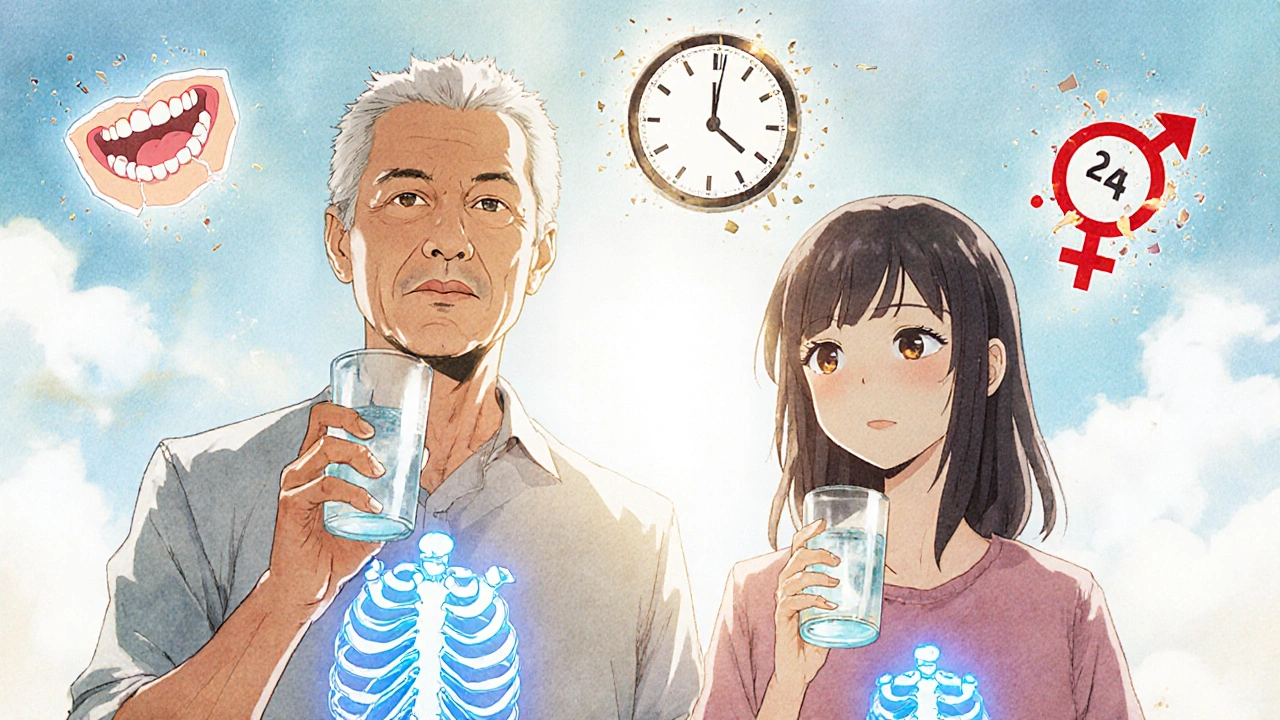
Many people take alendronate for osteoporosis, but far too many stop because they believe the wrong things about it. You’ve probably heard stories - ‘It gives you jaw problems,’ ‘You can’t ever eat again after taking it,’ ‘It’s worse than the disease.’ These aren’t facts. They’re myths. And they’re keeping people from getting the bone protection they need.
Myth: Alendronate Causes Jaw Death
The fear around osteonecrosis of the jaw (ONJ) sounds terrifying, and it’s real - but it’s extremely rare. Studies show that for people taking alendronate for osteoporosis, the risk is less than 1 in 10,000 per year. Compare that to people getting high-dose IV bisphosphonates for cancer - their risk is 10 to 100 times higher. The difference? Dose and route. Oral alendronate, taken once a week as prescribed, doesn’t flood your system. It’s designed to be absorbed slowly and mostly stays in the bones.
If you’re healthy, have good dental hygiene, and aren’t getting chemotherapy or steroids, your risk of ONJ from alendronate is practically negligible. Dentists often see patients who stopped alendronate out of fear - only to return with broken teeth or infections because their bones were too weak to heal. Don’t let fear of a rare side effect cost you your mobility.
Myth: You Can’t Eat or Drink Anything After Taking It
This one is exaggerated. You don’t need to fast for 24 hours. You don’t need to wait until dinner. You need to wait 30 minutes - and only if you’re taking it with water on an empty stomach.
Here’s the real rule: Take alendronate first thing in the morning with a full glass of plain water. Stay upright for at least 30 minutes. Don’t lie down. Don’t eat. Don’t drink coffee, tea, juice, or milk. Why? Because calcium, iron, and even caffeine can block absorption. After 30 minutes, you can eat, drink, and go about your day. No more waiting until lunch. No more skipping breakfast entirely. Just wait half an hour. That’s it.
Many patients quit because they thought they had to starve themselves all day. That’s not the science. That’s a misunderstanding.
Myth: Alendronate Is Only for Older Women
Alendronate isn’t a ‘women’s drug.’ It’s a bone drug. Men get osteoporosis too - about 1 in 5 men over 50 will break a bone due to weak bones. Men on long-term steroids, those with low testosterone, or who’ve had gastric bypass surgery are at higher risk. Alendronate works the same way in men: it slows bone loss, increases density, and reduces fracture risk.
A 2023 study in the Journal of Bone and Mineral Research followed 1,200 men on alendronate for five years. Their hip fracture rate dropped by 42%. That’s not a small benefit. That’s life-changing. If you’re a man with low bone density and your doctor recommends alendronate, don’t dismiss it because it’s ‘for women.’ Your bones don’t care about gender.
Myth: You Have to Take It Forever
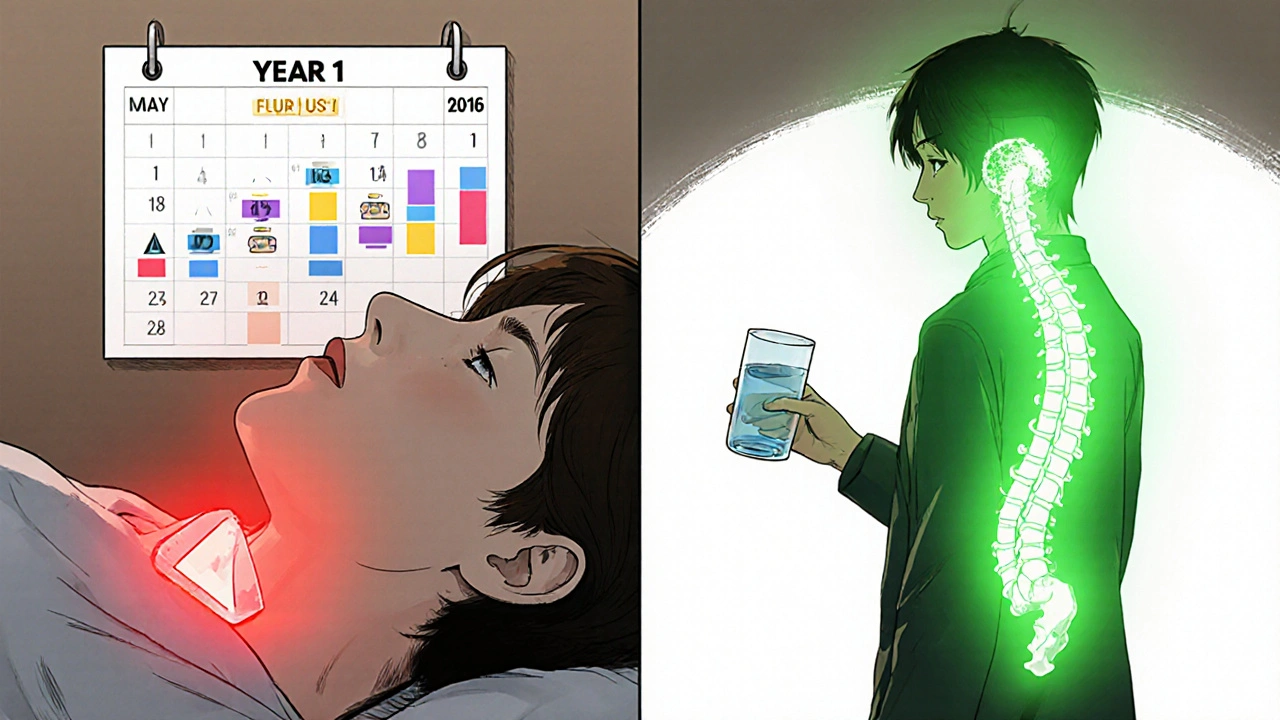
No one needs to take alendronate for life. In fact, many doctors now recommend a ‘drug holiday’ after 3-5 years - especially if your bone density has improved and you’re not at high risk for fractures.
How do you know if you’re eligible? Your doctor checks your bone density (DXA scan), looks at your fracture history, and considers your age and other risk factors. If your T-score is above -2.5 and you haven’t had any new fractures, you might pause the medication. Your bones still benefit for years after stopping, because alendronate binds tightly to bone tissue and works slowly over time.
Some people panic when they hear they need to stop. But stopping isn’t failure. It’s smart management. A 2024 UK guideline from NICE recommends re-evaluating treatment every 3-5 years. That’s not a loophole - it’s best practice.
Myth: It’s Dangerous for Your Stomach
Yes, alendronate can irritate the esophagus - but only if you take it wrong. If you lie down right after, take it with a sip of water, or swallow it with food, you risk reflux or ulcers. But if you follow the instructions - upright, full glass of water, 30-minute wait - the risk drops to near zero.
People who have severe GERD or a history of esophageal strictures might need a different medication. But for most, alendronate is safe. The alternative? A hip fracture at 70. That’s far more dangerous than a 0.5% chance of temporary heartburn.
And here’s something most don’t know: The stomach itself rarely gets affected. Alendronate isn’t absorbed in the stomach. It passes through quickly. The risk is in the esophagus - the tube connecting your mouth to your stomach. That’s why posture matters more than diet.

Myth: It Doesn’t Work If You Miss a Dose
Missed a week? Don’t panic. Don’t double up. Just take it the next morning you remember - and go back to your regular schedule. Alendronate stays active in your bones for months. One missed dose won’t undo your progress.
Think of it like a slow-burning fire. You don’t need to add fuel every single day. Once a week is enough to keep the flame going. Studies show that even people who take it only 60% of the time still get significant bone protection. Consistency over perfection is the real goal.
Use a pill organizer. Set a phone reminder. Tie it to brushing your teeth. But don’t let the fear of missing one dose stop you from taking it at all.
Myth: All Bisphosphonates Are the Same
Alendronate isn’t the only bisphosphonate - but it’s the most studied. Others like risedronate or ibandronate work similarly, but they have different dosing schedules and absorption profiles. Alendronate is taken weekly. Risedronate can be weekly or monthly. Ibandronate can be monthly or quarterly by injection.
But here’s the key: Alendronate has more long-term data than any other oral bisphosphonate. Over 20 years of studies show it reduces spine fractures by 50% and hip fractures by 30-40%. That’s not just good - it’s the gold standard.
If your doctor suggests switching, ask why. Is it because you can’t tolerate the timing? Or because you’re misinformed? Don’t assume another drug is better just because it’s newer. Proven beats trendy.
What Really Matters
Alendronate isn’t perfect. But it’s one of the most effective, safest, and cheapest tools we have to prevent fractures in people with osteoporosis. The side effects are rare. The benefits are massive. The myths? They’re loud - but they’re not true.
If you’re on alendronate and worried, talk to your doctor. Ask for your bone density results. Ask about your fracture risk. Ask if you’re eligible for a drug holiday. Don’t let misinformation make you quit.
Your bones remember what you do today. Don’t let a myth make them forget.
Can alendronate cause serious side effects?
Serious side effects from alendronate are rare. The most common are mild heartburn or upset stomach - usually from taking it incorrectly. Serious issues like osteonecrosis of the jaw or atypical femur fractures occur in fewer than 1 in 1,000 people over five years. These risks are far lower than the risk of breaking a hip or spine from untreated osteoporosis. Always follow dosing instructions to minimize any risk.
How long does it take for alendronate to work?
Alendronate doesn’t make your bones stronger overnight. It takes 6-12 months to show measurable increases in bone density. The real benefit - fewer fractures - shows up after 2-3 years of consistent use. That’s why sticking with it matters more than how fast you feel results.
Can I drink alcohol while taking alendronate?
Moderate alcohol consumption (one drink per day for women, two for men) is generally fine. Heavy drinking, however, increases your risk of falls and bone loss. Alcohol also interferes with vitamin D and calcium absorption - both critical for bone health. If you drink heavily, talk to your doctor. Cutting back may be more important than any medication.
Is alendronate safe for people with kidney problems?
Alendronate is cleared by the kidneys, so it’s not recommended if your kidney function is severely reduced (eGFR below 30-35 mL/min). For mild to moderate kidney issues, your doctor may adjust your dose or monitor you more closely. Always get your kidney function checked before starting and periodically while on the medication.
What happens if I stop taking alendronate suddenly?
Stopping suddenly doesn’t cause immediate harm, but your bones will start losing density again at their previous rate. If you were taking it to prevent fractures, stopping increases your risk over time. Never stop without talking to your doctor. They may recommend a drug holiday, a switch to another medication, or a recheck of your bone density before making a decision.






Posts Comments
Tyler Wolfe October 29, 2025 AT 21:47
Just started alendronate last month and honestly thought I’d have to live on water and silence for hours. Turns out 30 minutes is all it takes. Feels way more doable now.
Andrea Gracis October 30, 2025 AT 16:34
i always thought the jaw thing was real like i knew someone who stopped it and then got a tooth pulled and it didnt heal and i was terrified but now i see its super rare? wow
Kika Armata October 31, 2025 AT 15:31
It’s amusing how people mistake pharmacokinetics for folklore. Alendronate’s binding affinity to hydroxyapatite is well-documented, yet the public conflates it with black magic. The real issue isn’t the drug-it’s the lack of basic science literacy in patient education.
Matthew Wilson Thorne October 31, 2025 AT 16:12
30 minutes. Not 24 hours. That’s it.
Mirian Ramirez November 2, 2025 AT 01:37
So I’ve been on this for 4 years and honestly I forgot to take it one week and panicked so bad i thought my bones were crumbling but then i read somewhere that it sticks around for months and i was like ohhhhhhh. I’m so glad i didn’t quit. I started using a pill box with alarms and now it’s just part of my morning like brushing my teeth. Also my doc said i might get a drug holiday soon which feels weird but also kinda cool like i earned it??
Herbert Lui November 2, 2025 AT 17:24
There’s something quietly revolutionary about a pill that lets you keep your spine intact. We treat meds like magic bullets, but alendronate? It’s more like a quiet gardener-showing up once a week, tending to what’s invisible, asking for nothing but an upright posture and a glass of water. Most of us are too busy chasing fast fixes to notice the slow miracles.
Nick Zararis November 4, 2025 AT 14:21
Don’t forget: If you’re taking it, you’re doing something right. Seriously. Osteoporosis doesn’t care about your age, gender, or how much coffee you drink-it only cares if your bones are strong enough to hold you up. Alendronate? It’s not glamorous. But it’s reliable. And that’s worth more than you think.
Gordon Oluoch November 5, 2025 AT 13:37
The myth that alendronate causes jaw necrosis is a classic case of availability heuristic-people remember dramatic stories, not statistics. The real public health failure is not the drug, but the absence of clear, accessible patient education. When a patient is told to ‘avoid all food after dosing’ without context, they interpret it as ‘never eat again.’ That’s not medical advice. That’s negligence.
And yet, despite this, the medical community still fails to standardize patient handouts. Why? Because it’s easier to prescribe than to educate. The result? Millions of people abandon effective therapy out of fear. The drug works. The system doesn’t.
Meanwhile, men over 50 are still being told osteoporosis is a ‘women’s issue.’ That’s not just wrong-it’s lethal. A hip fracture in a man has a higher mortality rate than in a woman. And yet, screening rates for men remain abysmal. This isn’t about alendronate. It’s about systemic bias in geriatric care.
And let’s not pretend drug holidays are a loophole. They’re evidence-based. NICE guidelines exist for a reason. The idea that stopping = failure is a toxic narrative pushed by pharma marketing, not science. Bone density isn’t a race. It’s a marathon with pit stops.
The fact that people still believe they must take this forever speaks volumes about how poorly we communicate chronic disease management. Alendronate isn’t a life sentence. It’s a tool. And tools are meant to be used, not worshipped.
Also, if you’re drinking heavily and think alendronate will save you? It won’t. Alcohol doesn’t just interfere with absorption-it accelerates bone loss. No pill can outwork a bad lifestyle. That’s not a myth. That’s biology.
And finally: Yes, esophageal irritation happens. But only if you lie down with a pill stuck in your throat. That’s not a side effect. That’s a behavioral error. You wouldn’t swallow a battery without water. Don’t treat medication like it’s candy.
Emily Gibson November 5, 2025 AT 22:34
Just wanted to say thank you for writing this. My dad took alendronate for years and never told anyone he was scared of it. He thought he was the only one who had to wait 30 minutes before breakfast. He didn’t want to seem ‘difficult’ at the doctor’s. I’m glad someone’s clearing this up. He’s 78 now and still walking without a cane. That’s because he didn’t quit.
Write a comment