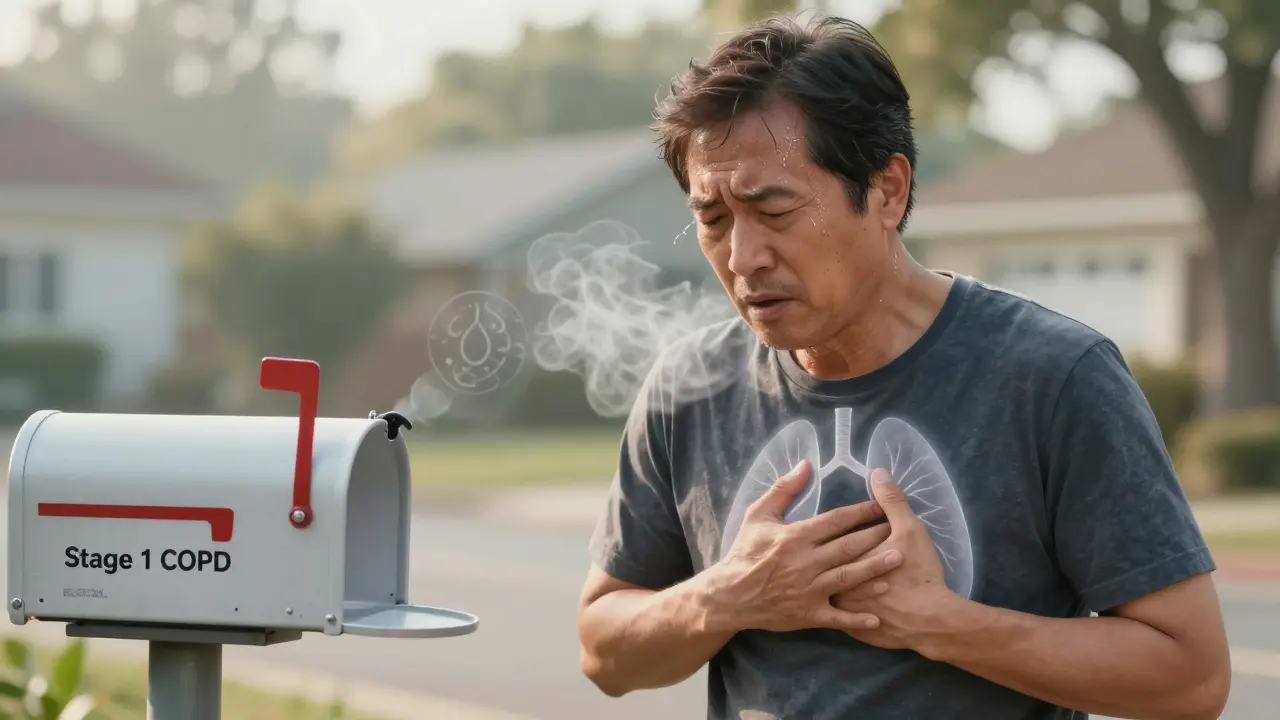
Most people don’t realize they have COPD until it’s already advanced. By then, simple tasks like walking to the mailbox or tying their shoes leave them gasping. The truth is, COPD doesn’t hit all at once-it creeps in slowly. And if you’re over 40, have smoked, or have been around smoke or fumes for years, you could already be in the early stages without knowing it.
What COPD Really Is
Chronic Obstructive Pulmonary Disease, or COPD, isn’t just a bad cough or wheezing after exercise. It’s a group of lung conditions-mostly emphysema and chronic bronchitis-that damage your airways and make it harder to breathe out. The damage is permanent, but it doesn’t have to get worse fast. That’s where understanding the COPD stages comes in.
The medical world uses the GOLD system to classify how bad your COPD is. It’s not just about how out of breath you feel. It’s about hard numbers: what your lungs can actually do. The key test is spirometry. You blow into a tube as hard and fast as you can. The machine measures how much air you can push out in one second-called FEV1. Then it compares that to what’s normal for someone your age, height, and sex. That’s how they put you in a stage.
Stage 1: Mild COPD
Stage 1 means your FEV1 is 80% or higher of what’s expected. Sounds fine, right? But here’s the catch: you might not feel sick at all. Many people brush off early symptoms as "just getting older" or "not being fit." You might notice you get winded faster than your friends when climbing stairs or walking uphill. Maybe you have a persistent morning cough with a bit of phlegm. You think it’s just a smoker’s cough.
But here’s what doctors know: if you’re in Stage 1 and you keep smoking, your lungs will lose about 60 milliliters of capacity every year. If you quit? That drops to 30. That’s half the damage. The Lung Health Study showed this clearly. Quitting at this stage doesn’t reverse the damage-but it stops the freefall.
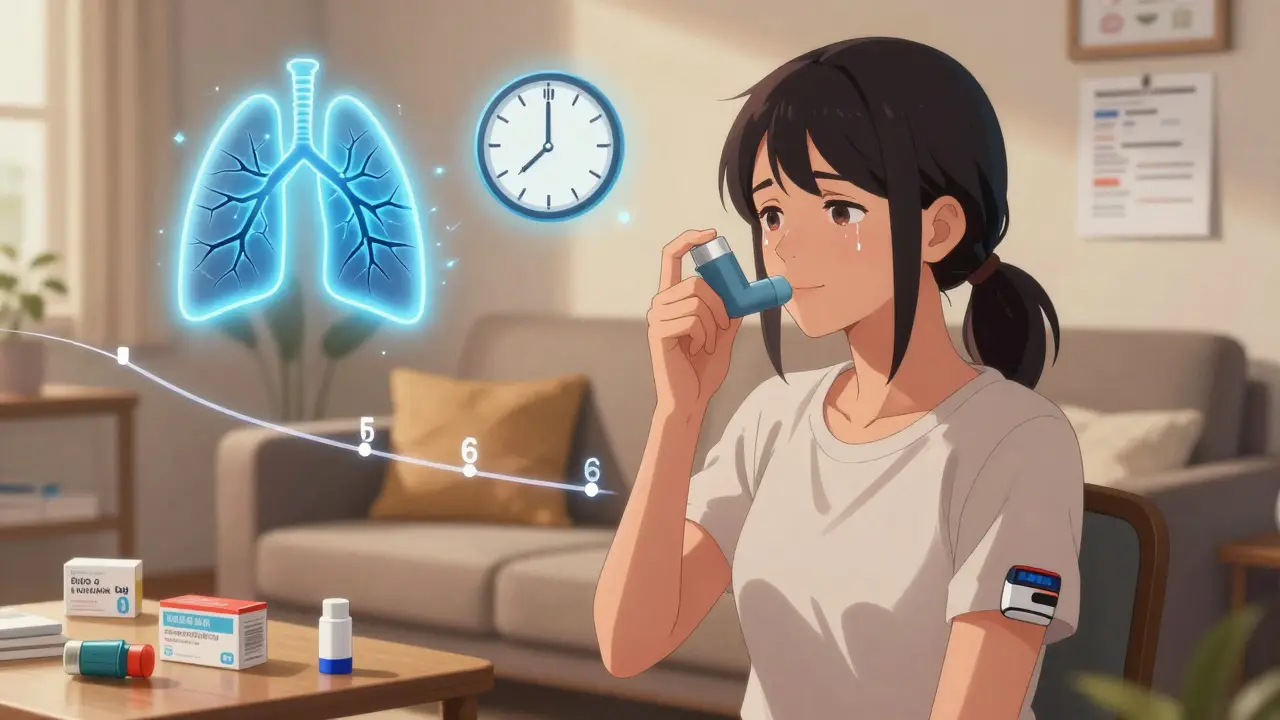
Most people in Stage 1 don’t need daily medication. The focus is simple: stop smoking, get vaccinated against flu and pneumonia, and maybe use a rescue inhaler like albuterol when you’re really struggling. Pulmonary rehab? Not usually needed yet. But if you do it now, you’ll build strength before things get worse.
Stage 2: Moderate COPD
Now your FEV1 is between 50% and 79%. This is where things start to feel real. You’re not just winded on hills-you’re stopping to catch your breath every few minutes on flat ground. You might need to sit down while washing dishes or dressing. Your cough is constant. Mucus builds up. You start avoiding social events because you’re afraid you’ll run out of air.
At this point, doctors usually prescribe long-acting inhalers-either LABA or LAMA. These aren’t rescue inhalers. You take them every day, even when you feel fine. The UPLIFT trial showed these can add 100-150 mL back to your lung capacity over time. That’s not a cure, but it’s enough to make a daily difference.
Pulmonary rehab becomes a game-changer here. It’s not just exercise. It’s breathing techniques, nutrition advice, and learning how to move without panicking. People who do it can walk 45 to 75 meters farther in six minutes. That’s the difference between needing help to shop and doing it yourself.
And here’s something most don’t know: 38% of people classified as "high risk" in the GOLD system actually have Stage 2 COPD. Their symptoms are worse than their lung numbers suggest. That’s why doctors now use the ABCD assessment-looking at both your symptoms (using the CAT or mMRC scales) and how often you’ve had flare-ups. Two bad flare-ups in a year? That’s a red flag, even if your FEV1 is still in the 70s.
Stage 3: Severe COPD
FEV1 drops to 30-49%. This is where daily life changes forever. You’re breathless putting on socks. Walking to the bathroom takes breaks. You might need oxygen during the day, even if you don’t use it at night yet. Your oxygen levels drop below 90% during simple tasks. That’s not normal. That’s your body struggling.
Treatment gets more aggressive. You’ll likely be on two long-acting inhalers together-LAMA plus LABA. Studies like SUNSET show this combo cuts flare-ups by 14% compared to just one. If your blood tests show high eosinophils (over 300 cells/μL), your doctor might add an inhaled steroid. The WISDOM trial showed this can reduce flare-ups by 25%.
But here’s the hidden danger: heart problems. Dr. Don Sin’s 2023 Lancet paper found that 65% of Stage 2 and 3 COPD patients already have heart disease. Many die from heart failure, not lung failure. That’s why doctors now check your heart along with your lungs. An EKG or echo might be part of your yearly checkup.
Patients in this stage often describe panic attacks triggered by basic tasks. One Reddit user wrote: "I can’t walk to my mailbox (20 feet) without stopping to breathe. My FEV1 is 38%. My doctors keep saying I’m ‘only’ Stage 3 so I must be exaggerating." That’s the gap between numbers and reality. Your symptoms matter as much as your FEV1.
Stage 4: Very Severe COPD
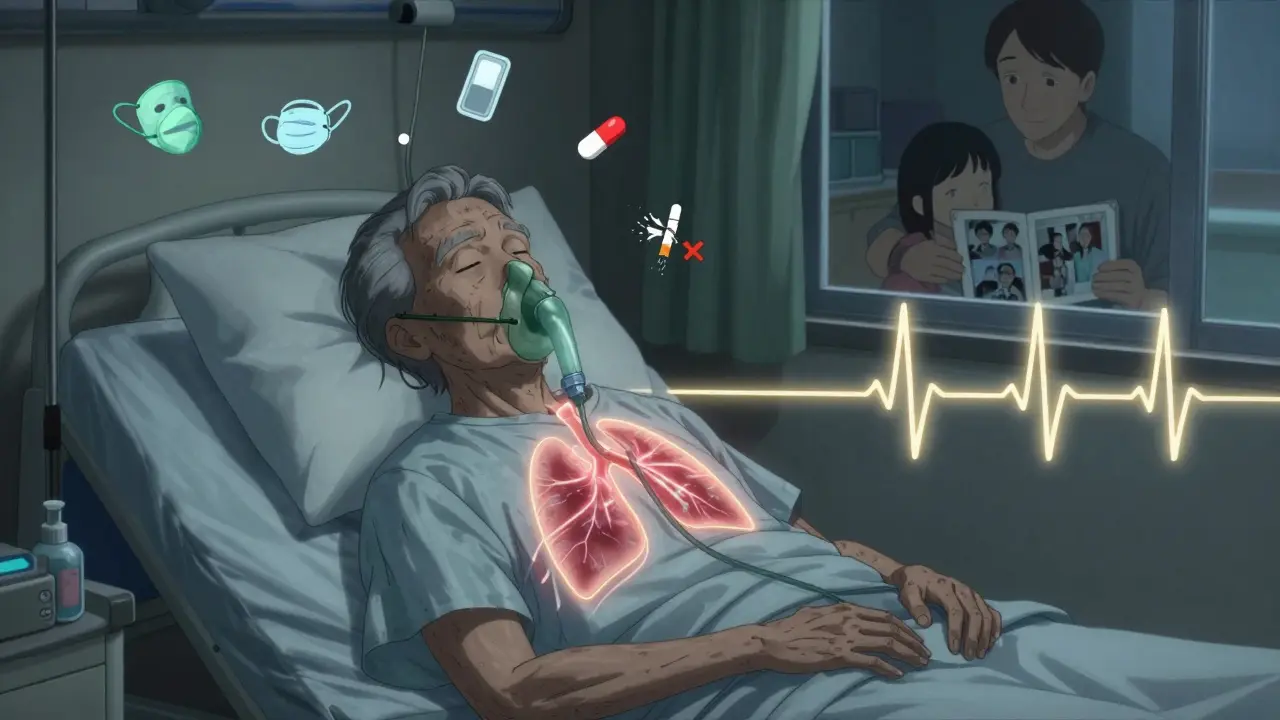
FEV1 under 30%. This is the most advanced stage. You’re on oxygen for 15+ hours a day. You can’t walk more than a few steps without stopping. You’ve had multiple hospital stays for flare-ups. Each one carries a 22% risk of dying within a year.
Long-term oxygen therapy isn’t optional here. The NOTT trial proved it: if you use oxygen 15+ hours a day, your one-year survival jumps from 73% to 90%. That’s life-changing. Non-invasive ventilation (a mask that helps you breathe at night) cuts hospital readmissions by 28%.
But the real struggle isn’t just medical-it’s emotional and financial. The American Lung Association found that 52% of Stage 4 patients pay $287 a month out-of-pocket for oxygen equipment-even with Medicare. Forty-four percent say social isolation is their worst symptom. They stop seeing friends because they’re too tired. They avoid going out because they need their oxygen tank.
And yet, some still get dismissed. "You’re not sick enough to need this," they’re told. But the numbers don’t lie. When your lungs are this damaged, every breath is a fight. That’s not weakness. That’s biology.
Why Early Detection Matters
Dr. Fernando J. Martinez says it plainly: "Identifying COPD at Stage 1 or 2 is critical. Treatment started early can slow progression by 50%." But here’s the problem: most people wait 5.2 years before getting diagnosed, according to CDC data. Why? Because they think breathlessness is normal. Because their doctor didn’t order a spirometry test.
Only 35.7% of primary care visits for breathing problems include spirometry-even though it’s the gold standard. And 42% of doctors misread the results because they haven’t had proper training. That’s why so many people slip through the cracks.
Here’s what you can do: If you’re over 40, smoked (or were exposed to smoke, dust, or fumes), and have a cough or shortness of breath, ask for a spirometry test. It’s quick, painless, and cheap. If you’re in Stage 1, quitting smoking might stop the disease cold. If you’re in Stage 2, you can still gain back control of your life.
What’s Next for COPD
Research is moving fast. Blood tests for fibrinogen-a protein linked to faster lung decline-are being tested. AI tools are helping interpret spirometry with 35% fewer errors. New drugs targeting inflammation are in trials. The COPD market is expected to hit $15.7 billion by 2028.
But the biggest challenge isn’t technology-it’s access. In low-income countries, 80% of COPD deaths happen because people never get tested. Even in the UK and US, millions go undiagnosed.
What’s clear is this: COPD doesn’t have to be a death sentence. It’s not about how far you’ve gone. It’s about what you do now. Whether you’re in Stage 1 or Stage 4, there’s always something you can do to breathe better, live longer, and reclaim your life.
Can COPD be reversed?
No, the lung damage from COPD is permanent. But progression can be slowed-sometimes dramatically. Quitting smoking, using prescribed inhalers, doing pulmonary rehab, and avoiding triggers can stop or greatly reduce further decline. Many people in Stage 1 who quit smoking never progress to Stage 2.
How do I know if I’m in the right COPD stage?
Your stage is based on spirometry results (FEV1) and your symptom/exacerbation history. Don’t rely on how you feel alone. Two people with the same FEV1 can have very different symptoms. Ask your doctor for your exact FEV1 number and your GOLD group (A, B, C, or D). If they don’t know, get a second opinion.
Is COPD the same as asthma?
No. Asthma is usually reversible with medication and often starts in childhood. COPD is progressive, usually linked to smoking or long-term exposure to irritants, and mostly affects people over 40. Some people have both, called asthma-COPD overlap syndrome (ACOS), which needs a different treatment approach.
What’s the best way to monitor my COPD at home?
Keep a daily symptom log: breathlessness level (on a scale of 1-10), cough, mucus, and whether you used your rescue inhaler. Use a pulse oximeter to check your oxygen levels if your doctor recommends it. Track how far you can walk without stopping. If your numbers get worse over a few weeks, call your doctor. Don’t wait for a flare-up.
Should I get a second opinion if I’ve been told I have mild COPD but feel worse?
Absolutely. Symptoms matter as much as numbers. If you’re struggling daily but your FEV1 says "mild," ask for a full GOLD assessment-symptom scores, exacerbation history, and possibly a 6-minute walk test. You might be in a higher group than your FEV1 suggests. Your quality of life deserves attention.
Can exercise help if I’m in Stage 3 or 4?
Yes-even if you’re on oxygen. Pulmonary rehab is designed for all stages. It teaches you how to move without overworking your lungs. Many people in Stage 4 report feeling more in control after just a few weeks. Start slow: seated leg lifts, short walks with oxygen, breathing exercises. Consistency beats intensity.



Posts Comments
Tiffany Wagner January 23, 2026 AT 20:29
I never realized how much I was brushing off my cough as just a smoker’s thing until I read this
Now I’m scared to go to the doctor but also too scared not to
My dad died of this and I swore I’d quit before it got to him
But I still smoke when I’m stressed
Maybe I need to stop making excuses
Chloe Hadland January 24, 2026 AT 14:18
This hit me right in the chest
My mom’s in Stage 3 and they keep telling her she’s lucky she’s not worse
But she can’t carry groceries anymore and she cries when she can’t play with her grandkids
Numbers don’t tell the whole story
Thank you for saying that
Amelia Williams January 26, 2026 AT 02:37
Just got my spirometry results yesterday
FEV1 at 72%
My doctor said I’m fine
But I’m stopping to catch my breath after walking to the fridge
So I’m asking for a second opinion tomorrow
If you’re reading this and you’re over 40 and you’re tired all the time
Don’t wait
Get tested
Even if you think it’s nothing
It’s not
And you deserve to breathe
Viola Li January 26, 2026 AT 04:01
So now we’re supposed to feel guilty for breathing wrong
What’s next
Blaming people for having lungs that got damaged by pollution they didn’t choose
Or for working in factories before they knew
Or for living near highways
Quit acting like this is all about smoking
It’s corporate negligence wrapped in medical jargon
Vatsal Patel January 26, 2026 AT 09:58
They sell you hope with spirometry tests and inhalers
But the real truth
Is that your lungs are a clock
And someone already wound it
Quitting smoking doesn’t rewind it
It just slows the ticking
And the system doesn’t care how fast it ticks
As long as you keep paying for the parts
They don’t fix the machine
They just sell you more tape
John McGuirk January 27, 2026 AT 10:43
They say COPD is permanent damage
But what if it’s not the lungs
What if it’s the oxygen they pump into you
What if the machines are making you dependent
And the real cure is never tested
Because Big Pharma owns the guidelines
And your FEV1 number is just a barcode
For their profit margin
Ask yourself
Who benefits if you stay sick
Michael Camilleri January 28, 2026 AT 03:28
People act like quitting smoking is the magic fix
But if you’re already in Stage 2
It’s too late to be a hero
You’re just delaying the inevitable
And now you’re supposed to feel good about it
Like you’re doing something noble
Meanwhile your kids are paying for your oxygen
And your wife is tired of watching you struggle to tie your shoes
Don’t pretend this is about willpower
It’s about consequences
And you chose this
lorraine england January 29, 2026 AT 15:30
My husband is Stage 2 and he started pulmonary rehab last month
He can now walk to the end of the driveway without stopping
He still coughs
He still gets tired
But he smiles again
It’s not a cure
But it’s something
And that’s worth fighting for
Kevin Waters January 30, 2026 AT 04:58
Just wanted to add something real quick
If you’re on oxygen and you’re scared to leave the house
Try this: get a lightweight tank and walk to your mailbox every day
Even if it takes 10 minutes
Even if you have to stop twice
Do it
Then do it again tomorrow
Small wins build confidence
And confidence builds breath
It’s not glamorous
But it’s yours
Write a comment