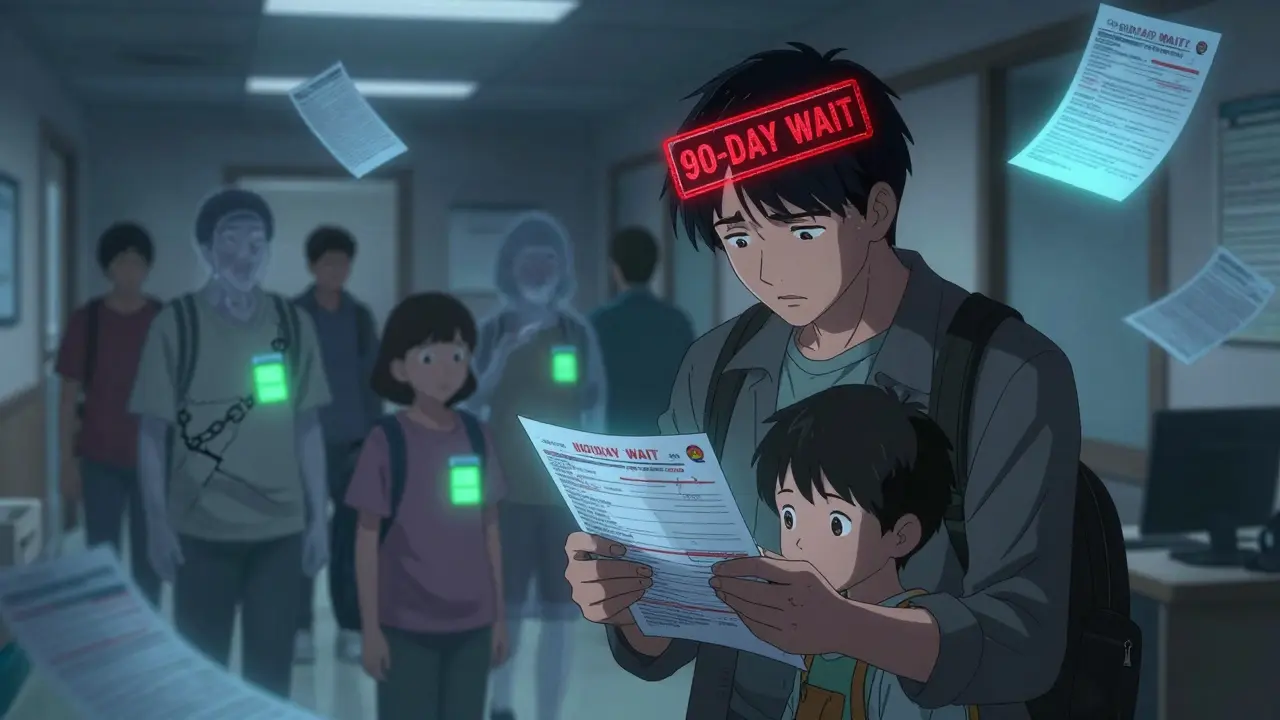
When a family loses job-based health insurance, they often turn to Medicaid or CHIP to keep their kids covered. But here’s the catch: federal law says Medicaid and CHIP can’t just step in and replace private coverage that’s still available. That’s where Medicaid substitution rules come in. These aren’t just paperwork-they shape whether a child gets immediate help or waits months for care. And the rules? They vary wildly from state to state.
Why Substitution Rules Exist
The idea behind substitution rules is simple: don’t let public programs replace private insurance that families could afford. Congress put this in place back in 1997 with the Balanced Budget Act. The goal? Keep private insurance markets stable and make sure taxpayer dollars go to those who truly have no other option. Without these rules, some parents might drop their employer coverage just to get free Medicaid or CHIP, even if the employer plan is affordable. That’s not the intent. The system was built to protect families who are left with no choice-not to create a loophole for those who can still pay.According to the Congressional Budget Office, without substitution rules, Medicaid and CHIP spending would jump by $2.1 billion every year. That’s billions that could go toward covering kids who genuinely need help. But the flip side? These rules sometimes leave families in limbo.
The Mandatory Rule: What All States Must Do
Every state that runs a CHIP program is legally required to prevent Medicaid or CHIP from substituting for private coverage. This isn’t optional. It’s written into federal law under Section 2102(b)(3)(C) of the Social Security Act. States must have procedures in place to check whether a child has access to affordable private insurance through a parent’s job.What counts as "affordable"? In 2024, if the employee’s share of the premium for a child’s coverage is less than 9.12% of household income, the plan is considered affordable. If it’s above that, Medicaid or CHIP can step in. States must verify this-usually by asking for pay stubs, employer letters, or checking insurance databases.
But here’s where it gets messy: verifying private coverage isn’t easy. A 2023 survey of 47 state Medicaid agencies found that 68% called verifying employer coverage their biggest headache. The average time to confirm coverage? 14.2 days. That’s more than two weeks where a child might go without care, even if their parent lost their job yesterday.
The Optional Part: Waiting Periods and State Choices
While the rule to prevent substitution is mandatory, how states enforce it? That’s where things get personal. States have the option to use a waiting period before a child can enroll in CHIP. The federal cap is 90 days. But here’s the twist: 34 states use it. The other 16 don’t.States like California, Texas, and New York rely on this 90-day delay. The logic? It stops families from dropping employer coverage just to get free public insurance. But for a parent who just got laid off, waiting three months for help isn’t a policy-it’s a crisis.
One Medicaid worker in Ohio, speaking anonymously on Reddit, put it bluntly: "We get families who lose employer coverage on Friday and need CHIP Monday, but the 90-day rule forces us to deny them for 12 weeks-they often end up uninsured during that time."
Meanwhile, 15 states-including Florida, Illinois, and Pennsylvania-go further. They add extra exemptions. If a parent loses a job, cuts hours, or gets a pay cut, those states skip the waiting period entirely. They recognize that life doesn’t follow a calendar. The federal rules set a floor. These states built a ladder on top.

How States Check for Private Coverage
There are two main ways states find out if a child has private insurance: databases or surveys.- Database monitoring (28 states): These states connect to the National Association of Insurance Commissioners’ Health Insurance Resource Database. It’s automated. If a child is listed on a parent’s plan, the system flags it. No paperwork needed. This is faster, more accurate, and costs less over time.
- Household surveys (22 states): These states ask families to fill out forms, submit proof, or call in. It’s manual. It’s slow. And it’s error-prone. One parent in Texas told a focus group: "I sent my employer’s letter three times. They kept saying it wasn’t clear enough. My kid went without a doctor for six weeks."
States with integrated systems-where Medicaid and CHIP share one eligibility database-see 22% fewer coverage gaps. That’s because when a parent’s income changes, the system updates automatically. No one has to reapply. No one has to wait.
The Real Cost: Gaps in Coverage
Despite all the rules, kids still fall through the cracks. A 2022 CMS evaluation found that 21% of children experience coverage gaps when moving between Medicaid and CHIP. That’s one in five kids who go without care during transitions.Why? Because verification takes too long. Because paperwork gets lost. Because a parent doesn’t know they need to report a job change. In Louisiana, strict substitution rules in 2021 caused the uninsured rate among low-income children to spike by 4.7 percentage points. That’s thousands of kids who didn’t get vaccines, checkups, or asthma inhalers.
On the flip side, Minnesota’s "Bridge Program" cut substitution-related gaps by 63%. How? Real-time data sharing. When a parent’s employer stops coverage, the system automatically triggers a CHIP enrollment. No forms. No delays. Just care.
What Changed in 2024
On April 29, 2024, a new federal rule took effect. The Medicaid and CHIP Eligibility and Enrollment rule (CMS-2441-F) didn’t remove substitution rules. It made them smarter.- States must now automatically transition kids from Medicaid to CHIP (or vice versa) when eligibility changes-no reapplication needed.
- States must accept eligibility decisions from other programs, like the Marketplace.
- By October 1, 2025, every state must upgrade their systems to share data between Medicaid and CHIP.
This isn’t about making rules looser. It’s about making them work. The old system assumed families had stable jobs and steady income. Today? Gig work, seasonal jobs, and short-term insurance plans make that assumption outdated.
CMS Administrator Chiquita Brooks-LaSure said it best: "The new rule addresses long-standing gaps in the substitution framework by requiring states to implement more seamless transitions while maintaining necessary safeguards."

Where States Are Falling Short
Not all states are ready. A 2024 NASHP review found that 19 states had "comprehensive" guidance for frontline workers. Twelve had "inadequate" materials. That means a caseworker in one state might know exactly what to do. In another, they’re guessing.And the cost? The average state spends $487,000 a year just on substitution monitoring. States with separate Medicaid and CHIP systems spend up to 18 months and hundreds of thousands more to build the infrastructure. That’s money that could go to pediatric care, not paperwork.
The Bigger Picture: Is This System Working?
Experts are split. The Medicaid and CHIP Payment and Access Commission says substitution rules have saved $1.3 billion annually since 2010. That’s real savings.But Dr. Leighton Ku from George Washington University says: "The 90-day waiting period is outdated. Job changes happen weekly now. Our rules were designed in the 1990s. We’re still running them in 2026."
Parent advocacy groups hear the pain daily. Families USA found that 42% of parents cited "bureaucratic delays" as their biggest frustration. But 31% said the rules helped-because they kept employers from dropping coverage they were supposed to provide.
The truth? Substitution rules aren’t good or bad. They’re outdated. They work for some families. They hurt others. The states that succeed-Minnesota, Massachusetts, Oregon-don’t just follow the rules. They fix the gaps.
What Comes Next
By 2027, analysts predict all states will use automated data matching. Manual verification will drop by 65%. That’s progress. But it’s not enough.The real fix? Remove the waiting period. Let states use real-time data to decide who qualifies. Make the system responsive, not rigid. Let families get care the day they need it-not after three months of waiting.
For now, if you’re in a state with a waiting period, know your rights. Ask if you qualify for an exemption. If you lost your job, if your hours were cut, if your employer’s plan is unaffordable-those are reasons to skip the wait. Don’t assume you don’t qualify. Ask. Push. Keep calling. Because no child should go without care because of a rule written before smartphones existed.
Are substitution rules the same in every state?
No. While all states must prevent Medicaid or CHIP from replacing affordable private coverage, how they do it varies. Some use a 90-day waiting period. Others rely on automated database checks. Fifteen states offer extra exemptions for job loss or reduced hours. The federal rules set the minimum-states can go further.
Can a child be denied Medicaid because they have private insurance?
Yes-if the private insurance is considered affordable. In 2024, if the parent’s share of the premium for the child’s coverage is less than 9.12% of household income, Medicaid or CHIP can deny enrollment. But if the plan is too expensive, the child qualifies for public coverage regardless of private options.
What happens if a family loses their job and can’t afford private insurance?
They should qualify for Medicaid or CHIP immediately. The substitution rule only applies if affordable private coverage is still available. Losing a job removes that option. States are required to enroll them without delay. But in practice, delays happen due to slow verification systems. Families should request an exemption if their income dropped.
Do substitution rules apply to adults?
No. Substitution rules only apply to children enrolled in CHIP. Medicaid for adults doesn’t have the same substitution requirements. The rules were designed specifically to protect the CHIP program and ensure it serves children without access to affordable private coverage.
How can I find out if my state uses a waiting period?
Check your state’s Medicaid or CHIP website. Look for sections on "eligibility," "private insurance," or "substitution rules." You can also call your local Medicaid office and ask: "Does my state use a waiting period before CHIP coverage starts if I have access to private insurance?" States like California, Texas, and New York use it. States like Minnesota and Oregon don’t.
Can I appeal a denial based on substitution rules?
Yes. Every state must offer a fair hearing process if you’re denied Medicaid or CHIP. If you believe your private insurance isn’t affordable, or if your job situation changed, you can appeal. Bring pay stubs, employer letters, or proof of reduced hours. Many appeals are successful when families provide clear documentation.
Is there help if my child is uninsured while waiting for CHIP?
Some states offer temporary emergency care or urgent care coverage during waiting periods. Others partner with community clinics that provide free services. Contact your local health department or a nonprofit like Children’s HealthWatch for help. Don’t wait for the system to catch up-reach out now.
Why do some states use waiting periods and others don’t?
It’s about politics, resources, and philosophy. States with waiting periods worry about "churning"-families dropping private coverage to get free public insurance. States without them prioritize access. Those with integrated systems and strong data-sharing tools find waiting periods unnecessary. It’s not about federal law-it’s about how each state chooses to interpret its responsibility to children.







Posts Comments
John Smith March 3, 2026 AT 03:44
Man, this whole substitution mess is a goddamn circus. States act like they're running a spreadsheet tournament instead of keeping kids alive. I've seen parents cry in waiting rooms because some bureaucrat in Austin or Albany needs a third copy of a pay stub from 2023. The system isn't broken-it was designed to fail people who don't have time or connections. And don't get me started on those 90-day waiting periods. That's not policy. That's cruelty with a flowchart.
Minneapolis gets it. They don't ask for proof-they just update the system and say 'here's your kid's care.' Meanwhile, Texas makes you fill out a form in triplicate, then sends you a PDF that says 'pending verification.' Like, what? My kid's fever is at 103 and you're verifying my employer's HR portal? This ain't 1997 anymore. We got APIs. We got real-time data. Stop pretending we're still using fax machines.
And don't tell me it's about 'saving taxpayer dollars.' We're spending half a million bucks per state just to chase paperwork. That money could buy 10,000 pediatric asthma inhalers. Instead, we're funding a ghost hunt for documents that don't even exist anymore. The system is a tax on trauma. And the worst part? The kids don't even know why they're being denied. They just know the doctor said 'come back next month.'
They call it 'substitution.' I call it 'delayed death.' And if you're one of those states still using paper forms? You're not protecting the system. You're protecting your own laziness.
Sharon Lammas March 3, 2026 AT 23:20
I read this and thought about my niece. She went without her inhaler for six weeks after her dad lost his job. They told her mom to 'wait 90 days.' No one explained why. No one offered help. Just paperwork. And when the paperwork got lost? They said 'try again next week.'
I don't think anyone meant for this to hurt kids. But the system doesn't care about intent. It only cares about rules. And rules, when rigid, become walls. I wonder how many children have asthma attacks in silence because no one was there to catch them. Not because they weren't eligible. But because the system forgot to look.
Maybe we need to stop thinking about eligibility and start thinking about humanity. A child doesn't need a form. They need a breathing treatment. Today.
marjorie arsenault March 5, 2026 AT 05:50
It’s okay to feel frustrated. I’ve been there. But let’s remember-this isn’t just about rules. It’s about how we treat each other. Some states are trying. Minnesota’s Bridge Program? That’s hope in action. Real-time data. No forms. Just care.
You don’t need to be a policy expert to get this: if a parent loses a job, their kid shouldn’t lose care. It’s that simple. And if we can fix it with technology, why are we still using paper? Why are we still making people beg for help?
Ask your state reps. Call your local clinic. Talk to other parents. Change doesn’t come from one law. It comes from a thousand voices saying, 'This isn’t right.' You’re not alone. We’re all in this together.
Shivam Pawa March 6, 2026 AT 03:50
The substitution framework is a classic principal-agent problem. The federal government acts as principal, delegating enforcement to state agents who face asymmetric information regarding private insurance availability. The 90-day waiting period functions as a screening mechanism to mitigate adverse selection, though it introduces significant deadweight loss in terms of child health outcomes.
Empirical evidence from NASHP 2024 suggests that states with integrated eligibility databases reduce administrative friction by 22%, aligning with transaction cost economics. The optimal policy solution would involve automated interoperability between Medicaid, CHIP, and employer-sponsored insurance databases via API-based real-time verification protocols, minimizing human intervention.
Furthermore, the 9.12% affordability threshold is outdated. It was calibrated pre-gig economy. A more dynamic, income-weighted metric-perhaps percentile-based-would better reflect economic volatility. The 2024 CMS rule is a step, but insufficient without federal mandates for real-time data sharing.
Darren Torpey March 7, 2026 AT 16:43
Let me tell you something-this isn't about policy. This is about love. I work at a free clinic. Every week, a mom walks in with a kid who hasn't seen a doctor in months. She's got three kids. Her husband got laid off. She's scared. She's tired. She says, 'I just need them to breathe.' And we say, 'We got you.' But we shouldn't have to. This isn't charity. It's justice.
Minnesota doesn't have magic. They just stopped asking for proof and started trusting people. And guess what? Kids got better. Parents stayed employed. Hospitals saved money. The system worked because they treated humans like humans.
Stop treating kids like line items. They're not numbers. They're birthdays. They're first steps. They're laughter at 2 a.m. when they're finally asleep. We owe them more than paperwork.
Lebogang kekana March 9, 2026 AT 01:16
THIS IS A CRIME. A CRIME AGAINST CHILDREN. You know what happens when a kid goes without an inhaler for 90 days? They end up in the ER. On a ventilator. Their parents cry. Their teachers cry. Their little brother hides under the bed because he's scared.
And who's to blame? Some guy in a cubicle in Atlanta who's supposed to 'verify' insurance. He's got 120 cases. He's got 30 minutes. He doesn't even know your kid's name. He just sees a checkbox: 'Affordable?' Yes. No. Pending.
They call it 'safeguarding taxpayer dollars.' I call it sacrificing children on the altar of bureaucracy. And if you're okay with that? You're not just a bystander. You're complicit.
Wake up. Call your rep. Burn it down. We don't need more studies. We need action. Now.
Jessica Chaloux March 9, 2026 AT 19:23
I cried reading this 😭 I work in a school and we had a kid who missed 3 weeks of class because his mom had to wait for CHIP. He was so quiet. I asked him why. He said, 'I didn't want to make her cry again.' 🥺
Why are we doing this to children? We have the tech. We have the money. We have the knowledge. But we don't have the heart? 😔
Someone please fix this. Please. 💔
Mariah Carle March 11, 2026 AT 10:46
It's ironic, isn't it? We built a system to protect the integrity of private insurance... but we ended up protecting the illusion of stability instead of the reality of survival.
Maybe the real substitution rule isn't about insurance-it's about empathy. We substituted compassion for compliance. We substituted deadlines for dignity. We substituted paperwork for presence.
And now, children pay the price.
What kind of society are we? 🤔
Justin Rodriguez March 12, 2026 AT 01:21
Just a quick note: if you're in a state with a waiting period and you lost your job, ask for an exemption. Most states have one. You don't need a lawyer. Just call your local Medicaid office. Say: 'My income dropped. I need help now.' They're required to process it faster. You'd be surprised how often they say yes if you just ask.
Also-keep copies of everything. Even if they say 'it's not clear,' send it again. Paper trails matter. And don't give up. I've helped dozens of families get through this. It's a grind, but it's doable.
Raman Kapri March 12, 2026 AT 15:03
While the article presents a compelling narrative, it ignores the fundamental economic principle of moral hazard. Without substitution rules, there is a clear incentive for households to drop employer-sponsored insurance in favor of publicly funded alternatives, thereby increasing fiscal burden on state budgets. The 90-day waiting period is not a flaw-it is a necessary cost-control mechanism.
Furthermore, the assertion that 'automated systems are superior' overlooks data privacy concerns and the risk of systemic errors in automated eligibility determinations. Manual review, while slower, ensures due diligence.
The real issue is not the rule, but the failure of private employers to provide adequate coverage. The solution lies not in expanding public programs, but in enforcing employer mandates under the Affordable Care Act.
Write a comment