
By 2030, nearly five out of every ten prescriptions filled worldwide will be for generic drugs. That’s not just a number-it’s the backbone of affordable healthcare for billions. As branded drugs lose patent protection and healthcare budgets shrink, generics aren’t just an option anymore. They’re the only way many countries keep their populations treated. But the future of this market isn’t just about more pills at lower prices. It’s about who makes them, where they come from, and what new challenges are reshaping the entire system.
Why Generics Are More Important Than Ever
In 2024, global healthcare spending hit $9.8 trillion. That’s more than the entire GDP of Japan. And yet, generic drugs accounted for just 23% of total pharmaceutical spending in the U.S.-while filling 90% of prescriptions. That’s the power of generics: they deliver the same clinical results as brand-name drugs at 80-85% lower cost. In Europe, Germany fills 72% of prescriptions with generics. Italy? Only 28%. The difference isn’t about medical need-it’s about policy, reimbursement rules, and how seriously governments take cost control. The numbers don’t lie. With chronic diseases like diabetes, heart disease, and cancer affecting 41% of the global population, demand for long-term medication is soaring. Governments can’t keep paying $10,000 a year for a branded drug when a generic version exists for $1,500. That’s why countries from Brazil to Egypt are pushing local generic production. Egypt now requires 50% of essential medicines to be made domestically by 2025. Saudi Arabia’s Vision 2030 is building entire pharmaceutical zones to cut imports. These aren’t just policies-they’re survival strategies.The Rise of Biosimilars: The New Frontier
For decades, generics meant small-molecule drugs-pills made from simple chemical structures. Think blood pressure meds, antibiotics, or painkillers. But now, the fastest-growing part of the market isn’t pills at all. It’s biosimilars: copies of complex biologic drugs made from living cells. Biologics treat cancer, autoimmune diseases, and rare disorders. They’re expensive-sometimes over $100,000 a year. Biosimilars cut that cost by 15-30%, not 80%. Why the smaller discount? Because making them is a nightmare. A conventional generic takes 1-5 million dollars and a few years to develop. A biosimilar? $100-250 million and up to a decade. It needs specialized labs, sterile environments, and highly trained staff. Only big players can afford it. But the market is moving fast. Mordor Intelligence predicts biosimilars will grow at 12.3% annually from 2025 to 2030. That’s nearly double the pace of traditional generics. Companies like Sandoz, Amgen, and India’s Biocon are racing to bring out biosimilars for Humira, Enbrel, and Rituxan. As more biologics lose patent protection-over $70 billion in branded drug revenue expires between 2024 and 2028-this segment will become the new battleground.Who Controls the Supply Chain? China and India
You might be taking a generic pill right now that was made in India, packed in China, and shipped from Singapore. The global generic market runs on two engines: India and China. India produces over 60,000 generic medicines. It supplies 20% of the world’s generic volume by quantity. Its companies-Sun Pharma, Dr. Reddy’s, Cipla-are household names in pharmacies from Nigeria to New Zealand. But India doesn’t make everything. It imports 65% of its active pharmaceutical ingredients (APIs)-the actual medicine inside the pill-from China. China manufactures nearly 40% of the world’s APIs. That’s a massive advantage. But it’s also a huge risk. If a factory in Shanghai shuts down due to regulation, pollution, or political tension, thousands of generic drugs worldwide could face shortages. The FDA issued 187 warning letters to foreign manufacturers in 2023-40% of them targeted facilities in India and China for quality control failures. Clean rooms weren’t maintained. Records were falsified. Testing skipped. That’s why countries are pushing back. The U.S. and EU are funding domestic API production. India’s government just gave $1.34 billion in incentives to local manufacturers under its Production Linked Incentive (PLI) scheme. The goal? Cut dependence on China. It’s not just about economics anymore-it’s about national security.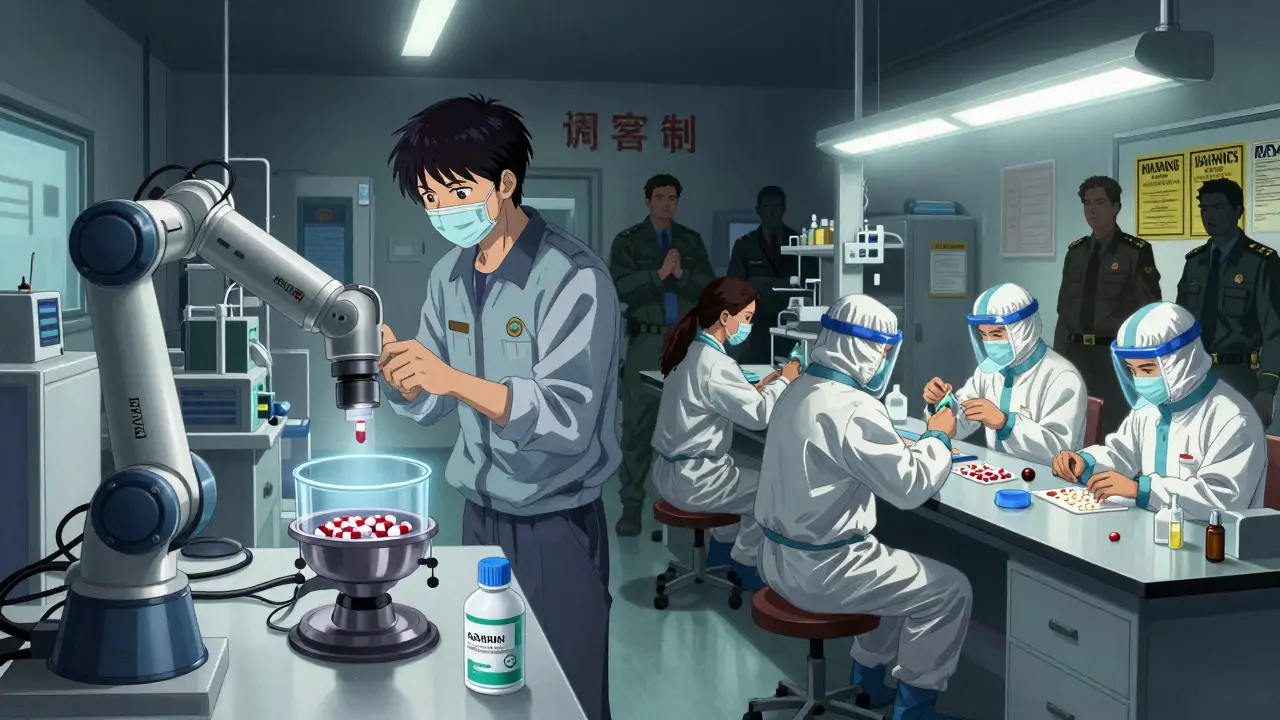
The Pharmerging Markets: Where Growth Is Happening
North America and Western Europe? Their generic markets are slowing. Price controls, long approval times, and shrinking margins mean growth is stuck at 2-5% annually. The real action is in the pharmerging markets: India, China, Brazil, Turkey, Russia, and parts of Africa and the Middle East. These countries aren’t just buying generics-they’re building them. Their populations are young, uninsured, or underinsured. Governments are rolling out public health programs that require affordable drugs. In Brazil, the government negotiates bulk prices directly with manufacturers. In Nigeria, local production of antimalarials and HIV drugs is rising fast. The Middle East is no longer just an importer. Saudi Arabia’s pharmaceutical market is set to hit $9.89 billion by 2025. Egypt, Algeria, and Morocco are all investing in local factories. Mordor Intelligence says these markets are growing at 9.66% a year-faster than any developed region. By 2025, they’ll add $140 billion in new drug spending. That’s not a trend. It’s a shift in power.Regulatory Chaos and the Push for Harmony
There are 78 different drug approval systems around the world. One country wants a six-month review. Another demands 18 months. One requires local clinical trials. Another accepts foreign data. This mess slows down access and raises costs. That’s why the International Council for Harmonisation of Technical Requirements for Pharmaceuticals for Human Use (ICH) matters. It’s a group of regulators from the U.S., EU, Japan, and now 15 more countries-including Brazil, South Korea, and Singapore-that agreed to standardize testing, documentation, and manufacturing rules. More countries joining ICH means faster approvals, lower costs, and fewer delays. But it’s not enough. The FDA still issues warning letters to foreign plants. The European Medicines Agency blocks imports over minor documentation errors. In countries with weak oversight, fake or substandard generics still flood the market. The World Health Organization estimates 1 in 10 medical products in low-income countries is counterfeit. That’s not just a financial problem-it’s a life-or-death one.
What’s Next? The Real Challenges Ahead
The future of generics isn’t just about more pills. It’s about adapting to a changing world. First, margins are shrinking. In 2020, generic manufacturers made 18% profit. By 2024, it dropped to 12%. Why? Too many players, too much competition, and buyers (like pharmacy benefit managers and government agencies) squeezing prices harder than ever. Second, innovation is shifting. Companies can’t just copy old pills anymore. They need to invest in complex biosimilars, combination therapies, and even digital delivery systems-like pills with sensors that track if patients take them. Third, supply chains are fragile. Relying on one country for 65% of your APIs is risky. The pandemic showed us what happens when borders close. Now, countries are diversifying. Vietnam, Thailand, and even Poland are building API plants. It’s slow, but it’s happening. And fourth, the market share of generics will likely drop-from 57.56% of global pharmaceutical sales in 2024 to around 53% by 2030. Why? Because specialty drugs, gene therapies, and personalized medicines are rising. They’re expensive. They’re complex. And they’re not easy to copy. But here’s the thing: even if generics lose market share, they’ll still be the most important part of global health. They’re the reason a diabetic in Kenya can afford insulin. A heart patient in Pakistan can get their blood pressure meds. A child in Indonesia can take antibiotics without her family going broke.Final Thoughts: Generics Are Not Just Cheap Drugs
They’re a lifeline. And their future depends on three things: quality, innovation, and equity. Quality means no more substandard pills. Every batch must be tested. Every factory must be inspected. No exceptions. Innovation means moving beyond pills. Biosimilars, inhalers, injectables, and even AI-driven manufacturing will define the next decade. Equity means making sure no country is left behind. Generics shouldn’t be a privilege for rich nations. They’re a right for everyone. The global generic market won’t stop growing. It’s just changing shape. The winners won’t be the biggest companies. They’ll be the ones who build trust, control their supply chains, and never lose sight of who they’re really serving: patients.Are generic drugs as effective as brand-name drugs?
Yes. By law, generic drugs must contain the same active ingredient, strength, dosage form, and route of administration as the brand-name version. They must also meet the same strict standards for quality, purity, and performance set by regulatory agencies like the FDA and EMA. The only differences are in inactive ingredients (like fillers or dyes) and packaging. Clinical studies consistently show generics work just as well.
Why are biosimilars more expensive to make than regular generics?
Biosimilars are copies of biologic drugs, which are made from living cells-like proteins or antibodies. These molecules are huge, complex, and sensitive to changes in temperature, pressure, and environment. Manufacturing them requires advanced bioreactors, sterile facilities, and over 10-20 times more steps than making a simple pill. A regular generic might cost $1-5 million to develop. A biosimilar can cost $100-250 million. That’s why they’re priced higher-15-30% below the original, not 80%.
Which countries produce the most generic drugs?
India and China dominate global generic production. India makes over 60,000 generic medicines and supplies 20% of the world’s generic volume by quantity. China produces about 40% of the world’s active pharmaceutical ingredients (APIs)-the raw material used in pills. Together, they control roughly 35% of global manufacturing capacity. Other growing players include Brazil, Turkey, and Vietnam, which are expanding local production to reduce imports.
Why do some countries have low generic usage despite lower costs?
It’s often about policy, not price. In countries like Italy or Spain, doctors may still prefer prescribing branded drugs due to habit, pharmaceutical marketing, or reimbursement rules that favor originators. Some health systems don’t incentivize pharmacists to substitute generics. Others lack public awareness or trust in generic quality. In contrast, Germany and the U.S. have strong policies that encourage or even require generic substitution, leading to much higher usage.
Is it safe to buy generic drugs from online pharmacies?
Only if they’re licensed and regulated. Many online pharmacies sell counterfeit or substandard generics-especially those based outside your country. The WHO estimates 1 in 10 medicines in low-income countries are fake. Always buy from pharmacies that require a prescription, display a verifiable license, and are registered with your national health authority. Avoid sites offering drugs at prices that seem too good to be true-they usually are.
What’s the biggest threat to the future of generic drugs?
The biggest threat is supply chain fragility. With China supplying 65% of global APIs, any disruption-political, environmental, or regulatory-can cause worldwide shortages. Add to that shrinking profit margins, rising regulatory scrutiny, and the complexity of biosimilars, and many smaller manufacturers are being pushed out. Without investment in local production, quality control, and innovation, the system risks becoming unstable just when it’s needed most.


Posts Comments
Nupur Vimal December 16, 2025 AT 13:39
India makes 60k generics but still imports 65% of APIs from China 🤦♀️ this isn't pharma its a hostage situation. We think we're self-sufficient but we're just repackaging Chinese powder with our own label. No one talks about this. The PLI scheme is theater. Real change needs infrastructure not incentives.
Lisa Davies December 18, 2025 AT 01:07
This is so important 💪 I work in a clinic and every day I see patients choosing generics because they can't afford the brand. It's not just about cost-it's dignity. 🌍❤️
Melissa Taylor December 18, 2025 AT 09:52
The fact that biosimilars cost $100M+ to develop but only save 15-30% is insane. We need to stop treating biologics like luxury goods. If we can make a smartphone in a garage, why can't we make life-saving proteins affordably? This system is broken.
Michelle M December 18, 2025 AT 19:01
Generics are the quiet heroes of global health. No one throws parades for them. No celebrities endorse them. But without them, millions would die quietly in the dark. It's not about profit. It's about whether we believe health is a right or a commodity. And if it's a right, then we're failing spectacularly.
Cassie Henriques December 19, 2025 AT 20:14
The ICH harmonization is a step forward but still insufficient. The FDA's 187 warning letters in 2023? 40% targeted India/China. That's not quality control-it's protectionism dressed as compliance. Regulatory arbitrage is alive and well. We're punishing the very suppliers who keep the system running.
Jake Sinatra December 21, 2025 AT 13:57
The data on generic efficacy is overwhelming. Meta-analyses show no clinical difference between branded and generic drugs across 100+ therapeutic categories. The resistance to generics in some countries stems from institutional inertia, not scientific evidence. We must prioritize evidence over tradition.
Raj Kumar December 22, 2025 AT 07:51
bro china makes the stuff but india bottles it and sells it as their own. its like a factory in shenzhen makes your phone and then you put an apple logo on it. we all know its the same thing but the branding makes people feel better. also pli scheme is just money thrown at big pharma. small players still get crushed.
John Brown December 23, 2025 AT 22:38
I've seen this play out in rural clinics. A mom in Mississippi chooses the $4 generic instead of the $400 brand. She doesn't care about the label. She cares that her kid gets better. The real villain isn't the manufacturer-it's the system that lets prices spiral out of control in the first place.
Christina Bischof December 24, 2025 AT 18:11
i just read this and thought about my dad's blood pressure med. he's been on the same generic for 12 years. never had an issue. wonder if the people writing all these reports ever actually talked to someone who takes them daily
Jocelyn Lachapelle December 26, 2025 AT 13:46
The rise of pharmerging markets is the most exciting part. Brazil negotiating bulk prices. Nigeria building local antimalarial plants. This isn't just about cost-it's about sovereignty. When countries make their own medicine, they stop being customers and start being partners.
Mike Nordby December 27, 2025 AT 07:09
The claim that generics will drop to 53% market share by 2030 is misleading. While specialty drugs are growing, their absolute volume remains small. Generics will still constitute the overwhelming majority of prescriptions dispensed. Market share by revenue ≠ market share by volume. The distinction matters.
John Samuel December 27, 2025 AT 23:41
Imagine a world where the most vital medicines are manufactured in the shadow of geopolitical tension. Where a single factory shutdown in Shanghai sends ripples through ICU wards from Lagos to Lisbon. We've turned life-saving pharmaceuticals into a supply chain gamble. This isn't capitalism-it's recklessness with human lives as the collateral.
Sai Nguyen December 28, 2025 AT 03:21
India makes 60k generics? Good. But China controls the soul of every pill. We let them. We let them poison our water, our air, our supply chains. Now we want to be global pharma leaders? First, stop being their subcontractors. Build your own labs. Own your own future. No more begging for API scraps.
Write a comment