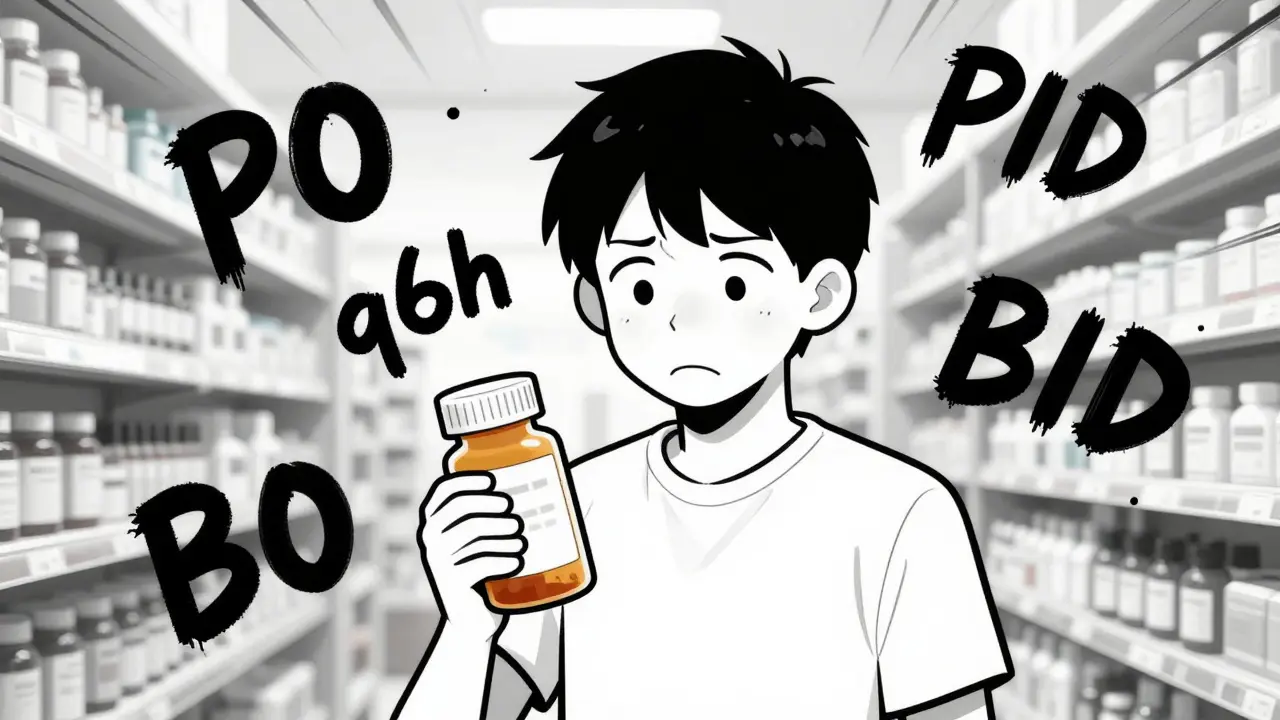
Imagine picking up a new bottle of antibiotics. The label says "Take 1 tab PO q6h while awake." You read it, nod, and walk out. But here is the catch: you have no idea what "PO" or "q6h" means. You guess. Maybe you take it every six hours, even at night. Or maybe you think "q6h" means four times a day because there are twenty-four hours in a day. This isn't just a hypothetical scenario. It is happening right now, leading to over 350,000 hospital admissions annually in the United States alone.
Prescription labels are supposed to be your roadmap for getting better. Instead, they often act as a barrier. Confusing jargon, tiny fonts, and inconsistent instructions create a minefield for patients. The result? Medication errors that cost billions and, more importantly, put lives at risk. If you have ever stared at a pharmacy label feeling confused, you are not alone. Let's break down why these misunderstandings happen and exactly how you can protect yourself.
Why Prescription Labels Fail Us
The root of the problem lies in a mismatch between medical language and everyday understanding. For decades, pharmacists and doctors used Latin abbreviations and clinical shorthand. Terms like BID (bis in die, meaning twice daily) or PRN (pro re nata, meaning as needed) were standard. But for the average person, these codes are meaningless.
Research from the early 2000s revealed a startling truth: nearly half of primary care patients misunderstood at least one instruction on their prescription label. A study by Davis et al. found that 46% of patients at community health centers misinterpreted directions. Even worse, among those with marginal literacy, that number jumped to 71%. The issue isn't intelligence; it is clarity. When labels use an 8th-grade reading level instead of a 3rd-grade level, the chance of misunderstanding increases by nearly 13 times.
Another major culprit is design. Many labels cram too much information into small spaces. Font sizes vary wildly between pharmacy systems, ranging from unreadable 10-point text to clearer 14-point text. Color contrast is often poor, making black text on white backgrounds hard to distinguish for older adults or those with vision issues. Without standardized icons or clear visual cues, patients are left guessing about critical details like whether to take a pill with food or on an empty stomach.
The Most Common Misinterpretations
Certain phrases consistently trip people up. Understanding these specific pitfalls can help you spot them before they cause harm.
- "Twice Daily" vs. "Every Two Hours": Patients often confuse "twice daily" (BID) with taking medication every two hours. Taking a drug eight times a day instead of two can lead to dangerous overdoses.
- "Once Daily" vs. "Once": Some patients see "once daily" and assume they only need to take the entire course once, rather than continuing it every day until finished.
- "Take With Food": This instruction is frequently misunderstood as "take instead of food." Others interpret it as needing a full meal, when a simple snack might suffice. Conversely, some skip meals entirely, causing stomach irritation.
- Latin Abbreviations: As mentioned, terms like "q6h" (every six hours) or "HS" (at bedtime) are rarely understood by laypeople. One patient shared a story online where they calculated "q6h" as four doses a day (24 divided by 6), leading to severe stomach bleeding from antibiotic overdose.
These aren't minor mistakes. They lead to emergency room visits, skipped doses, and treatment failures. According to the Institute of Medicine, inadequate attention to patient literacy in label design is a systemic failure that contributes significantly to these errors.
How Standards Are Trying to Fix the Problem
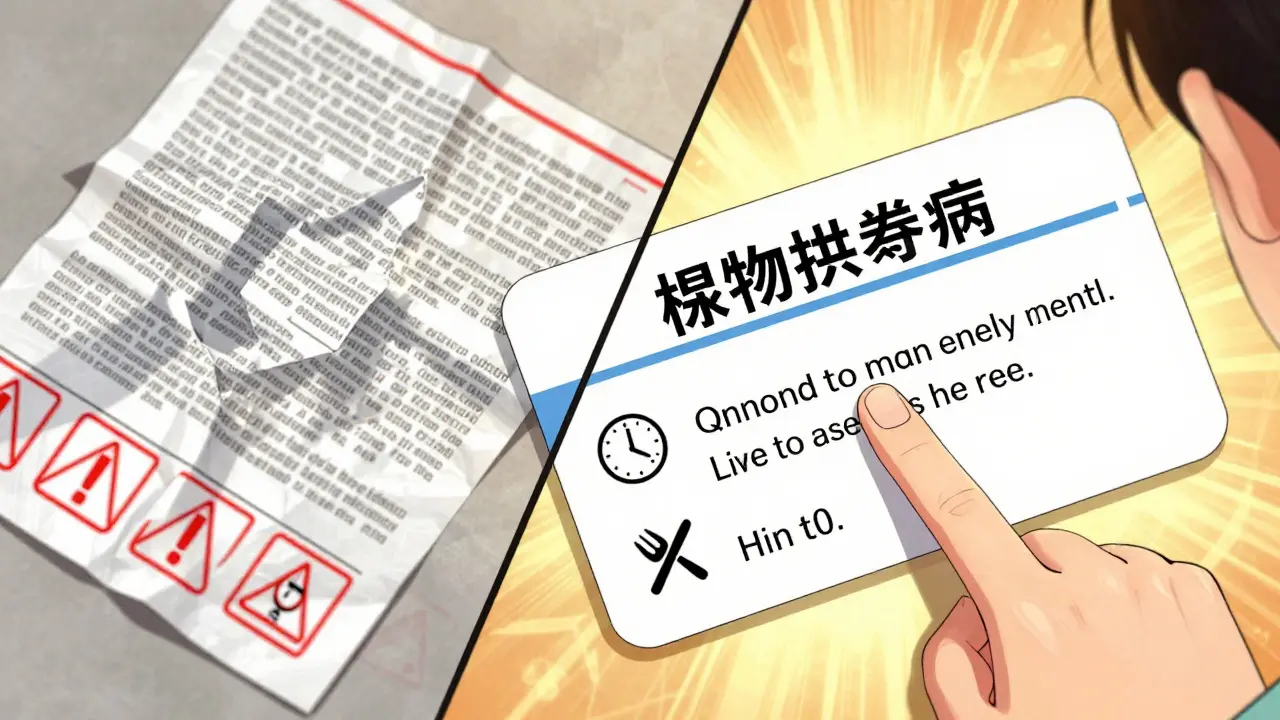
Fortunately, the industry is waking up to this crisis. The US Pharmacopeia (USP) has been leading the charge with its Chapter <17> standards. These guidelines aim to make labels universally understandable. Key requirements include using plain English, prominent drug names in large font, and clear dosage instructions.
| Feature | Standard Label | Evidence-Based Label (USP Compliant) |
|---|---|---|
| Language | Medical jargon (e.g., "ii tab PO qHS") | Plain English (e.g., "Take 2 tablets by mouth at bedtime") |
| Reading Level | High school level (Lexile >1000L) | 3rd-6th grade level |
| Error Rate | 46% for dosage instructions | 12% for dosage instructions |
| Visual Aids | Rarely used | Standardized icons (e.g., clock, fork/knife) |
| Font Size | Inconsistent (10-12pt) | Prominent minimum 12pt for drug name |
Major pharmacy chains like CVS and Walgreens have adopted versions of these standards. Walgreens' "ClearView" system, for instance, showed a 31% improvement in patient comprehension compared to non-standard templates. However, adoption is inconsistent. While 78% of chain pharmacies use USP standards, only 32% of independent pharmacies have followed suit due to the costs of updating their software systems.
Newer innovations are also emerging. The USP updated its standards in 2023 to include QR codes linking to pictogram instructions. In pilot programs at Mayo Clinic, this reduced errors by 62%. Additionally, apps like GoodRx's "Label Lens" use AI to simplify instructions, offering another layer of safety for tech-savvy users.
Practical Steps to Protect Yourself
You cannot control how your pharmacist prints the label, but you can control how you interact with it. Here is a actionable checklist to ensure you understand your medication.
- Use the Teach-Back Method: This is the single most effective tool available. After the pharmacist explains your medication, repeat the instructions back to them in your own words. Say, "So, I should take one tablet in the morning with breakfast and one at dinner, correct?" Studies show this reduces errors by 58%. Do not be shy; pharmacists expect this and prefer it to silent confusion.
- Ask for Plain Language: If you see abbreviations like "BID" or "QD," ask the pharmacist to write out "twice a day" or "once a day." You can request that they add handwritten notes or stickers to clarify timing.
- Request Visual Aids: Ask if your pharmacy offers labels with icons. Symbols for "take with food" (a fork and knife) or "take at bedtime" (a moon) are much easier to process quickly than text.
- Check for Large Print: If you have trouble reading small text, ask for a large-print label. Most major chains offer this free of charge. It ensures the font size is legible without squinting.
- Clarify "As Needed": If a label says "PRN" or "as needed," ask specifically: "What symptoms should trigger me to take this?" and "What is the maximum amount I can take in 24 hours?" Vague instructions lead to under-dosing or over-dosing.
- Record the Conversation: With permission, record the pharmacist's explanation on your smartphone. Hearing it again later helps reinforce memory, especially if you are stressed or unwell.
For seniors, consider using a weekly pill organizer. Sorting pills on Sunday evening removes the daily guesswork. Apps that send reminders can also bridge the gap between complex schedules and daily routines.

The Role of Health Literacy
Health literacy is not just about reading skills; it is about understanding complex medical information. Dr. Michael Wolf from Northwestern University noted that low-literacy patients are 3.4 times less likely to interpret labels correctly. But even college-educated individuals make mistakes. Dr. Ruth Parker found that 23% of college-educated patients still misunderstood common directions.
This highlights a crucial point: everyone is vulnerable to poor labeling. It is not a reflection of your intelligence. It is a reflection of a system that prioritizes brevity over clarity. By advocating for yourself, you contribute to a culture of safety. When you ask questions, you signal to pharmacists that clarity matters.
Language barriers exacerbate this issue. Only 12% of US pharmacies provide labels in Spanish, despite millions of Spanish speakers. Translated labels often suffer from inconsistent terminology, leading to 3.2 times more confusion. If English is not your first language, bring a family member or friend who speaks English to your pharmacy visit. Do not rely solely on machine translation apps for critical medical instructions.
Looking Ahead: What Can We Expect?
The landscape is shifting. Regulatory pressure is intensifying, with 17 states passing legislation requiring health-literate labels by 2025. The FDA has proposed rules that could establish federal standards, potentially reducing national error rates by 44%. Technology is also playing a bigger role. Voice-enabled labels and AI-driven simplification tools are becoming more common, particularly for elderly populations.
However, full standardization faces hurdles. Pharmacy reimbursement structures often do not compensate for the extra time spent counseling patients. Until that changes, the burden remains partly on the patient to engage actively. The goal is a future where every label is as clear as a street sign, but until then, vigilance is your best defense.
Medication errors are preventable. By understanding the common pitfalls of prescription labels and employing strategies like the teach-back method, you take control of your health. Don't leave your well-being to chance. Ask questions, seek clarity, and never hesitate to double-check your instructions.
What does "PO" mean on a prescription label?
"PO" stands for "per os," which is Latin for "by mouth." It simply means you should swallow the medication orally. If you see this abbreviation, you can safely interpret it as "take by mouth."
How can I tell if my prescription label is easy to understand?
An easy-to-understand label uses plain English instead of Latin abbreviations. It should state the drug name clearly, specify the dose (e.g., "1 tablet"), and give explicit timing (e.g., "twice a day" instead of "BID"). Look for a reading level that feels accessible, ideally similar to a 3rd-grade textbook.
What is the "Teach-Back" method?
The Teach-Back method involves repeating the pharmacist's instructions back to them in your own words. This confirms that you understood the message correctly. For example, you might say, "Just to be sure, I take this pill with food every morning." This technique reduces medication errors by nearly 60%.
Why do some pharmacies still use confusing labels?
Many independent pharmacies have not yet updated their software systems to meet modern standards like USP Chapter <17>. Upgrading label templates can cost thousands of dollars per location. Additionally, there is no federal mandate enforcing these standards, so adoption varies widely across the country.
Can I ask my pharmacist to change my label?
Yes, absolutely. You can request large-print labels, plain-language instructions, or additional warning stickers. Pharmacists are trained to assist with health literacy and will often rewrite instructions to make them clearer for you at no extra cost.
What should I do if I don't speak English well?
Bring a trusted family member or friend who speaks English to your pharmacy visit. While some pharmacies offer translated labels, they may not always be accurate or consistent. Having a human interpreter ensures you fully understand the dosage and timing.
Are digital tools helping with prescription labels?
Yes. New technologies like QR codes on labels link to pictorial instructions, and apps like GoodRx's "Label Lens" use AI to simplify text. Voice-enabled labels are also being tested to help elderly patients hear their instructions clearly.