
Tramadol Medication Interaction Checker
Check Your Medications for Risk
This tool helps you identify if your medications could interact with tramadol and increase your risk of serotonin syndrome. Select any medications you're currently taking.
Results
High Risk
High Risk
Tramadol combined with these medications significantly increases your risk of serotonin syndrome, a life-threatening condition.
Do not take tramadol with the medications selected above. This combination is dangerous.
If you've already started tramadol and are taking these medications, stop tramadol immediately and seek emergency medical help.
Emergency Information
Call emergency services immediately if you experience:
- High fever (above 100.4°F)
- Severe muscle rigidity or twitching
- Confusion or agitation
- Uncontrollable shaking
- Rapid heartbeat
- High blood pressure
Most people think of opioids as drugs that just block pain - things like morphine, oxycodone, or fentanyl. But tramadol isn’t like the rest. It’s an opioid, yes, but it also acts like an antidepressant. That’s why it can cause serotonin syndrome even when taken alone - something no other opioid does. And this isn’t a rare edge case. It’s a well-documented, dangerous interaction that doctors are still underestimating.
What Makes Tramadol So Unusual?
Tramadol was developed in the 1970s in Germany and hit the U.S. market in 1995. At first, it was seen as a safer alternative to stronger opioids. But over time, researchers noticed something odd: people on tramadol were getting serotonin syndrome - a life-threatening condition caused by too much serotonin in the brain. Symptoms include high fever, muscle rigidity, confusion, rapid heartbeat, and uncontrollable shaking. These aren’t side effects you’d expect from a painkiller. They’re classic signs of serotonin overload.
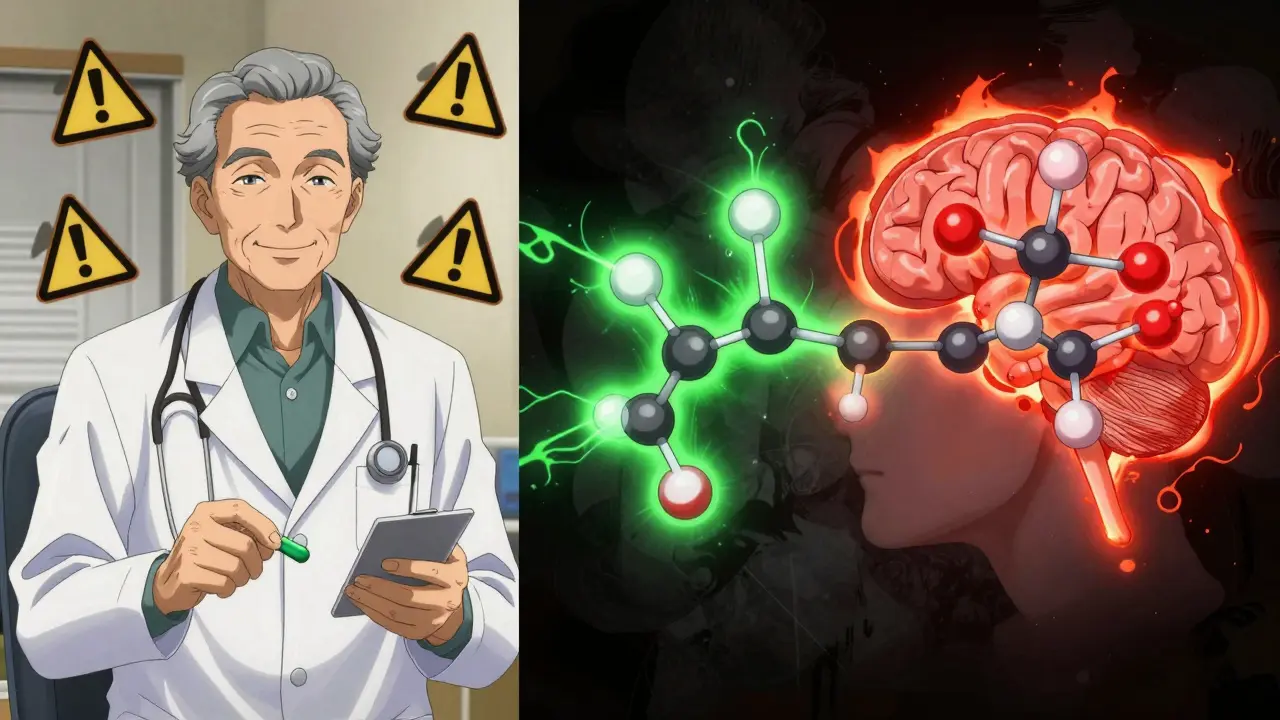
Here’s the twist: tramadol doesn’t just bind to opioid receptors. It also blocks the reuptake of serotonin and norepinephrine. That’s the same mechanism used by antidepressants like Lexapro and Effexor. In fact, the (+)-enantiomer of tramadol - one of its two molecular forms - is a potent serotonin reuptake inhibitor. That means even if you’re not taking any other meds, tramadol alone can flood your brain with serotonin. And unlike morphine or codeine, which almost never cause serotonin syndrome on their own, tramadol has been linked to over 47 documented cases of serotonin syndrome from single-agent use since 2008.
How Serotonin Syndrome Happens
Serotonin syndrome isn’t just about taking too much of one drug. It’s about stacking effects. Your brain has a delicate balance of serotonin. When too much builds up, nerve cells overfire. This triggers a cascade: muscles tighten, body temperature spikes, your heart races, and your nervous system goes haywire.
Tramadol makes this worse because of how your body processes it. Most of it is broken down by an enzyme called CYP2D6. But about 7% of white people - and up to 10% of some populations - have a genetic variation that makes this enzyme work poorly. These are called “poor metabolizers.” In them, tramadol doesn’t turn into its active painkiller form (M1) as well. Instead, more of the parent drug builds up, especially the serotonin-blocking version. This raises the risk of serotonin syndrome even at normal doses.
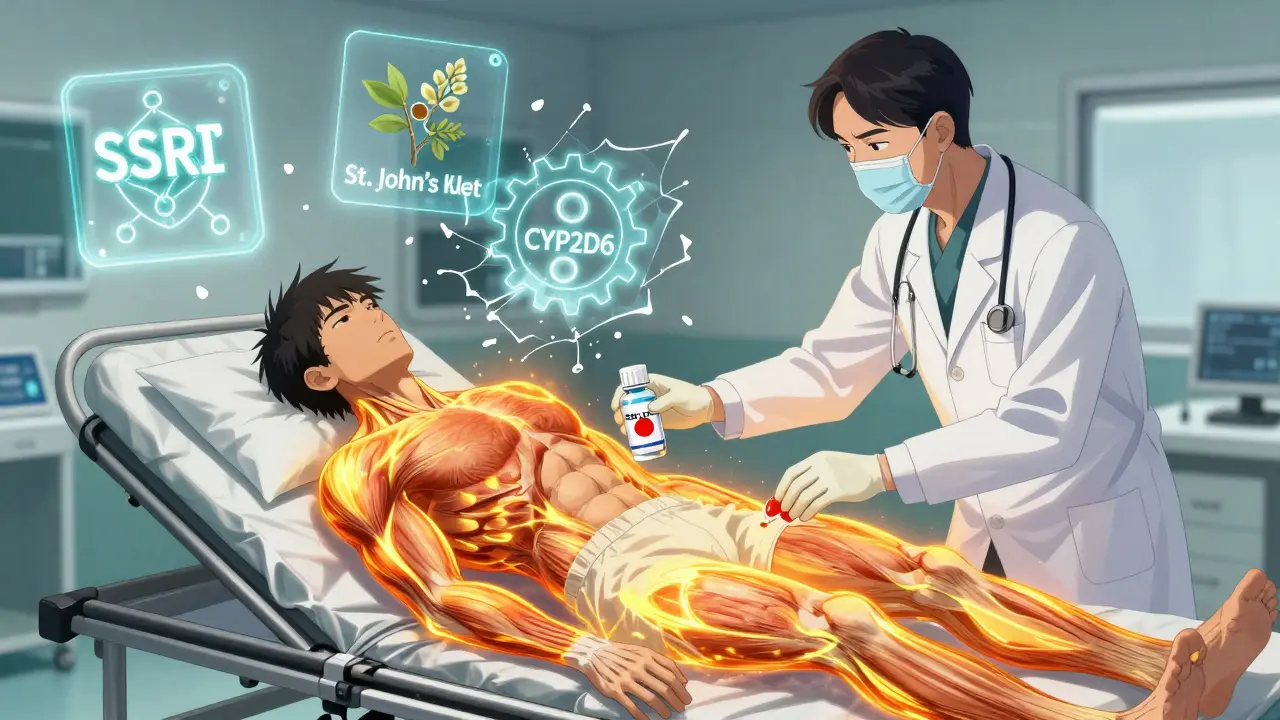
And if you’re taking an SSRI - like sertraline, fluoxetine, or escitalopram - things get even riskier. SSRIs block CYP2D6 too. So now you’ve got two drugs shutting down the same enzyme. Your body can’t clear tramadol. It piles up. A 2015 study of 187,000 Medicare patients found that combining tramadol with an SSRI increased serotonin syndrome risk by 3.6 times compared to taking the SSRI alone. That’s not a small bump. That’s a red flag.
Real Cases, Real Consequences
One 42-year-old woman took two 50 mg tramadol tablets for back pain - no other meds. Within hours, she had a fever of 103°F, rigid muscles, and confusion. She was rushed to the ER. Doctors ruled out infection, stroke, and drug overdose. Then they remembered: tramadol. She was given cyproheptadine - an antihistamine that blocks serotonin - and recovered in 24 hours.
Another case involved a 35-year-old man who took 600 mg of tramadol with fluoxetine. His temperature hit 41.2°C (106°F), his blood pressure soared to 210/110, and his heart rate hit 142 bpm. He spent three days in the ICU. These aren’t outliers. They’re textbook examples of what happens when you ignore tramadol’s dual nature.
Even Reddit forums like r/painmanagement are full of stories. One user wrote: “I didn’t realize my 50 mg tramadol was interacting with my Lexapro until I ended up in the ER with a 104°F fever.” That’s not exaggeration. That’s a real person who thought they were just managing pain.
Who’s Most at Risk?
Not everyone who takes tramadol will get serotonin syndrome. But some groups are far more vulnerable:
- People on SSRIs, SNRIs, or MAOIs - These include common antidepressants and migraine meds like triptans.
- Poor CYP2D6 metabolizers - Especially those of European descent. Genetic testing can identify this, but it’s rarely done.
- Older adults - The American Geriatrics Society lists tramadol as potentially inappropriate for people over 65 because of increased risk.
- People with bipolar disorder or depression - Tramadol can trigger hypomania or worsen mood instability, as seen in documented cases.
The FDA issued a black box warning in 2011 - the strongest possible - about seizure risk at doses over 400 mg/day. But they didn’t stop there. In 2014, they reclassified tramadol as a Schedule II controlled substance, putting it in the same category as oxycodone and fentanyl. That change alone cut U.S. prescriptions by 9.3%. It was a sign that regulators finally recognized the danger.
How Doctors Should Respond
When someone walks in with chronic pain and says, “I’ve been on Zoloft for 10 years,” the last thing you should do is reach for tramadol. There are better options.
Tapentadol is one. It’s another opioid-like painkiller, but it doesn’t affect serotonin reuptake. A 2023 NIH study called TRAM-SAFE found tapentadol had a 63% lower rate of serotonin syndrome than tramadol in patients with depression. That’s not a minor difference - it’s a game-changer.
The Hunter Serotonin Toxicity Criteria is the gold standard for diagnosis. It’s simple: if you have spontaneous clonus (involuntary muscle contractions) OR inducible clonus with fever and sweating, you have serotonin syndrome. No lab test needed. No CT scan. Just clinical observation.
Management is straightforward:
- Stop tramadol immediately.
- Give cyproheptadine - 12 mg orally, then 2 mg every 2 hours if needed.
- Use benzodiazepines (like lorazepam) for agitation and muscle rigidity.
- Monitor temperature, heart rate, and blood pressure closely.
When treated within 6 hours, mortality drops from 22% to under 0.5%.
The Bigger Picture
Tramadol is still prescribed over 39 million times a year in the U.S. It’s cheap - generic versions cost $15-25 for 30 tablets. That makes it tempting for doctors, especially in primary care. But the risks are real, and underdiagnosed. A 2021 study estimated only 28% of tramadol-induced serotonin syndrome cases are correctly identified. Why? Because symptoms look like withdrawal, infection, or heatstroke.
Europe is moving to restrict tramadol use in patients with psychiatric conditions. The European Medicines Agency called its risk-benefit profile “unacceptable” in 2022. By 2025, prescribing may be severely limited there.
Meanwhile, researchers are testing new versions of tramadol - like M1-tramadol - that keep the pain relief but remove the serotonin effect. Phase II trials are underway. That’s the future. But today, we’re stuck with the old version.
What You Should Do
If you’re on tramadol:
- Check what else you’re taking - antidepressants, migraine meds, even St. John’s Wort.
- Watch for signs: shivering, sweating, confusion, muscle stiffness, fever above 100.4°F.
- If symptoms appear, stop the drug and go to the ER. Don’t wait.
- Ask your doctor if you’re a CYP2D6 poor metabolizer. Genetic tests are available.
- Consider alternatives like tapentadol, gabapentin, or physical therapy - especially if you have depression or anxiety.
If you’re a prescriber:
- Never prescribe tramadol with an SSRI, SNRI, or MAOI.
- Screen for psychiatric history. Bipolar disorder? Avoid it.
- Use the Hunter Criteria to diagnose - not guess.
- Know your patient’s meds. Ask about OTC supplements. Many don’t realize St. John’s Wort is a serotonin booster.
Tramadol isn’t evil. It helps people. But it’s not just an opioid. It’s a serotonin modulator in disguise. And that’s what makes it dangerous. Ignoring that truth has cost lives. It’s time to treat it like what it really is - a high-risk drug that demands careful use.
Can tramadol cause serotonin syndrome on its own?
Yes. Unlike other opioids like morphine or oxycodone, tramadol can cause serotonin syndrome even when taken alone. Documented cases exist where patients developed full symptoms after taking only therapeutic doses (e.g., 100 mg twice daily) with no other serotonergic drugs. This is due to its direct inhibition of serotonin reuptake, a mechanism not found in traditional opioids.
What are the first signs of serotonin syndrome from tramadol?
The earliest signs include shivering, muscle twitching, restlessness, sweating, and mild confusion. As it progresses, you may notice high body temperature (above 100.4°F), rapid heartbeat, high blood pressure, and uncontrollable muscle contractions (clonus). If you experience any of these after starting or increasing tramadol, stop the drug and seek emergency care immediately.
Is tramadol safe if I’m not on antidepressants?
It’s not automatically safe. About 7-10% of people - especially those of European descent - are poor metabolizers of tramadol due to CYP2D6 gene variations. In these individuals, tramadol builds up in the bloodstream, increasing serotonin levels even without other medications. Genetic testing can identify this risk, but it’s rarely done. If you have a history of anxiety, depression, or migraines, the risk is still elevated.
Why is tramadol still prescribed if it’s so risky?
Tramadol is cheap, widely available, and effective for certain types of pain - especially nerve-related pain like diabetic neuropathy. Studies show 40-50% of patients get meaningful pain relief at doses under 300 mg/day when no interacting drugs are used. For some, the benefits outweigh the risks. But it should never be first-line. Safer alternatives like tapentadol or gabapentin exist and are now recommended for patients with psychiatric conditions.
What should I do if I think I have serotonin syndrome?
Stop taking tramadol immediately. Call emergency services or go to the nearest ER. Do not wait for symptoms to worsen. Tell the medical team you’re on tramadol - that’s critical. Treatment with cyproheptadine and benzodiazepines can reverse the condition quickly if given within hours. Mortality drops from over 20% to under 0.5% with prompt care.



Posts Comments
peter vencken March 24, 2026 AT 10:10
so i was on tramadol for like 6 months after my knee surgery and never knew it could mess with serotonin. i was on zoloft too and just thought i was being moody. ended up in the er with a fever and thought it was the flu. dumbass move. doc said i got lucky. never take tramadol with antidepressants. period.
Elaine Parra March 26, 2026 AT 00:45
Of course Americans are still prescribing this like it’s candy. In Europe they’ve already banned it for psychiatric patients. This isn’t a ‘risk’-it’s negligence. If you’re prescribing tramadol to someone on SSRIs, you’re not a doctor-you’re a liability.
Caroline Bonner March 26, 2026 AT 18:11
I’ve been a nurse for 18 years, and I’ve seen this happen twice-both times with elderly patients on tramadol and citalopram. One woman developed full-blown clonus and a 105°F fever within 4 hours. She didn’t even know she was on a serotonergic drug. The system is broken. We don’t screen for CYP2D6 status. We don’t educate patients. We just write the script because it’s cheap. And then we wonder why people end up in the ICU. We need mandatory counseling, genetic screening for high-risk groups, and clear labeling. This isn’t rocket science-it’s basic pharmacology.
Linda Foster March 27, 2026 AT 22:39
Thank you for this comprehensive and clinically accurate overview. The integration of pharmacokinetic data with real-world case examples is both enlightening and alarming. I would urge all prescribers to consult the Hunter Criteria prior to initiating tramadol therapy in patients with a history of mood disorders or concurrent serotonergic agents. The evidence is unequivocal.
Chris Crosson March 28, 2026 AT 01:34
Just had a chat with my pain doc last week. He switched me from tramadol to tapentadol because I’m on fluoxetine. Said the data’s clear: 63% lower risk. No more guessing. I’m glad someone finally listened. Also, my pharmacist flagged the interaction before I even asked. That’s how it should be.
Rama Rish March 28, 2026 AT 02:10
tramadol + lexapro = bad idea. i learned the hard way. fever, shaking, scared me. stop it. go to er. simple.
Natasha Rodríguez Lara March 29, 2026 AT 14:58
I’m from the U.S. but my mom’s from India, and she’s been on antidepressants for over a decade. When she started tramadol for her back, I freaked out. We looked up CYP2D6 variants and found she’s a poor metabolizer. Turned out she was already at higher risk. We switched to gabapentin. I’m so glad we caught it. This isn’t just a medical issue-it’s a cultural one. We need better patient education across communities. Language barriers, stigma, lack of access to pharmacists… it all stacks up. Let’s fix this before someone else dies.
Anil Arekar March 30, 2026 AT 13:20
As a medical educator in India, I have consistently emphasized the dual pharmacology of tramadol in our postgraduate seminars. The under-recognition of its serotonergic properties among primary care providers remains a critical gap in our clinical training. While cost-effectiveness is a valid consideration, patient safety must supersede economic convenience. We are currently developing a regional guideline for opioid selection in patients with comorbid psychiatric conditions, and tramadol has been explicitly excluded from first-line recommendations. The data is unequivocal, and the responsibility lies with us to act.
Write a comment