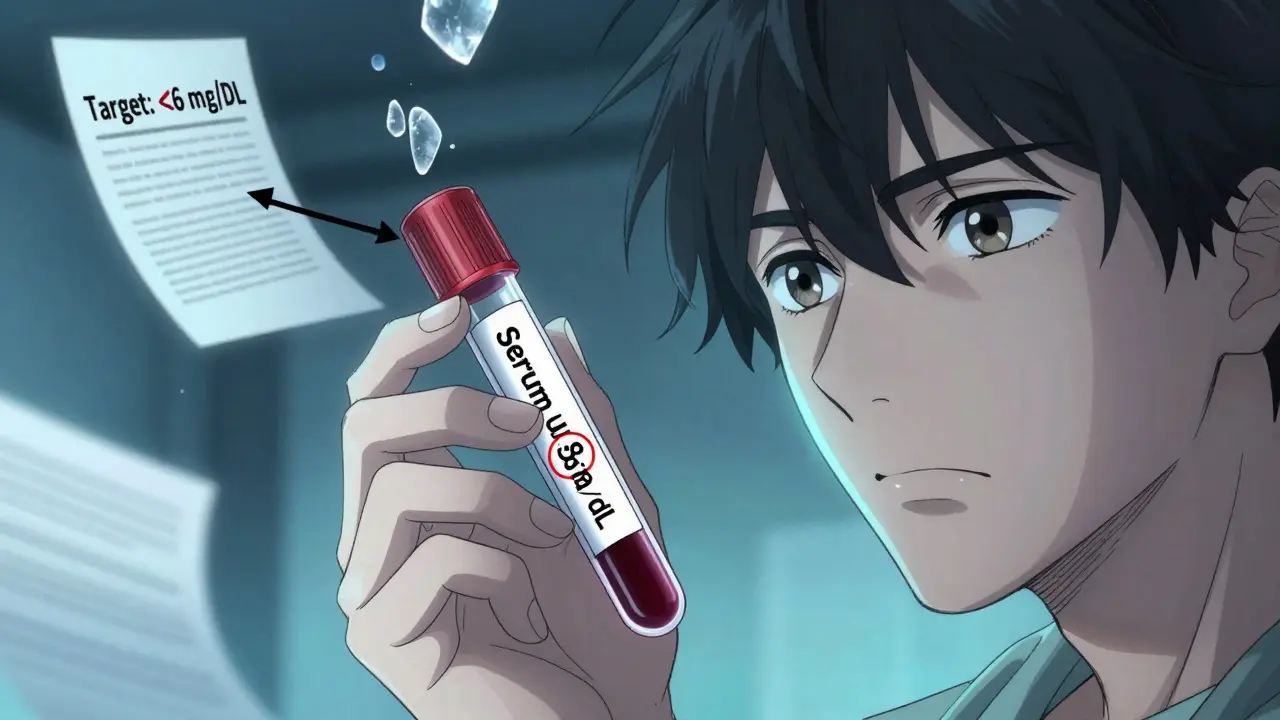
For decades, gout was seen as a painful but inevitable condition-something you just had to live with. But today, we know better. Urate targets have changed everything. If you’re managing gout, your goal isn’t just to stop the flares. It’s to lower your blood uric acid enough to dissolve the crystals already in your joints and prevent new ones from forming. That’s the core idea behind treat-to-target therapy. And it works-if you do it right.
What’s the Right Urate Level?
The science is clear: serum urate needs to stay below 6 mg/dL (360 micromol/L) to stop gout from progressing. That’s the saturation point where monosodium urate crystals start to form. Keep it under that number, and your body slowly starts to dissolve the existing crystals. For most people, hitting this target cuts flare frequency by 74%.
But if you’ve got tophi-those visible lumps under the skin-or joint damage from long-term gout, you need to go lower. Experts now recommend pushing serum urate below 5 mg/dL (300 micromol/L) in these cases. Why? Because studies show you dissolve tophi faster and reduce joint damage more effectively at this level. One 2023 study found that patients hitting <0.30 mmol/L saw an 89% reduction in tophus burden, compared to just 72% at <0.36 mmol/L.
Don’t go too low, though. Below 3 mg/dL (180 micromol/L), there’s no extra benefit-and possibly some risk. No guideline recommends going under that. It’s not about chasing the lowest number possible. It’s about finding the sweet spot where crystals dissolve without unnecessary side effects.
Allopurinol: The First-Line Choice
Allopurinol is still the most common starting point for urate-lowering therapy. It’s cheap, effective, and has been used for over 50 years. Generic versions cost between $4 and $12 a month in the U.S., making it accessible even without good insurance.
But here’s the catch: most people start too low and never increase the dose. Doctors often begin with 100 mg daily-sometimes even 50 mg if kidney function is reduced. That’s fine as a starting point, but it’s rarely enough. Real-world data shows that 30-50% of patients need more than 300 mg per day to reach their target. Some even need 600-800 mg daily, especially if they have normal kidney function.
The key is titration. Don’t stay at 100 mg for six months. Check your serum urate every 4-6 weeks. If it’s still above 6 mg/dL, increase the dose by 50-100 mg. Keep going until you hit your target. This isn’t optional-it’s the difference between control and constant flares.
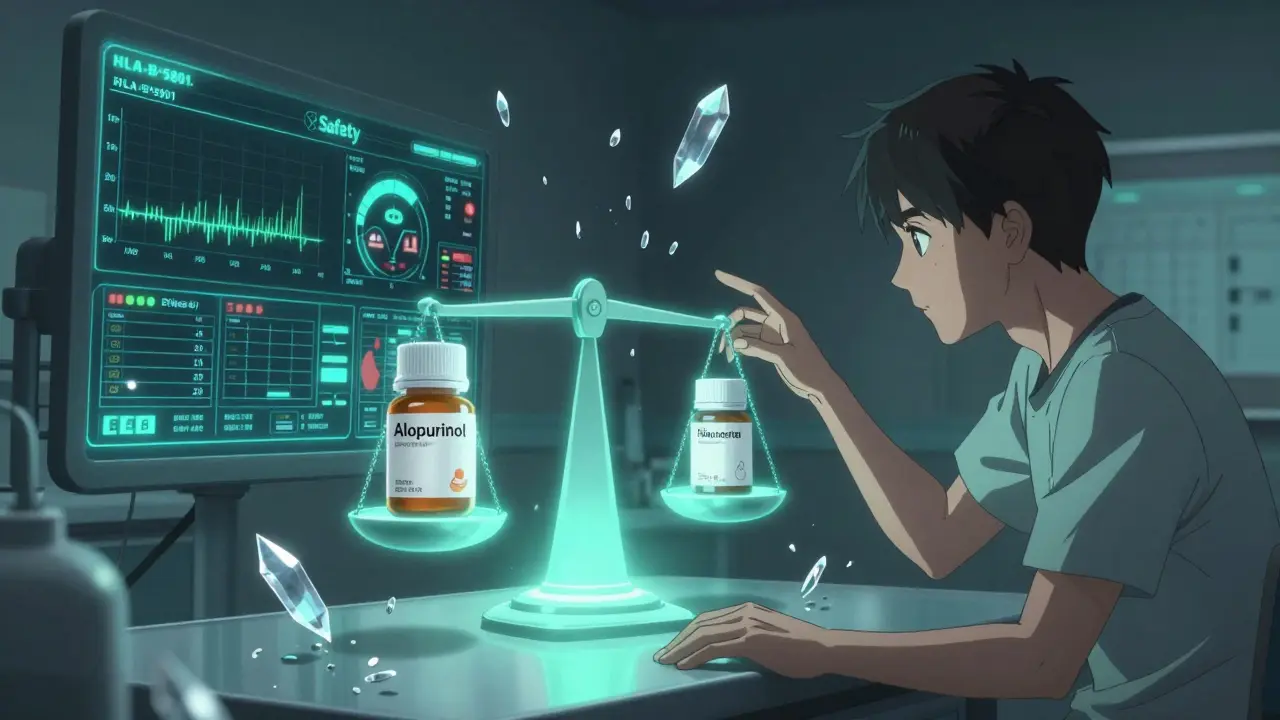
There’s one big safety note: allopurinol can cause a rare but serious reaction called hypersensitivity syndrome. The risk is highest in people with the HLA-B*5801 gene variant, which is more common in people of Asian, African, or Native American descent. Testing for this gene before starting allopurinol is recommended in high-risk groups. Even without testing, watch for rash, fever, or flu-like symptoms in the first few weeks. Stop the drug and call your doctor immediately if they appear.
Febuxostat: When Allopurinol Isn’t Enough
Febuxostat is the other main option. It works differently than allopurinol-it blocks uric acid production more completely. That makes it especially useful for people who can’t reach target levels on high-dose allopurinol, or who can’t tolerate it.
It starts at 40 mg daily. If your urate level is still above target after a month, bump it up to 80 mg. Studies show febuxostat achieves target levels in about 15% more patients with severe kidney disease than allopurinol. That’s why some guidelines, like NICE NG219, say it’s a valid first-line option alongside allopurinol.
But it’s not perfect. Febuxostat costs $30-50 a month in the U.S.-three to ten times more than allopurinol. It’s also linked to a slightly higher risk of cardiovascular events in older patients with heart disease, according to the FDA’s 2019 safety review. So if you have a history of heart attack or stroke, your doctor might lean toward allopurinol unless you absolutely need febuxostat.
One advantage? You don’t need dose adjustments for mild kidney problems. Allopurinol requires careful dosing if your kidneys aren’t working well. Febuxostat doesn’t. That makes it easier to use in older patients or those with chronic kidney disease.

Why So Many People Fail to Reach Target
Here’s the uncomfortable truth: only about 42% of gout patients reach their urate target within a year. Why? It’s not because the drugs don’t work. It’s because of how they’re used.
First, many doctors don’t monitor urate levels regularly. Medicare data shows only 54% of patients get monthly tests during the titration phase. But studies prove monthly monitoring increases success by 31%. If you’re not getting your blood checked every 4-6 weeks, you’re flying blind.
Second, patients get scared. When you start allopurinol or febuxostat, your body starts breaking down urate crystals. That can trigger a flare-sometimes worse than before. Patients think the medicine is making things worse and stop taking it. That’s called the “flare paradox.” It’s temporary. Starting a low-dose colchicine or NSAID at the same time as ULT can prevent this. But few patients are told this ahead of time.
Third, education is lacking. A survey of 12,450 gout patients found that 62% said their doctor didn’t explain how to titrate the dose properly. They were given a pill and told to take it daily-but not told to come back for blood tests. No wonder so many give up.
What’s New in 2025?
The field is moving fast. In 2024, the ACR updated its quality measures to say that successful gout management requires two consecutive serum urate readings below 6 mg/dL, at least 30 days apart. One test isn’t enough. You need proof it’s sustained.
There’s also new interest in precision dosing. A 2024 study called GOUT-PRO showed that using genetic testing (looking at ABCG2 and SLC22A12 genes) to guide allopurinol dosing increased target achievement from 61% to 83% in six months. This isn’t routine yet-but it’s coming.
And then there’s the ULTRA-GOUT trial, which is comparing fixed-dose allopurinol (like 300 mg daily) versus treat-to-target titration. Results are expected late 2025. If the trial shows titration is clearly better, it could change guidelines worldwide.
On the horizon: new drugs like verinurad, a uricosuric that helps kidneys excrete more uric acid. It could mean fewer high-dose pills and less risk of side effects. But they’re still in trials.
What Should You Do?
If you have gout and aren’t on urate-lowering therapy, ask your doctor why. If you’re on allopurinol or febuxostat but still having flares, ask for a serum urate test. Don’t wait for your next annual checkup. Get it done now.
Ask these questions:
- What’s my current serum urate level?
- What’s my target? Is it 6 mg/dL or lower?
- Am I on the right dose? Have we increased it since I started?
- Are you monitoring my levels every 4-6 weeks?
- Am I taking something to prevent flares when I start this medicine?
Don’t settle for “it’s just gout.” This is a chronic disease with a proven, effective treatment. But it only works if you and your doctor treat it like one.
When to Stop or Switch Therapy
You don’t stop urate-lowering therapy just because you haven’t had a flare in a year. Stopping means crystals will reform. You might feel fine, but the damage is still there.
Only consider stopping if:
- You’ve had no flares for 5+ years,
- Your tophi are completely gone (confirmed by imaging),
- Your serum urate has been below 5 mg/dL for at least 2 years,
- Your doctor agrees it’s safe to try tapering.
Even then, do it slowly. Reduce the dose over 6 months and monitor urate levels closely. If it rises above 6 mg/dL, restart the original dose.
Switching from allopurinol to febuxostat (or vice versa) is common. If you’ve hit the max dose of one and still aren’t at target, switching is the next step. Don’t wait for another flare. Just ask.
What About Asymptomatic High Uric Acid?
If your uric acid is high but you’ve never had a gout flare, you don’t need medication. The 2020 ACR guideline says this clearly: don’t treat asymptomatic hyperuricemia. The risk of side effects from allopurinol or febuxostat outweighs the benefit if you’ve never had a flare.
Focus on lifestyle instead: cut back on alcohol (especially beer), reduce sugary drinks, lose weight if needed, and avoid organ meats. These help-but they rarely lower uric acid enough to prevent flares on their own. That’s why medication is only for those who’ve already had gout.
Final Thoughts
Gout isn’t a punishment for eating too much steak. It’s a metabolic disease with a clear, measurable target. Allopurinol and febuxostat are tools. But they only work if used correctly-with regular monitoring, proper dosing, and patient education.
The data is solid. The guidelines agree. The tools are available. The only thing missing is action.
What is the ideal serum urate level for gout?
For most people with gout, the target is below 6 mg/dL (360 micromol/L). If you have tophi, joint damage, or frequent flares, aim for below 5 mg/dL (300 micromol/L). Never go below 3 mg/dL (180 micromol/L)-there’s no added benefit and potential risks.
Is allopurinol better than febuxostat?
Allopurinol is usually first-line because it’s cheaper and has a long safety record. Febuxostat is better for people with severe kidney disease or those who can’t reach target on high-dose allopurinol. But febuxostat carries a slightly higher cardiovascular risk in older patients with heart disease. The choice depends on your health, kidney function, and cost.
Why do I get more flares when I start allopurinol?
When urate-lowering therapy starts, crystals begin to dissolve, which can trigger inflammation. This is called the flare paradox. It’s temporary. Taking low-dose colchicine or an NSAID for the first 3-6 months reduces this risk significantly. Talk to your doctor about starting this alongside your ULT.
How often should my urate levels be checked?
During dose titration, check every 4-6 weeks until you reach your target. Once stable, check every 6 months. Monthly monitoring increases success by 31% compared to quarterly. If your doctor isn’t testing you regularly, ask why.
Can I stop taking allopurinol if I haven’t had a flare in years?
Only under strict conditions: no flares for 5+ years, all tophi gone (confirmed by imaging), and serum urate below 5 mg/dL for at least 2 years. Even then, taper slowly and monitor levels. Stopping usually leads to recurrence.
Do I need genetic testing before taking allopurinol?
Not always, but it’s strongly recommended if you’re of Asian, African, or Native American descent, or if you’ve had a previous skin reaction to allopurinol. The HLA-B*5801 gene increases risk of hypersensitivity syndrome. Testing can prevent life-threatening reactions.
What’s the difference between treat-to-target and fixed-dose therapy?
Fixed-dose means taking the same amount every day (like 300 mg allopurinol) regardless of your urate level. Treat-to-target means adjusting the dose based on blood tests until you hit your goal. Treat-to-target is far more effective-studies show it doubles the chance of reaching target levels.
Are there any new gout drugs coming soon?
Yes. Verinurad, a new uricosuric, is in phase III trials and could help patients reach target levels with lower doses. Other drugs targeting uric acid production and excretion are in early development. But allopurinol and febuxostat remain the backbone of treatment for now.






Posts Comments
Ian Cheung January 10, 2026 AT 05:50
Man I used to think gout was just beer and steak karma until my uncle lost three toes to tophi and the doc said 'lower your urate or lose more' - now I’m on allopurinol and my joints feel like they remember what walking is
Saumya Roy Chaudhuri January 11, 2026 AT 03:35
Oh please. You think 6 mg/dL is enough? In India we’ve seen patients with chronic tophi dissolve completely at 4.5 mg/dL - and that’s with no fancy meds, just strict diet and allopurinol titrated slowly. Western medicine still underdoses because they’re scared of liver enzymes. Pathetic.
anthony martinez January 12, 2026 AT 15:06
So we’re saying if you don’t hit 5 you’re basically just letting your joints turn into rock candy? That’s… oddly poetic in a horrifying way
Mario Bros January 12, 2026 AT 18:37
Keep going man. You got this. Low urate = less pain = more coffee, more walks, more life. You’re not just treating gout - you’re reclaiming your body. 💪
Jake Nunez January 13, 2026 AT 22:45
In my village in Nigeria, we used to crush papaya seeds and boil them with ginger for gout. Didn’t know about urate targets but the swelling went down. Maybe science is finally catching up to grandma’s wisdom?
Christine Milne January 15, 2026 AT 05:21
It is both scientifically indefensible and ethically irresponsible to suggest that serum urate levels below 5 mg/dL are universally beneficial. The 2023 study referenced lacks adequate control for confounding variables, including dietary purine intake, renal function, and concomitant diuretic use - all of which significantly influence outcomes. One must exercise extreme caution before adopting such aggressive therapeutic targets.
lisa Bajram January 15, 2026 AT 06:21
YES. YES. YES. I’ve been screaming this from the rooftops - if you’ve got tophi, 6 is a fantasy. I had one the size of a marble under my elbow for 8 years. At 5.1, it shrunk. At 4.8, it vanished. My podiatrist cried. I cried. My cat cried. We all cried. This isn’t medicine - it’s magic. And you’re not ‘over-treating’ - you’re giving your body back its dignity.
Ted Conerly January 16, 2026 AT 01:19
Just a heads up - if you’re on allopurinol and still flaring, you’re probably not on enough. Start low, go slow, but don’t stop until you’re under 5. Most docs quit at 300mg because they’re scared. You don’t have to be.
Faith Edwards January 16, 2026 AT 22:16
It is lamentable that the medical establishment has succumbed to the vulgar pragmatism of ‘treat-to-target’ - a concept born not of clinical wisdom, but of pharmaceutical marketing and the commodification of chronic illness. One wonders whether the goal is patient health… or simply the expansion of biologics revenue streams.
Jay Amparo January 17, 2026 AT 11:13
My cousin in Delhi was told to take febuxostat after his first flare. He refused. Said ‘I’ll just stop eating fish and beer.’ He did. Three years later - zero flares. Urate was 5.2. He’s happy. Maybe not everyone needs pills?
Lisa Cozad January 17, 2026 AT 20:02
My mom’s been on allopurinol for 12 years. She’s 76. Never had another flare. Her urate’s been at 4.9 since 2018. I just wish more doctors would tell patients this isn’t a ‘sometimes’ thing - it’s a lifelong habit.
Bradford Beardall January 18, 2026 AT 02:31
Wait - so if I hit 4.8, do the crystals just… disappear? Like magic dust? Or do they slowly dissolve over months? Does it hurt? Is there a visual? I need to know this for my next TikTok.
Aurora Memo January 19, 2026 AT 06:57
I just want to say - if you’re reading this and you’re scared to start treatment, you’re not alone. I was too. But this isn’t about being perfect. It’s about showing up. Even if it’s just one pill a day. You’re doing better than you think.
chandra tan January 20, 2026 AT 21:25
My uncle in Kerala says gout is ‘karma for eating too much chicken curry’. He’s been on febuxostat for 5 years. Still eats chicken curry. Still no flares. So maybe the curry’s fine. It’s the beer that’s the problem.
Dwayne Dickson January 21, 2026 AT 13:01
It is worth noting that the pharmacokinetic variability of febuxostat in individuals with CYP2C9 polymorphisms may necessitate genotype-guided dosing - a consideration conspicuously absent from current guidelines. One must question whether the current treat-to-target paradigm is truly personalized, or merely standardized under a veneer of innovation.
Write a comment