
Imagine you're in the middle of a stressful evening with a sick toddler. You've got the fever reducer ready, and in a rush, you grab a teaspoon from the kitchen drawer. It seems like a harmless shortcut, right? Wrong. That simple act is one of the most common mistakes parents make, and it can lead to a dangerous situation. When it comes to kids, the difference between a healing dose and a toxic one can be as small as a few milliliters. Children's medicine dosing requires absolute precision because children's bodies process medication differently than adults, making them far more sensitive to even slight errors.
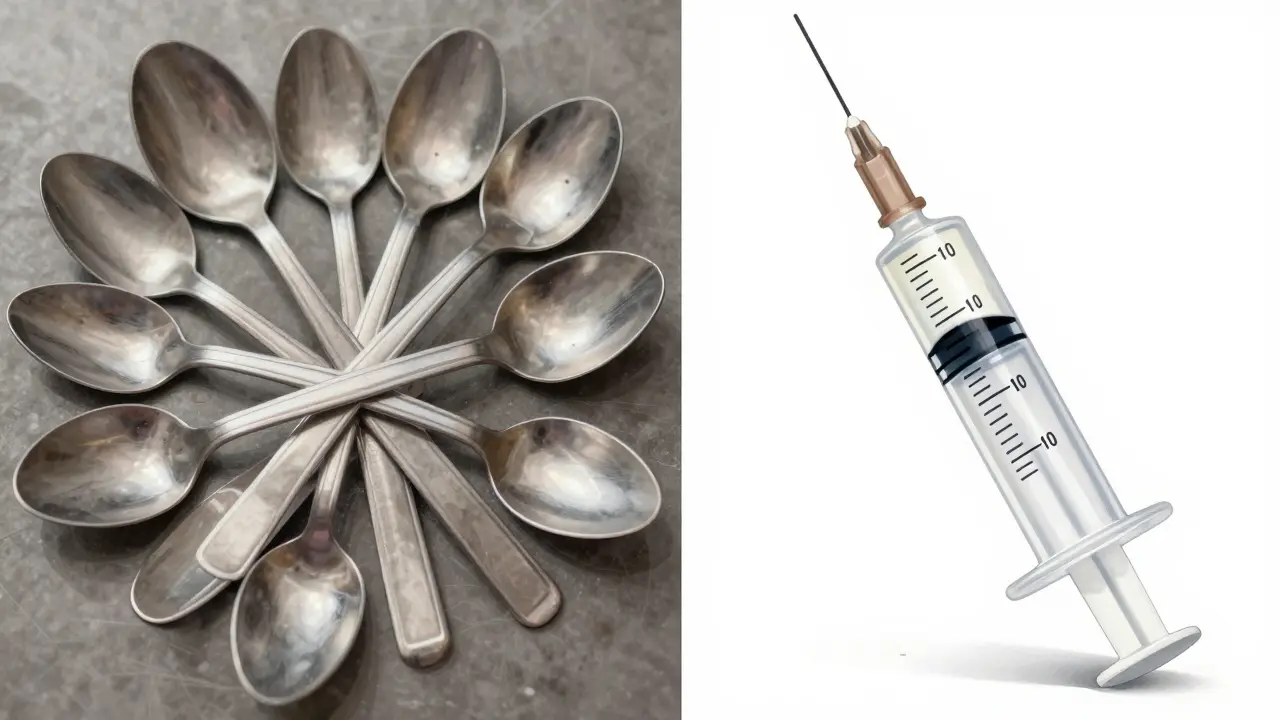

The reality is that your kitchen spoons are designed for soup, not science. A standard medical teaspoon is exactly 5 milliliters (mL), but a search through a random kitchen drawer reveals a chaotic variety. Some household spoons hold 3 mL, others hold 7 mL. This means you could be off by as much as 40% without even realizing it. If you accidentally grab a tablespoon instead of a teaspoon, you might give your child three times the amount of medicine they actually need. This isn't just a minor slip-it's a gamble with your child's safety.
The High Cost of 'Close Enough'
You might wonder if being off by a milliliter or two really matters. In pediatric care, it absolutely does. According to data from the National Institutes of Health (NIH), using household spoons doubles the chance of a dosing error. In fact, nearly 40% of parents who use these tools fail to measure the intended dose correctly. The consequences range from underdosing-where the medicine doesn't work and the infection persists-to overdosing, which can lead to severe side effects or toxicity.
Poison control centers deal with the aftermath of these mistakes every day, receiving over 10,000 calls annually specifically related to liquid medication errors in children. These aren't usually cases of intentional misuse; they are parents trying their best with the wrong tools. The American Academy of Pediatrics (AAP) has been warning against this since 1978, yet the habit persists because it feels intuitive. But intuition doesn't measure medicine; calibration does.
Comparing Your Dosing Options
Not all measuring tools are created equal. If you're choosing between a cup, a dropper, and a syringe, the choice impacts the safety of the dose. For example, dosing cups are great for larger amounts but struggle with precision when you need a dose that isn't a multiple of 5 mL (like 3.5 mL). Oral syringes are the gold standard because they allow you to measure down to 0.1 mL increments.
| Tool | Accuracy | Best Use Case | Major Risk |
|---|---|---|---|
| Household Spoon | Very Low | Eating soup | Up to 40% variance in volume |
| Dosing Cup | Medium | Doses in 5mL increments | Difficult to read small volumes |
| Oral Syringe | Very High | Precise, small doses | None if used correctly |
| Medicine Dropper | High | Infant medications | Potential for dripping/loss |
The 'Milliliter' Rule
There is a reason why doctors and pharmacists are pushing for a total shift toward milliliters. Terms like "teaspoon" or "tsp" are dangerously ambiguous. Research shows that when a label says "teaspoon," about 33% of parents are tempted to use a kitchen spoon. However, when the label explicitly uses milliliters (mL), that number drops to less than 10%.
The Centers for Disease Control and Prevention (CDC) created the "Spoons are for Soup" campaign to drive this point home. The logic is simple: by removing the word "spoon" from the medical equation, we remove the temptation to use the kitchen drawer. When you see "mL," you know you need a medical device. When you see "tsp," you might think of your silverware.
How to Administer Medicine Safely
Getting the dose right is only half the battle; the way you give the medicine also matters. If you're using an oral syringe, don't just squirt it anywhere. To prevent choking and ensure the child swallows the full amount, aim the syringe toward the inside of the cheek. This allows the liquid to flow naturally toward the back of the throat without hitting the gag reflex.
Follow these practical steps for every dose:
- Check the device: Only use the syringe or cup that came with that specific medication. Don't swap devices between different medicines.
- Eye-level check: Always hold the syringe or cup at eye level to ensure the liquid line is exactly on the mark. Looking from above or below creates a parallax error, leading to an incorrect dose.
- Double-verify: Read the label, then look at the syringe, then read the label again. It takes five extra seconds but prevents a trip to the ER.
- Ask the pro: If you lost the measuring device, don't guess. Call your pharmacist and ask for a replacement oral syringe.
Dealing with Common Dosing Dilemmas
What happens when your child spits out half the medicine? Many parents panic and immediately give a second full dose. This is where dangerous overdosing happens. Before you double up, check the medication type. Some drugs have a wider safety margin than others. The best move is to call your pediatrician or a pharmacist and tell them exactly how much you think was lost. They can tell you if a partial "top-up" dose is safe.
Another common issue is the struggle with a fighting child. If you're fighting to get a spoon into a child's mouth, the risk of aspiration (medicine going into the lungs) increases. This is why oral syringes are not just more accurate, but safer. They allow you to control the flow and position of the medicine much better than a spoon ever could.
Why are household spoons inaccurate for medicine?
Household spoons are manufactured for eating, not measuring. While a medical teaspoon is exactly 5 mL, kitchen spoons vary widely, often ranging from 3 mL to 7 mL. This variance can lead to a 40% error in the dose your child receives.
Is an oral syringe better than a dosing cup?
Yes. Oral syringes are generally the most accurate tool, especially for doses smaller than 5 mL. They have finer graduations (down to 0.1 mL) and allow for more controlled administration into the side of the mouth, reducing the risk of choking.
What should I do if my medicine label says 'teaspoon' instead of 'mL'?
Even if the label uses the word 'teaspoon,' you should still use a calibrated medical device. One standard medical teaspoon equals 5 mL. If you are unsure, contact your pharmacist to clarify the exact milliliter amount needed.
Can I reuse a dosing syringe from a previous medication?
It is best to use the device that comes with the current medication to ensure the volume markings match the concentration of that specific drug. If you must reuse one, wash it thoroughly with soap and water and verify that the mL markings are clear and accurate.
What are the signs of a medication overdose in a child?
Signs vary by medication but can include extreme drowsiness, nausea, vomiting, or difficulty breathing. If you suspect a dosing error, contact your local poison control center or seek emergency medical care immediately.
Next Steps for Parents
The next time you visit the pharmacy, do a quick audit of your medicine cabinet. Toss any old, unmarked plastic cups and replace them with a few high-quality oral syringes. If you're buying over-the-counter meds, check that they come with a measuring device. If they don't, don't leave the store without asking the pharmacist for one.
When you're at your next pediatric appointment, ask your doctor to show you the exact mark on the syringe for your child's current weight-based dose. Knowing exactly where that line is-before the child is sick and crying-makes the process much calmer and significantly safer.







Posts Comments
dwight koyner April 7, 2026 AT 08:35
It is imperative to emphasize that the concentration of medication varies significantly between brands. Using a syringe from a different bottle can lead to catastrophic dosing errors if the markings are not calibrated to the specific drug concentration. Always verify the volume against the current prescription label.
Jamar Taylor April 8, 2026 AT 01:36
Such a great reminder for all the new parents out there! Keeping those oral syringes in a designated spot makes the whole process way smoother when the kids are sick! You've got this everyone! 💪
Jitesh Mohun April 8, 2026 AT 06:15
obvious stuff but people still mess it up just use the syringe and stop guessing with kitchenware its not that hard to be precise with your kids health
Jay Vernon April 8, 2026 AT 07:00
Thanks for sharing this! 🌟 It really helps to know the right way to do things. Safety first! 😊
Timothy Burroughs April 8, 2026 AT 16:42
only in america do people need a manual to not use a spoon lol imagine being that clueless about basic measurements but then again look at how we handle everything else here just pathetic
Brady Davis April 9, 2026 AT 06:28
Oh wow, a revolutionary discovery: spoons are for eating and not for medical grade precision. Truly a groundbreaking insight that will surely change the world as we know it. 🙄
Toby Sirois April 9, 2026 AT 18:14
I've seen people do this for years and it's honestly shocking. Most parents are just lazy and don't want to find the actual syringe. If you can't follow a simple label, you shouldn't be in charge of a child's meds. It's basic logic. Use the tool that actually measures volume, not a piece of silverware that varies by brand and size. I can't believe I even have to explain this but here we are. Just get the syringe and stop making excuses for why it's "too hard" to be accurate.
shelley wales April 11, 2026 AT 12:36
It's so easy to feel overwhelmed when your little one is sick, so please be kind to yourselves while learning these tips. We all want what's best for our kids and taking a second to double-check the syringe is a great way to ensure their safety.
Nikhil Bhatia April 13, 2026 AT 02:36
Too much text.
Alexander Idle April 13, 2026 AT 05:12
The sheer audacity of assuming some of us are still using spoons in this day and age is simply staggering! I find it utterly quaint that such a warning is necessary, yet I must admit the parallax error mention is a sophisticated touch to an otherwise elementary guide. It's practically a theatrical performance of caution! I'm absolutely floored by the simplicity of it all!
Sarabjeet Singh April 14, 2026 AT 11:44
Definitely a good tip to keep a few extra syringes handy. Keeps the stress down when the baby is crying and you're rushing.
charles mcbride April 16, 2026 AT 07:27
I truly believe that focusing on the milliliter rule is the most effective way to reduce errors. It's a simple change in terminology that creates a much safer environment for pediatric care.
Write a comment