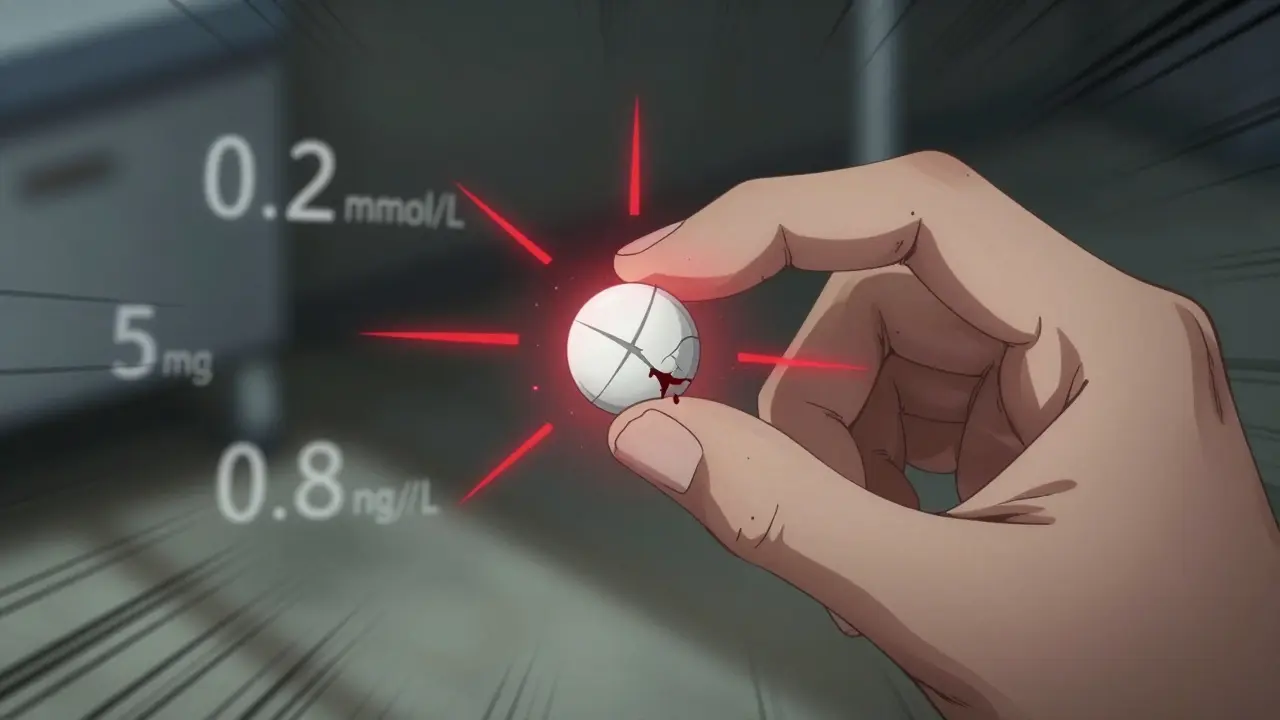
When you take a pill, you expect it to work exactly as it should. Not a little less. Not a little more. Just right. For most medications, that’s true. But for a small group of drugs-called narrow therapeutic index (NTI) medications-even tiny changes in dose or blood concentration can mean the difference between life and death. And if those pills are past their expiration date? The risk gets even worse.
What Exactly Is a Narrow Therapeutic Index?
NTI drugs are the medical equivalent of walking a tightrope. The gap between the dose that works and the dose that harms is razor-thin. The U.S. Food and Drug Administration (FDA) defines them as medications where a small change in blood concentration can lead to serious side effects, treatment failure, or even death. That’s not an exaggeration. For example:
- Warfarin: A 10% drop in potency might mean your blood doesn’t thin enough, leading to a stroke or pulmonary embolism. A 10% increase? You could bleed internally.
- Lithium: Used for bipolar disorder, it’s toxic at levels just above the therapeutic range. A shift of 0.2 mmol/L can cause tremors, confusion, or kidney damage.
- Digoxin: The difference between a therapeutic level (0.5-0.9 ng/mL) and a toxic one (above 1.2 ng/mL) is less than a third. Even a small loss of potency can make it ineffective.
These aren’t rare drugs. They’re commonly prescribed. About 1 in 10 patients on long-term medication takes at least one NTI drug. And because their effects are so precise, they require regular blood tests-called therapeutic drug monitoring-to make sure levels stay in the safe zone.
Why Expiration Dates Matter More for NTI Drugs
Most people think expiration dates are just a manufacturer’s suggestion. But for NTI drugs, they’re a safety line. The FDA says most medications retain at least 90% of their potency for years after the printed date-especially if stored properly. That’s true for ibuprofen or amoxicillin. But for NTI drugs? That 10% loss is dangerous.
Imagine a warfarin tablet that’s 6 months past expiration. Even if it’s still 95% potent, that’s a 5% drop. For someone on a 5 mg daily dose, that’s 0.25 mg less than intended. In someone with a mechanical heart valve, that tiny drop could push their INR (a blood-clotting measure) from 2.8 down to 2.3. Suddenly, they’re no longer protected from clots. And if the tablet degraded unevenly? One pill might be 92% potent, the next 98%. That kind of inconsistency? It’s unpredictable. And for NTI drugs, unpredictability is deadly.
Some NTI drugs don’t just lose potency-they can turn toxic. While tetracycline isn’t an NTI drug, its degradation products are known to cause kidney damage. The same principle applies here: if a drug breaks down chemically, the byproducts might be harmful. For drugs like phenytoin or carbamazepine, which are used for seizures, even slight chemical changes can alter how the body absorbs them. That leads to erratic blood levels. One day, the drug works. The next, it doesn’t. And you won’t know why.
How Regulators Handle NTI Drugs (and Why Expiration Isn’t Addressed)
The FDA doesn’t treat NTI drugs like regular generics. In 2011, they introduced special bioequivalence rules: instead of allowing a 80-125% potency range for generics (the standard), they tightened it to 90-111% for key NTI drugs like levothyroxine, tacrolimus, phenytoin, and carbamazepine. That means a generic version can’t be more than 11% stronger or weaker than the brand-name drug. It’s a huge shift-and it shows how seriously they take precision.
But here’s the problem: those rules apply to manufacturing. They don’t say anything about what happens after the pill leaves the pharmacy. No regulatory body has studied how NTI drugs degrade over time. There’s no official guidance saying, “Don’t use expired lithium.” But there’s also no evidence that it’s safe.
Pharmacists in the U.S. and Europe are already raising red flags. A 2021 American Pharmacists Association position paper called for “specific labeling requirements” for NTI drugs, including warnings about storage and expiration. The European Medicines Agency has acknowledged that “small changes in exposure may lead to lack of efficacy or unacceptable toxicity.” Yet, no country has changed its expiration policies for these drugs.
Real-World Risks You Can’t Ignore
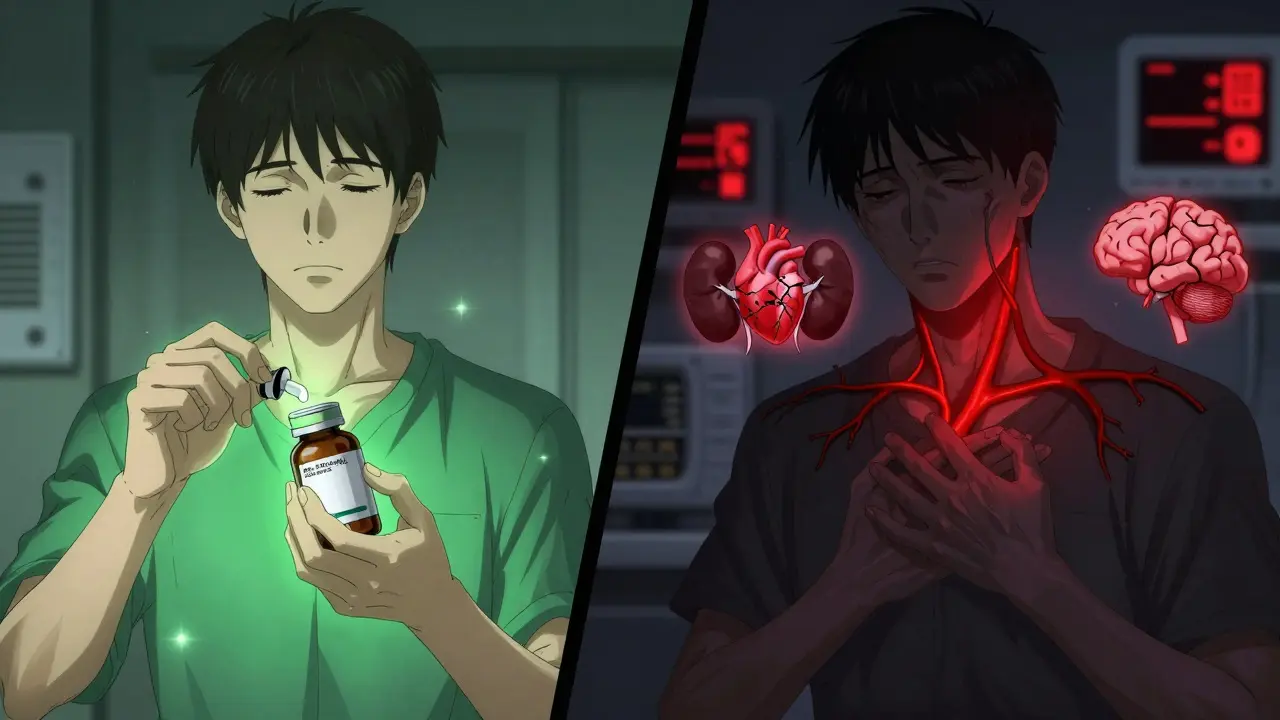
A 2014 study in the Journal of Clinical Pharmacy and Therapeutics found that drug-related problems involving NTI medications were far more likely to cause hospitalization than those involving other drugs. Why? Because the consequences are immediate and severe.
- A patient on digoxin for heart failure takes an expired bottle. Their blood level drops from 0.8 ng/mL to 0.6 ng/mL. Their heart rate becomes irregular. They end up in the ER.
- An elderly person on warfarin switches to a different generic brand, then later uses a bottle that’s 18 months past expiration. Their INR fluctuates wildly. They suffer a gastrointestinal bleed.
- A transplant patient on ciclosporin takes a tablet that’s lost 7% potency. Their immune system starts attacking the new organ. Rejection begins.
These aren’t hypotheticals. They’re documented cases. And they happen more often than you think. The Institute for Safe Medication Practices classifies all NTI drugs as “high-alert medications.” That means every prescription should be double-checked. Every refill should be reviewed. Every expired bottle should be thrown away.
What Should You Do?
If you take an NTI drug, here’s what you need to know:
- Never use expired medication. This isn’t a suggestion. It’s a safety rule. Even if the pill looks fine, the chemistry inside has changed.
- Store them properly. Keep them in a cool, dry place. Avoid bathrooms. Don’t leave them in a hot car. Heat and moisture speed up degradation.
- Don’t switch brands or generics without talking to your doctor. Even FDA-approved generics can have slight differences in absorption. For NTI drugs, that matters.
- Get regular blood tests. If you’re on warfarin, lithium, digoxin, or phenytoin, your levels should be checked every few weeks or months. Don’t skip them.
- Ask your pharmacist for a new prescription. If your bottle is expired, don’t wait. Call your pharmacy. Most will replace it at no cost if it’s a critical medication.
Some people think, “I’ve had this pill for 2 years. It’s still in the original packaging. It’s probably fine.” But NTI drugs aren’t like vitamins. They’re precision tools. A 5% change in concentration can have a 50% change in effect. That’s not a gamble you can afford to take.
What’s Being Done? What Should Be Done?
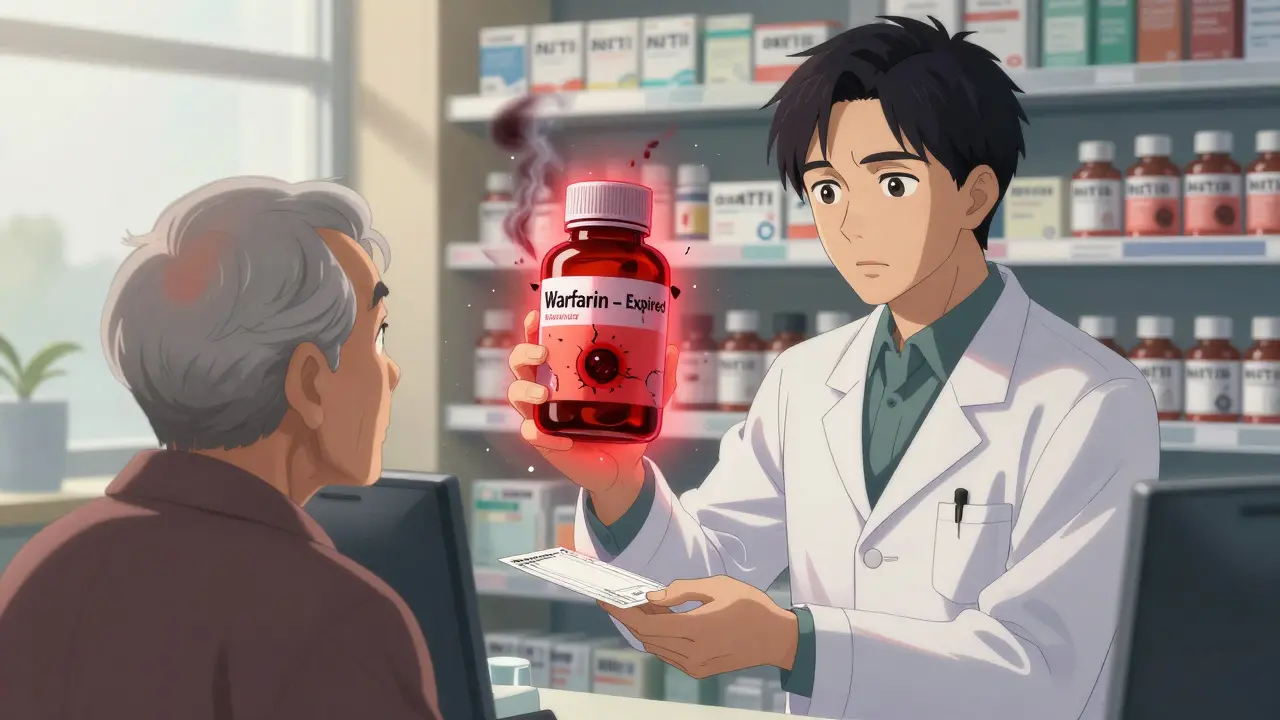
Manufacturers are starting to wake up. A 2022 study found that 78% of major drug companies now conduct extended stability testing on NTI drugs-longer than the labeled expiration date. That’s progress. But it’s not public. You won’t see it on the bottle.
What’s missing? Clear labeling. A warning on the box: “Do not use after expiration. Potency loss may cause serious harm.” A sticker on the bottle: “This is a high-risk medication. Use only within expiration date.”
Until then, the responsibility falls on you. If you’re on one of these drugs, treat every expiration date like a deadline. Not a suggestion. A hard stop.
Are all expired medications dangerous?
No. Most medications, like pain relievers or antibiotics, remain safe and effective for years after their expiration date. But NTI drugs are different. Their narrow window means even small potency losses can cause harm. For drugs like warfarin, lithium, or digoxin, expiration means risk-not convenience.
Can I still use an NTI drug if it’s only a few months past expiration?
Don’t. Even a few months past expiration can mean a 5-10% drop in potency. For a drug where the therapeutic range is only 20% wide, that’s enough to push you out of safety. There’s no safe gray zone. If it’s expired, replace it.
Do pharmacies replace expired NTI medications for free?
Many do. Especially for high-risk drugs like warfarin or levothyroxine. Call your pharmacy and explain you’re on a narrow therapeutic index medication. Most will provide a replacement without charge, particularly if you’re a regular patient. Insurance often covers it too.
Why don’t drug labels say “Do not use after expiration” for NTI drugs?
Because regulators haven’t updated the rules. Current labeling standards treat all drugs the same. But experts agree this needs to change. The FDA and EMA acknowledge the risks, but no formal labeling requirements exist yet. Until they do, patients must assume the worst and act accordingly.
What should I do if I accidentally took an expired NTI drug?
If you took one dose, don’t panic-but act fast. Contact your doctor or pharmacist immediately. They may recommend a blood test to check your drug levels. For drugs like warfarin or digoxin, even one dose of degraded medication can cause instability. Don’t wait for symptoms. Early action can prevent serious harm.
Final Thought
Medication safety isn’t just about taking pills. It’s about respecting their limits. NTI drugs aren’t ordinary. They demand precision. And expiration dates? They’re not suggestions. They’re safeguards. For these drugs, using an expired pill isn’t a risk you can afford to take.



Posts Comments
Brandice Valentino February 23, 2026 AT 19:00
okay but like… i just took my levothyroxine that’s 8 months expired bc the pharmacy was out and i was like ‘eh, it’s a pill’? and my tsh didn’t even flinch? like, maybe the whole ‘narrow therapeutic index’ thing is just pharma fearmongering? 🤷♀️
also why is everyone so obsessed with expiration dates? my grandma’s aspirin is from 1997 and she still takes it like it’s a ritual. she’s 92. we’re all still here.
Larry Zerpa February 24, 2026 AT 19:04
You’re not ‘just taking’ levothyroxine-you’re gambling with your pituitary axis. The FDA’s 90-111% bioequivalence window for NTI drugs exists because pharmacokinetic variability isn’t theoretical-it’s documented in peer-reviewed journals since 1987. A 5% potency loss in levothyroxine can elevate TSH by 15-30% in susceptible individuals. That’s not ‘not flinching’-that’s subclinical hypothyroidism creeping in while you scroll TikTok. And no, your grandmother’s aspirin isn’t a valid data point. Aspirin degrades into salicylic acid, which is still therapeutic. Levothyroxine degrades into inactive, non-functional isomers. There is no ‘eh’ here. There is only biochemistry. And you ignored it.
Maranda Najar February 25, 2026 AT 06:03
Oh my GOD. I read this post and I just… I felt it in my bones. Like, imagine waking up one morning and your body doesn’t recognize the medicine you’ve trusted for years. The tremor in your hands. The fog in your brain. The ER lights flashing as they pump you full of antidotes because some faceless corporation decided ‘expiration’ was just a suggestion. It’s not just chemistry-it’s betrayal. Every pill is a promise. And when that promise breaks? It doesn’t just fail. It shatters. And for someone with bipolar disorder, or heart failure, or a transplanted kidney? That shattering is the last thing they ever feel before the silence. I’m crying. I’m so angry. Someone needs to put a red stamp on these bottles. ‘DANGER: THIS COULD KILL YOU IF YOU’RE LAZY.’
Matthew Brooker February 25, 2026 AT 23:53
Hey everyone-just wanted to say this is one of those posts that actually matters. Real talk: if you’re on warfarin or lithium, you’re not just taking a pill-you’re managing a precision instrument. And like a watch, if the gears are off by a tooth, everything stops. I’ve been on carbamazepine for 12 years. My neurologist made me switch generics once. I had a seizure two weeks later. Turns out the new one absorbed slower. We caught it because I called and said ‘something’s off.’ Don’t wait for symptoms. Call your pharmacist. Ask for a new bottle. No shame. No guilt. Just safety. You’re worth the extra 10 minutes on the phone.
Also-store them in a drawer. Not the bathroom. Not the car. Not the sun. Cool. Dry. Dark. Simple.
Nick Hamby February 26, 2026 AT 06:24
There’s a deeper philosophical layer here that deserves attention. We treat medication as if it’s a commodity-something we buy, store, and consume like groceries. But NTI drugs are more like calibrated tools: a scalpel, a stethoscope, a defibrillator. You don’t use a 10-year-old defibrillator because it ‘looks fine.’ You don’t use a scalpel with a dull edge because ‘it’ll cut, eventually.’
Expiration dates on NTI drugs aren’t arbitrary-they’re ethical boundaries. They represent the boundary between care and negligence. The system fails us by not labeling them clearly. But until that changes, we must become our own guardians. The responsibility isn’t just medical-it’s moral. To yourself. To your family. To the people who depend on you. Use it. Don’t risk it.
Haley Gumm February 26, 2026 AT 16:56
Actually, I think this whole NTI thing is overblown. I work in a pharmacy and we get maybe 2-3 calls a month about expired NTI meds. Out of thousands of prescriptions. The real issue is non-adherence-people skipping doses, not testing, switching generics without telling anyone. The expiration panic? It’s a distraction. We should be pushing better monitoring, not scaring people into throwing away perfectly good meds.
Also-warfarin levels fluctuate with diet, antibiotics, even vitamin K supplements. Blaming expiration? That’s like blaming your car for a flat tire when you didn’t check the pressure.
Shalini Gautam February 28, 2026 AT 02:45
In India, we don’t have this luxury. Expired meds? We use them. Because we don’t have money for new ones. My mother takes phenytoin that’s 2 years expired. She hasn’t had a seizure in 5 years. Why? Because she’s careful. She takes it with food. She sleeps on time. She avoids stress. Maybe the problem isn’t the pill. Maybe it’s the system that makes people choose between medicine and rent.
Don’t lecture us about precision when you live in a country with 10 pharmacies on every block. We’re not careless. We’re surviving.
Timothy Haroutunian February 28, 2026 AT 11:40
Look. I get it. NTI drugs are scary. But let’s be real. The FDA hasn’t updated their expiration guidelines in 40 years. Drug companies are making billions off replacement bottles. They don’t want you to know that 90% of these drugs are still potent 5 years out. The science is there. Studies from the DoD, from NASA, from the Shelf Life Extension Program-they’ve tested pills from military stockpiles that are 15 years old and still effective.
So why are we being told to throw away life-saving meds like they’re expired milk? Because profit. Because fear. Because someone’s got a PowerPoint slide titled ‘Compliance = Revenue.’
I’m not saying take expired NTI drugs. I’m saying demand transparency. Demand testing. Demand a label that says ‘Tested stable for X years.’ Not ‘Throw it out.’
Until then? Yeah, I’ll probably use mine. And I’ll sleep just fine.
Write a comment